Introduction
Nonprofit finance teams are being stretched thinner than ever. With 74.6% of US nonprofits reporting job vacancies as of April 2023 — and 51.7% reporting more vacancies than pre-pandemic levels — the staffing crisis has collided with rising compliance demands and growing grant portfolios to create an environment where outsourced accounting isn't just a cost-cutting strategy. It's a structural solution to a sector-wide problem.
The real value of outsourced accounting shows up in day-to-day accuracy, audit readiness, and the ability to lead from financial clarity rather than playing catch-up. This article explains what outsourced nonprofit accounting delivers in practice: the measurable advantages, what poor financial oversight costs organizations, and the best practices that separate a high-value partnership from a frustrating one.
Key Takeaways
- Outsourced nonprofit accounting covers bookkeeping, financial reporting, grant tracking, compliance, and fractional CFO-level strategy — without multiple full-time hires
- Core advantages include cost efficiency, compliance and risk reduction, and freeing internal staff to focus on programs rather than paperwork
- Without proper accounting infrastructure, nonprofits face compounding errors, audit findings, and loss of funder trust
- The right provider specializes in nonprofits, understands fund accounting and Form 990 structure, and functions as a strategic partner
What Is Outsourced Nonprofit Accounting?
Outsourced nonprofit accounting is the practice of engaging an external firm or fractional team to manage some or all of a nonprofit's finance and accounting functions — from daily bookkeeping to strategic financial leadership — on a flexible, right-sized basis.
It's typically applied in three situations:
- Organizations lacking a dedicated internal finance team — small nonprofits that need senior-level oversight but can't justify the cost of a full-time CFO or Controller
- Nonprofits navigating growth or leadership transitions — organizations adding federal grants, launching new programs, or experiencing staff turnover in finance roles
- Organizations that need expertise without the overhead — those crossing funding thresholds that introduce new compliance requirements or preparing for their first audit
In each of these situations, the underlying goal is the same: build a finance function that supports compliance, informed decision-making, and long-term organizational health — not just offload tasks.
When the Philadelphia Zoo experienced the simultaneous departure of both their CFO and Controller, One Abacus Advisory stepped in to provide fractional CFO and Controller support, optimize their NetSuite environment, and onboard new financial leadership — ensuring continuity and stability throughout the transition.
Key Advantages of Outsourced Nonprofit Accounting
The advantages below focus on operational and financial outcomes nonprofits can actually track — not theoretical efficiency gains. Each is tied to the specific structural demands of nonprofit accounting.
Cost Efficiency Without Sacrificing Expertise
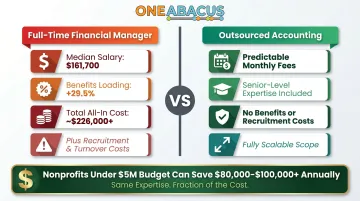
Outsourced accounting gives nonprofits access to controllers, senior accountants, and fractional CFOs at a fraction of the all-in cost of hiring those roles internally. The Bureau of Labor Statistics reports a median annual wage of $161,700 for financial managers as of May 2024, with nonprofit-sector proxies (grantmaking and civic organizations) showing a mean of approximately $141,410.
Add benefits loading — which represents 29.5% of total compensation according to December 2024 BLS data — and the true cost of a full-time hire approaches 1.4x base salary. For a nonprofit with an annual budget under $5 million, that cost is prohibitive.
In practice, a small-to-mid-size nonprofit can have senior-level financial oversight for the cost of a part-time bookkeeper. No recruitment cycles, no benefits administration, no coverage gaps during turnover. Predictable monthly fees are easier to budget around than variable staffing costs, and dollars not spent on excess overhead can go directly toward programs — funders increasingly scrutinize that ratio.
KPIs impacted:
- Overhead ratio
- Finance department cost as a percentage of total budget
- Cost per audit
- Time to close monthly books
When this advantage matters most:
- Organizations with annual budgets under $5 million
- Nonprofits recovering from a funding shortfall
- Organizations experiencing staff turnover in their finance function
Compliance, Accuracy, and Audit Readiness
Nonprofit accounting is structurally different from for-profit accounting. It requires fund accounting, classification of restricted vs. unrestricted net assets, functional expense allocation, grant compliance, and Form 990 reporting. These are areas where generalist bookkeepers regularly make errors — often without realizing the downstream impact.
An outsourced team that specializes in nonprofits brings this knowledge as a baseline, building grant tracking, release-from-restriction entries, and functional expense schedules into the monthly process rather than treating them as year-end corrections.
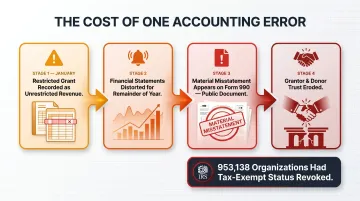
The scale of noncompliance is significant: between May 2010 and October 2021, 953,138 tax-exempt organizations had their status automatically revoked by the IRS for failure to file Form 990 for three consecutive years. Only approximately 13% successfully reinstated their status.
Errors in fund accounting compound month over month. A restricted grant recorded as unrestricted revenue in January distorts every financial statement for the rest of the year and creates a material misstatement on the Form 990 , a public document that grantors and major donors review. Clean, consistent reporting directly supports fundraising credibility.
A GAO report examining single audit findings found that 65% were repeat findings from prior years, indicating that many organizations fail to remediate identified weaknesses. Material weaknesses in internal controls can result in grant suspension, additional monitoring requirements, or loss of future federal funding eligibility.
KPIs impacted:
- Audit findings and material weaknesses
- Form 990 error rates
- Grant compliance rate
- Time required for year-end close and audit preparation
When this advantage matters most:
- Nonprofits receiving federal grants subject to Uniform Guidance
- Organizations preparing for their first audit or single audit
- Any nonprofit that has experienced staff turnover mid-year in a finance role
Mission Focus and Strategic Scalability
When accounting is handled externally by a qualified team, internal staff stop playing bookkeeper and start focusing on programs, development, and community relationships — the work that directly advances the mission.
85% of nonprofits expect service demand to increase in 2025, yet only 41% can pay all full-time staff a living wage. Outsourcing administrative functions redirects both budget and staff hours toward program delivery, where they have direct impact.
Beyond day-to-day relief, outsourced models that include fractional CFO or COO support give nonprofit leaders access to strategic financial guidance during growth, transitions, or funding complexity — without the cost of a full-time executive hire. One Abacus Advisory structures this kind of engagement around where each nonprofit actually is: organizations like the San Diego Food Bank and Laguna Playhouse have used fractional financial leadership to navigate exactly these inflection points.
Nonprofits adding federal funding, launching new programs, or growing their grant portfolio need teams that can absorb increased volume without the lag of a new hire. Boards gain clearer, more consistent financial reporting — which makes governance conversations more productive and less reactive.
KPIs impacted:
- Staff hours redirected to program or development work
- Time-to-board-report
- Grant reporting turnaround time
- Leadership satisfaction with financial visibility
When this advantage matters most:
- During periods of growth or program expansion
- Executive director transitions
- When a nonprofit crosses key funding thresholds that introduce new compliance requirements
What Happens When Nonprofit Accounting Is Inadequate or Ignored
When nonprofit accounting is handled by under-resourced internal staff, generalist bookkeepers, or not consistently at all, several compounding problems emerge:
- Restricted and unrestricted funds get mixed, creating compliance violations that may require returning grant funds to funders
- Inaccurate books produce an inaccurate Form 990, which then distorts the public record used by funders and watchdog organizations
- Audit preparation becomes a crisis instead of a routine, pulling staff away from programs and sometimes delaying the audit itself
- Financial reports reach the board late, inconsistently formatted, or without context, leading to decisions made on incomplete information
- When accounting staff leave, institutional knowledge leaves with them — without documented processes and clean books, the next person inherits a reconstruction project rather than a functioning finance system
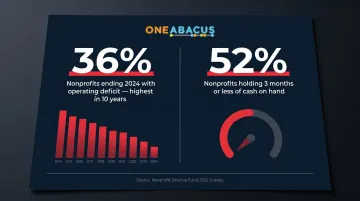
These aren't isolated failures — they're patterns that compound over time and show up in sector-wide data. The Nonprofit Finance Fund found that 36% of nonprofits ended 2024 with an operating deficit, the highest figure in 10 years of survey data, and 52% have three months or less of cash on hand. Financial mismanagement doesn't just create compliance risk; it threatens organizational survival.
Best Practices to Get the Most Value from Outsourced Nonprofit Accounting
Choose a Provider with Genuine Nonprofit Expertise
Look for demonstrated fluency in fund accounting, donor restrictions, grant compliance, and Form 990 structure — not just general bookkeeping experience. Ask for references from similarly sized organizations, and dig into specifics: how did they handle audit preparation? How do they track restricted funds across multiple grants?
Put Scope, Deliverables, and Responsibilities in Writing
Before work begins, document exactly what each party owns. This means clarifying:
- Who uploads source documents
- Who approves payments
- What the monthly close timeline looks like
- How questions are routed
Ambiguity here is the most common cause of breakdowns in outsourced engagements.
Require readable, actionable reporting. Ask to see sample reports before signing. Financial statements should be understandable to your executive director and board — not just your accountant — and should arrive on a consistent schedule you can rely on.
Bring your outsourced team into strategic conversations. The highest-value arrangements happen when the provider joins budget discussions, grant planning, and board preparation — not just transaction processing after decisions are made.
Build in regular reviews and act on what you learn. Schedule monthly or quarterly check-ins to review financial trends, flag variances, and assess whether the current scope still fits your organizational needs. The arrangements that deliver the most value are ones where both sides adjust as the organization evolves.
Conclusion
Outsourced nonprofit accounting delivers its strongest returns when it functions as ongoing financial leadership — not a one-time fix. Clean, compliant books give leadership real control. Reporting that boards can actually read builds credibility. Processes that survive staff transitions and audits create the kind of organizational stability funders notice.
Organizations that commit to a strong outsourced accounting partnership become more audit-ready, more credible to funders, and better positioned for strategic planning with each year that passes.
The right partner meets each organization where it is and scales with it. One Abacus Advisory works with nonprofits at every stage — from cleaning up foundational accounting to supporting complex multi-funder reporting — so financial infrastructure never becomes the bottleneck to growth.
Frequently Asked Questions
Can you outsource nonprofit bookkeeping?
Yes, nonprofits can and regularly do outsource bookkeeping. The best arrangements go beyond transaction recording to include fund accounting, grant tracking, and reporting aligned with nonprofit compliance requirements. This ensures accuracy and funder confidence.
What is the best accounting system for nonprofits?
The right system depends on organizational size and complexity. QuickBooks Online with proper class and fund setup works for smaller nonprofits, while mid-size and larger organizations often benefit from purpose-built platforms like Sage Intacct or NetSuite, which offer true fund accounting and multi-dimensional grant reporting.
What are common 501(c)(3) compliance issues?
The most frequent compliance problems include commingling restricted and unrestricted funds, late or inaccurate Form 990 filings, missing functional expense allocations, and failure to track grant expenditures against allowable cost categories. These issues often result in audit findings and loss of funder trust.
What is the 27-month rule for 501(c)(3)?
The 27-month rule allows a newly formed nonprofit to apply for 501(c)(3) status within 27 months of formation and have its tax-exempt status recognized retroactively to its founding date. Keeping accurate financial records from day one is essential to support that application.
How much does outsourced nonprofit accounting cost?
Outsourced accounting costs vary by organizational size and scope, but typically run well below the $180,000+ all-in annual cost of a full-time controller or CFO. For nonprofits under $5 million in annual budget, outsourced arrangements are almost always more cost-effective.
What is the difference between a fractional CFO and an outsourced bookkeeper for nonprofits?
An outsourced bookkeeper handles day-to-day transaction recording, reconciliations, and reporting. A fractional CFO provides senior-level strategic guidance: budgeting, scenario planning, board presentations, and financial leadership on a part-time basis. Many nonprofits benefit from having both layers of support.