A nonprofit CFO is the strategic financial executive who connects day-to-day financial management to long-term mission sustainability. This role goes far beyond bookkeeping or accounting—it's about forward-looking financial leadership that drives organizational resilience. This guide covers what a nonprofit CFO does, how the role differs from for-profit CFOs, the skills required, full-time versus fractional options, and when your organization may be ready for CFO-level support.
Key Takeaways
- Nonprofit CFOs provide strategic financial leadership—budgeting, forecasting, risk management, and board advisory—not transactional bookkeeping
- They navigate unique complexities like restricted funds, grant compliance, and mission-driven financial decisions
- Fractional CFOs deliver senior expertise at scalable cost, ideal for organizations needing CFO-level thinking without full-time commitment
- Signs you need one: cash flow uncertainty, growing funding complexity, or a board pushing for deeper financial insight
- Full-time nonprofit CFO salaries range from $80,000 to over $200,000; fractional engagements typically cost a fraction of that
What Is a Nonprofit CFO?
A nonprofit CFO is a senior financial executive responsible for financial strategy, oversight, and long-term planning—not transactional accounting. The role is fundamentally forward-looking: it covers scenario modeling, risk forecasting, and sustainability planning. According to Thompson Greenspon, the CFO works closely with the executive director, board treasurer, and audit/finance committee while serving as a business partner to program heads.
How Nonprofit CFOs Differ from For-Profit CFOs
The primary goal differs fundamentally: mission impact, not profit maximization. Revenue comes from grants, donations, corporate sponsorships, fundraising events, membership fees, and earned income—not traditional sales. Candid reports that earned income accounts for 71% of total nonprofit revenue, with contributions and government funding adding approximately 18%.
That revenue diversity creates a layer of complexity most for-profit CFOs never face. Nonprofit CFOs must manage both restricted funds (designated for specific purposes by donors or funders) and unrestricted funds (available for general operations), ensuring compliance with donor restrictions while preserving financial flexibility.
CFO vs. Other Finance Roles
Understanding the distinction between finance roles prevents confusion among nonprofit leaders:
| Role | Focus | Key Responsibilities |
|---|---|---|
| CFO | Strategic | Financial vision, long-range planning, board reporting, audit preparation, development support |
| Controller/Senior Accountant | Tactical/Operational | Month-end close, reconciliations, general ledger, Form 990, internal controls implementation |
| Staff Accountant | Transactional | Day-to-day transactions, recordkeeping, accounts payable/receivable |
| Board Treasurer | Governance/Oversight | Finance committee leadership, financial governance oversight—not an employee role |
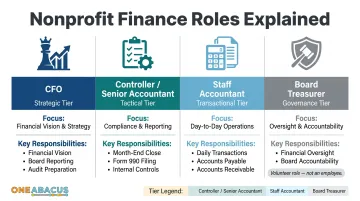
These roles work best in concert. A CFO setting financial direction needs a functional team executing the day-to-day work—without that foundation, strategic planning stalls at the implementation stage.
Reporting Structure and Communication
The nonprofit CFO reports to the Executive Director or CEO and collaborates closely with the board's finance or audit committee. This dual relationship makes communication skills as critical as financial acumen—the ability to translate complex financial data into clear, actionable insights for non-financial board members is essential.
How the role is structured depends heavily on organizational size:
- Smaller nonprofits: Financial duties often fall to the Executive Director or are outsourced entirely
- Midsize nonprofits: CFOs frequently oversee accounting alongside HR, IT, facilities, and administration
- Larger nonprofits: The role narrows to core finance functions—risk management, investments, and financial reporting
Core Responsibilities of a Nonprofit CFO
Financial Strategy and Planning
The CFO leads long-term financial planning by developing multi-year financial models, scenario analyses, and forecasts. Done well, this work gives leadership a clear picture of where the organization stands financially—and where it's headed.
During the annual budgeting process, the CFO collaborates with program staff, development teams, and leadership to build a mission-aligned budget. This budget must account for:
- Restricted versus unrestricted funds
- Projected revenue across all sources
- Program expansion or contraction plans
- Reserve requirements and cash flow needs
One Abacus Advisory's fractional CFO work with organizations like the San Diego Food Bank and Laguna Playhouse reflects this approach—delivering financial analysis formatted for board review so leadership can make informed decisions during periods of growth or transition.
Grant and Funding Source Management
Nonprofits rarely rely on a single income stream. Most draw revenue from a mix of sources—each carrying its own compliance requirements and spending restrictions:
- Federal, state, and local grants
- Foundation grants with specific reporting requirements
- Individual donor contributions (restricted and unrestricted)
- Corporate sponsorships
- Fundraising events
- Membership fees
- Earned income from programs or services
The CFO oversees the financial aspects of grant management, including:
- Accurate overhead cost calculations for grant applications
- Tracking spending against individual grants
- Ensuring compliance with each funder's specific requirements
- Managing drawdowns and reimbursements
- Maintaining documentation for audits
According to OMB Uniform Guidance (2 CFR 200), nonprofits receiving federal funding must maintain structured procurement requirements above $15,000, documented reasonable pricing for every purchase, and an auditable paper trail. Failure to comply can jeopardize current and future funding.
Compliance, Risk Management, and Internal Controls
The CFO ensures regulatory compliance across multiple fronts:
- GAAP adherence: Following Generally Accepted Accounting Principles
- IRS compliance: Accurate and timely Form 990 preparation
- State regulations: Meeting state-specific charitable solicitation and reporting requirements
- Grant-specific rules: Adhering to each funder's unique financial requirements
FASB ASU 2016-14 established nonprofit financial reporting standards requiring:
- Two net asset classes: with and without donor restrictions
- Statement of Financial Position, Activities, Cash Flows, and Functional Expenses
- Expense reporting by both nature and function
- Liquidity and availability disclosures
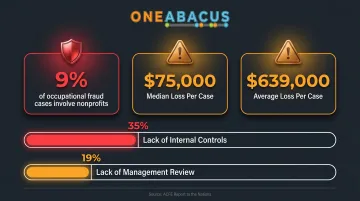
Internal controls safeguard assets, prevent fraud, and ensure financial integrity. This is critical—according to ACFE data cited by the North Carolina Center for Nonprofits, nonprofits represented 9% of occupational fraud cases, with a median loss of $75,000 per case and an average loss of $639,000. Top control weaknesses included lack of internal controls (35%) and lack of management review (19%).
Board and Stakeholder Engagement
Those fraud and compliance risks make board-level financial communication more than a formality. The CFO serves as the primary financial communicator to the board—presenting reports, leading finance committee discussions, and translating complex data into insights board members can act on. The goal is bridging the gap between technical financial detail and mission-focused decision-making.
External relationship responsibilities include:
- Working with auditors during annual audits
- Managing relationships with banks and lenders
- Coordinating with legal counsel on financial matters
- Providing transparent financial updates to major donors
- Reporting to grant-making agencies
When boards understand the financial story—not just the numbers—they're better positioned to govern effectively and support long-term organizational health.
Key Skills and Qualifications of a Nonprofit CFO
Essential Technical Skills
Nonprofit CFOs must demonstrate proficiency across multiple technical domains:
- Financial modeling and forecasting
- Nonprofit accounting standards (FASB ASC 958)
- Grant management and compliance
- Cash flow management
- Regulatory compliance knowledge
- Accounting software expertise (NetSuite, Sage Intacct, QuickBooks Online)
- Audit preparation and coordination
- Risk assessment and internal controls
Critical Soft Skills
CapinCrouse emphasizes that CFO success often depends on Emotional Quotient (EQ) alongside technical competencies. The soft skills that separate good nonprofit CFOs from great ones include:
- Communication: Translates complex financials for board members and program staff who aren't finance-trained — the story behind the numbers matters as much as the numbers themselves
- Problem-solving under constraints: Finds creative financial solutions in resource-limited environments without sacrificing mission impact
- Cross-departmental collaboration: Partners with program directors and development staff to align financial strategies with fundraising goals and programmatic priorities
- Strategic thinking: Contributes to organizational direction, not just compliance — turning financial data into decisions that drive growth
Educational and Credential Pathways
Common qualifications include:
- Bachelor's degree in finance, accounting, or related field
- MBA or master's in nonprofit management (common but not required)
- CPA (Certified Public Accountant) certification
- CNAP (Certified Nonprofit Accounting Professional) credential
The CNAP credential, sponsored by Nonprofit CPAs and delivered through BDO training courses, covers basic and intermediate nonprofit accounting, internal controls, budgeting, and strategies to improve financial health. It provides up to 19 CPE credits for existing CPAs.
Thompson Greenspon notes that while a CPA with an MBA or equivalent experience is ideal, nonprofit-sector experience matters just as much as academic credentials. Hands-on exposure to donor relations, grant cycles, and board reporting develops judgment that no certification program replicates.
Full-Time vs. Fractional Nonprofit CFO
Understanding the Two Models
A full-time CFO is a salaried, in-house executive dedicated entirely to one organization — typically 40+ hours per week. They develop deep institutional knowledge and are fully embedded in day-to-day operations.
A fractional CFO works part-time or on a project basis, often across multiple nonprofit clients. They bring broad cross-sector experience and an outside perspective, without the cost of a full-time hire.
Cost and Value Comparison
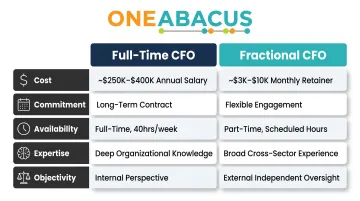
| Factor | Full-Time CFO | Fractional CFO |
|---|---|---|
| Cost | $80,000-$200,000+ annually plus benefits | $2,000-$10,000 monthly retainer or $150-$500 hourly |
| Commitment | Long-term employment relationship | Flexible engagement, scalable as needs change |
| Availability | Full-time, embedded in organization | Part-time, scheduled engagement |
| Expertise depth | Deep organizational knowledge | Broad cross-sector nonprofit experience |
| Objectivity | Internal perspective, culturally embedded | External perspective, objective oversight |
When researching options, nonprofit leaders should benchmark full-time salaries using resources like ZipRecruiter, Candid's Nonprofit Compensation Report, or BLS data. Candid's 2024 report shows the median compensation for top finance positions at $125,000 based on FY2022 IRS data.
On the fractional side, pricing varies based on specialization, scope, and time commitment. According to CFO for Good, typical ranges run $150-$500 per hour, $2,000-$10,000 monthly retainers, or $5,000-$30,000+ per project.
Which Model Fits Your Organization?
Full-time CFOs are best suited for:
- Large nonprofits with budgets exceeding $10-20 million
- Organizations with complex, ongoing financial operations
- Nonprofits requiring daily executive financial presence
- Organizations with sufficient budget for full salary and benefits
Fractional CFOs are ideal for:
- Small to midsize nonprofits (budgets under $10 million)
- Organizations in growth phases requiring strategic guidance
- Nonprofits navigating leadership transitions
- Organizations facing temporary financial complexity (audits, capital campaigns)
- Nonprofits needing CFO expertise before a full-time hire is financially viable
The Objectivity Advantage
Fractional CFOs aren't embedded in organizational culture or emotionally tied to specific programs. That distance is an asset — it's especially useful when evaluating program financial viability, pushing through difficult but necessary changes, or spotting risks that internal teams have grown accustomed to ignoring.
The Growth Bridge Scenario
Many nonprofits use a fractional CFO during critical scaling periods before transitioning to a full-time hire. This "growth bridge" provides executive-level financial oversight without overcommitting resources before it's financially sustainable.
When the Philadelphia Zoo lost both their CFO and Controller within the same period, One Abacus Advisory stepped in with fractional CFO and Controller support. The engagement included a full accounting assessment, NetSuite optimization, improved reporting processes, and hands-on support through the recruiting and onboarding of permanent financial leaders — keeping operations stable while building internal capacity for the long term.
Signs Your Nonprofit May Need a CFO
Clear Financial Structure Indicators
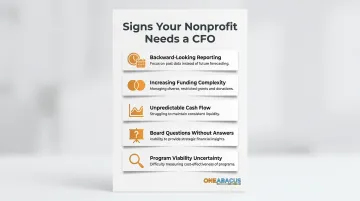
Three indicators signal that a nonprofit has outgrown its current financial structure:
Backward-looking reporting: Financial reports cover only last month or last quarter, with no multi-year forecasting or scenario planning. The organization reacts to numbers rather than using them to steer.
Increasing funding complexity: Multiple grants with different restrictions, new earned income streams, capital campaigns, or major donor initiatives are all in play simultaneously. Without CFO-level oversight, this creates compliance risk and operational drag.
Unpredictable cash flow: Leadership is regularly caught off-guard by budget variances. NFF's 2025 survey found that 52% of nonprofits have three months or less of cash on hand, with 18% holding just one month or less — fragility that demands proactive forecasting, not reactive fixes.
Governance and Strategy Warning Signs
Financial complexity rarely stays contained to the finance function — it surfaces in the boardroom and in program decisions too. Two more warning signs point to the same gap:
Board questions without confident answers: The board asks about projections, reserves, or long-term sustainability, and no one can respond with confidence. That gap erodes governance and slows strategic planning.
Program viability uncertainty: Leadership can't reliably assess whether a new initiative is financially sound before committing to it. Without financial modeling, mission-driven decisions carry unexamined financial risk.
A Practical Self-Assessment
These signs reflect natural growth, not crisis. Any organization experiencing three or more of them would benefit from CFO-level guidance. A fractional CFO can be engaged quickly and scaled as needs evolve — a practical first step that doesn't require a full-time hire.
One Abacus Advisory has identified the most common triggers for nonprofits seeking CFO support:
- Preparing for audits or major funding decisions
- Experiencing rapid program growth
- Navigating executive or leadership transitions
- Managing operational strain from complex grant portfolios
Nonprofit CFO Salary Expectations
Full-Time Compensation Ranges
According to ZipRecruiter data from May 2026, nonprofit CFO salaries vary significantly based on organization budget size, geographic location, and sector complexity:
| Salary Metric | Amount |
|---|---|
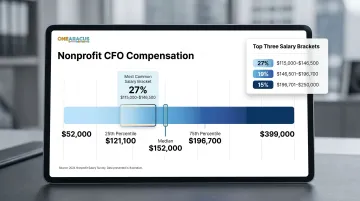
| Average annual pay | $261,533 |
| Median annual pay | $152,000 |
| 25th percentile | $121,100 |
| 75th percentile | $196,700 |
| Full range | $52,000 - $399,000 |
Salary distribution shows 27% of positions fall in the $115,000–$146,500 range (most common bracket), 19% in the $146,500–$178,000 range, and 15% in the $178,000–$209,500 range.
Candid's 2024 Nonprofit Compensation Report provides additional context, showing the median compensation for top finance positions at $125,000 based on fiscal year 2022 IRS data from over 128,000 tax-exempt organizations.
For context, the BLS reports that the median annual wage for all financial managers across sectors is $161,700 as of May 2024, with employment expected to grow 15% through 2034—much faster than average.
Factors Influencing Compensation
Significant variation exists based on:
- Budget size drives the widest gap: a CFO at a $5M community nonprofit typically earns substantially less than one at a $50M national organization
- Geographic location adds 20–40% in major metros (New York, San Francisco, Los Angeles) compared to smaller markets
- Sector complexity in healthcare, higher education, or international development typically pushes salaries higher due to specialized knowledge requirements
- Credentials and track record — CPA certification, nonprofit-specific experience — have a meaningful impact at every budget tier
Fractional CFO Pricing
The full-time salary data above is useful context, but many nonprofits under $10M in annual budget aren't hiring a full-time CFO at all — they're using a fractional arrangement instead.
Fractional CFO engagements are typically structured as monthly retainers or hourly arrangements. Costs vary by scope, but organizations commonly spend $2,000–$8,000 per month for part-time fractional CFO support — a fraction of the $150,000–$200,000+ total compensation a full-time hire would require. For nonprofits in that sub-$10M range, this model provides senior financial oversight without the full-time salary commitment.
Frequently Asked Questions
What does a CFO do in a non-profit?
A nonprofit CFO oversees financial strategy, budgeting, compliance, grant management, and cash flow while providing strategic financial guidance to the Executive Director and board. The role focuses on mission sustainability, ensuring financial decisions support long-term organizational health and impact rather than short-term gains.
Can a non-profit have a CFO?
Yes, nonprofits of all sizes can and do employ CFOs. For smaller organizations, fractional or outsourced CFO services provide access to executive-level expertise without the cost of a full-time hire. This flexibility makes CFO-level financial leadership accessible regardless of organization size.
What are the top 3 priorities for a CFO?
Nonprofit CFOs focus on three core priorities:
- Financial sustainability: managing cash flow, reserves, and liquidity
- Compliance and risk: maintaining internal controls and regulatory adherence
- Forward-looking strategy: scenario planning that supports leadership decisions and mission advancement
What are the most important skills for a CFO?
High-performing nonprofit CFOs combine technical skills (financial modeling, compliance knowledge, accounting standards, and software proficiency) with essential soft skills. Clear communication with non-financial stakeholders, strategic thinking tied to mission, and collaborative problem-solving under resource constraints are equally important.
How much should a CFO be paid?
Full-time nonprofit CFO salaries typically range from $80,000 to over $200,000 depending on organization size, location, and complexity. Fractional arrangements are more affordable, typically ranging from $2,000–$10,000 per month on retainer or $150–$500 per hour depending on engagement scope.
What is the highest position in a nonprofit?
The Executive Director or CEO holds the top leadership position, with ultimate responsibility for organizational performance and mission. The CFO serves as the senior financial executive and a critical strategic partner to the ED and board.
Looking for fractional CFO support tailored to your nonprofit's unique needs? One Abacus Advisory provides right-sized financial leadership to organizations navigating growth, transitions, and operational complexity. With over 25 years of experience serving nonprofits like the San Diego Food Bank, Philadelphia Zoo, and Laguna Playhouse, we deliver clear, actionable insights that strengthen financial foundations and support mission-driven decisions. Contact us at lorin@oneabacusadvisory.com or call 760-845-3808 to schedule a consultation.