Introduction
Nonprofit finance teams face a persistent challenge: accounts payable is often the most manual, compliance-heavy function in the organization — yet it's routinely handled by a junior staffer or someone splitting time across three other roles. Unlike for-profit AP, where the primary risk is a late payment, nonprofit AP errors can trigger questioned costs in federal audits, strain donor relationships, or put tax-exempt status at risk.
Outsourcing AP is one way organizations are addressing this — but it's worth understanding exactly what that means before committing.
This guide covers:
- What nonprofit AP outsourcing actually is (and how it differs from just adopting AP software)
- What's typically included in an outsourced AP arrangement
- How outsourcing reduces audit risk and lowers overhead
- How to select the right partner for your organization's needs
Key Takeaways
- Outsourcing AP means transferring the function to an external, specialized team — not just implementing software
- Nonprofit AP requires precise tracking by fund, program, department, and grant period — across every disbursement
- Outsourcing reduces compliance risk, typically costs less than a full-time hire, and frees leadership to focus on mission
- A well-structured outsourced AP function supports cleaner audits and faster grant reporting cycles
- The right partner brings deep nonprofit accounting expertise — not generic bookkeeping skills
Why Nonprofit AP Is More Complex Than It Looks
Nonprofit accounts payable goes far beyond paying vendors on time. Every invoice must be coded to the correct fund, program, department, and grant period. Errors don't just affect cash flow — they can produce questioned costs in grant audits, compliance violations, or damaged funder relationships that jeopardize future funding. Two areas drive most of that complexity: restricted fund requirements and audit/IRS obligations.
Restricted Funds and Grant Compliance
Nonprofits manage two distinct categories of net assets: those with donor restrictions and those without. FASB Accounting Standards Update No. 2016-14 requires organizations to track these separately, meaning every AP transaction charged against restricted funds must be traceable to the donor-imposed restriction. Misallocation — even accidental — can require repayment or erode trust with funders.
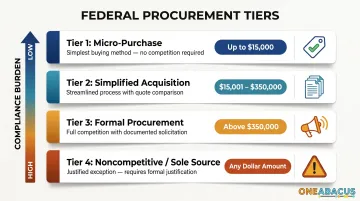
For federally funded nonprofits, the stakes are higher. Under 2 CFR Part 200, organizations must follow tiered procurement methods:
| Procurement Tier | Threshold | Requirement |
|---|---|---|
| Micro-purchase | Up to $15,000 | Price must be reasonable based on research or experience |
| Simplified acquisition | $15,001 to $350,000 | Obtain price quotations from adequate number of qualified sources |
| Formal procurement | Above $350,000 | Full competitive bidding required; publicly advertised |
| Noncompetitive (sole source) | Any amount | Only when item is available from single source, emergency exists, or federal agency authorizes |
Recipients must maintain procurement records documenting the rationale for their chosen method, contractor selection basis, and contract price justification. Costs charged to federal awards must be necessary, reasonable, allocable, and adequately documented.
A 2024 HHS Office of Inspector General audit of New York Medical College identified $7,542,821 in questioned costs across 24 NIH awards. Findings included $7,469,306 in unsupported costs because the College used budget estimates rather than actual activity records, plus $73,515 in unallowable costs including non-reimbursable travel expenses like alcohol and seat selection fees. When AP records can't support actual costs incurred, questioned costs follow — and repayment demands come with them.
Audit Exposure and IRS Obligations
Nonprofit disbursement audits examine the full lifecycle: original invoices, purchase orders, receiving reports, payment confirmations, expense reports with itemized receipts, and grant agreements for allowability. Auditors test for proper functional classification, accurate cutoff, and correct treatment of donor restrictions.
A March 2025 GAO report analyzing 3,680 single audit findings from 2022-2024 found that 36% of findings were associated with subaward oversight issues, including incomplete reporting and failure to verify eligibility decisions.
Accurate AP records directly support IRS filing obligations:
- Form 1099-NEC: Required for nonemployee compensation of $600 or more paid to individuals, partnerships, or eligible LLCs; organizations filing 10 or more information returns must file electronically
- Form 1042-S: Required when payments to foreign persons are subject to US withholding; AP records must capture payee status and withholding amounts
- Form 990 accuracy: Schedule completion and supplemental financial disclosures rely directly on documented AP transactions
Small nonprofits face a segregation of duties challenge: when one person handles both purchasing and payment, internal controls break down. The National Council of Nonprofits recommends:
- Dual signatures on checks
- Segregation between check-logging and deposit functions
- Advance written approval for expense reimbursements
Most small teams don't have the headcount to implement these controls without external support.
What Nonprofit AP Outsourcing Actually Includes
Nonprofit AP outsourcing means an external team of specialists handles the function on your behalf. This differs fundamentally from AP automation software, which is a tool your internal team operates. Many nonprofits need the former, not just the latter, especially when staff capacity or specialized expertise is limited.
Core AP Tasks Typically Covered
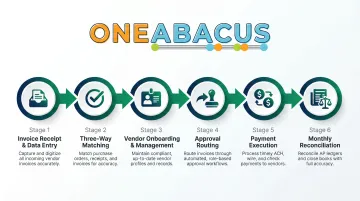
Outsourced providers typically handle:
- Invoice receipt and data entry — capturing vendor invoices and entering transaction details
- Three-way matching — verifying purchase order, receipt, and invoice align before payment
- Vendor onboarding and management — setting up new vendors, collecting W-9 forms, maintaining vendor master files
- Approval routing to ensure disbursements receive proper authorization before processing
- Payment execution via check or ACH according to approved schedules
- Monthly reconciliation against bank statements and general ledger accounts
Beyond these standard tasks, grant-level expense coding adds a layer specific to nonprofits. The provider allocates costs across programs and funding sources, keeping the general ledger aligned with grant restrictions so reports are audit-ready.
Strategic and Compliance-Oriented AP Support
Nonprofit-specialized AP outsourcing should include compliance support:
- Supporting 1099 and 1042-S preparation
- Collecting W-9 and W-8 forms from vendors
- Maintaining payment documentation for Form 990 reporting
- Flagging disbursements that fall outside allowable cost categories for grants
Some outsourced AP arrangements also include a fractional CFO or controller oversight layer — a senior advisor who reviews the AP function and advises on cash flow timing. This connects compliance work directly to the financial decisions boards and executive directors need to make with confidence.
Key Benefits of Outsourcing AP for Your Nonprofit
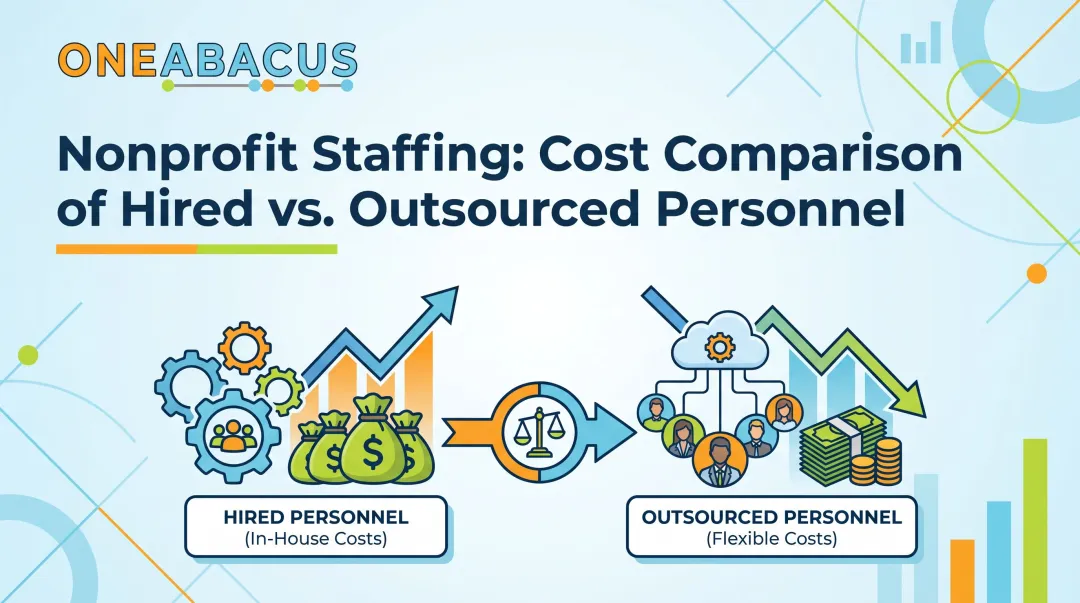
Outsourcing AP is often more cost-effective than hiring a dedicated AP staffer when you account for salary, benefits, training, turnover risk, and the software licenses the hire would need.
The Bureau of Labor Statistics reports the median annual wage for bookkeeping, accounting, and auditing clerks at $49,210 (May 2024 data). But total compensation costs — including Social Security, Medicare, unemployment, workers' comp, insurance, paid leave, and retirement — add another 29.5%, bringing the real cost to roughly $69,800 annually.
The SBA notes that total employee cost typically runs 1.25 to 1.4 times base salary once all employment-related expenses are included.
Additional benefits include:
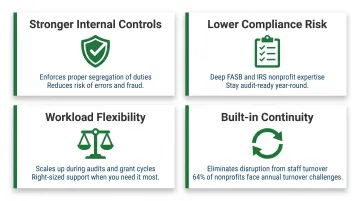
- Stronger internal controls: Outsourcing naturally creates segregation of duties — the external team processes and records invoices while internal leadership approves and reviews. Single-employee AP shops can rarely achieve this structure.
- Lower compliance risk: A team specializing in nonprofit accounting stays current on FASB guidance, IRS rules, and grant requirements — expertise a generalist staffer typically can't match.
- Workload flexibility: Outsourced arrangements scale up during audits, grant renewals, or growth phases, then contract during quieter periods — unlike the fixed cost of a full-time hire.
- Built-in continuity: When an internal AP person leaves, compliance knowledge leaves with them. Candid's 2024 retention survey found 64% of nonprofit finance and operations staff were considering leaving within a year. An outsourced team delivers consistent coverage regardless of individual turnover.
Is AP Outsourcing Right for Your Nonprofit?
Signs that suggest outsourcing is worth exploring:
- AP tasks are scattered across several people without formal accounting training
- Invoices are frequently late or miscoded to incorrect funds or programs
- Audit preparation causes significant internal disruption or last-minute scrambling for documentation
- The organization has grown in programs or grants but hasn't added finance staff
That said, in-house AP still makes sense for larger nonprofits with dedicated finance teams, robust internal controls, and consistent clean audits. These organizations still turn to outsourced support during staff transitions or complex grant periods.
A quick self-assessment: Does your current AP process consistently produce audit-ready documentation, accurate grant reports, and on-time vendor payments? If the answer is "not always," it's time to seriously explore what outsourcing can do for your organization.
How to Choose the Right Nonprofit AP Outsourcing Partner
Ask about nonprofit-specific expertise first. A generalist bookkeeper or business accounting firm won't understand fund accounting, donor-restricted contributions, grant compliance, or Form 990 implications. Ask prospective partners directly how many of their clients are nonprofits and how they handle restricted fund coding and grant-period tracking.
Confirm systems compatibility before signing anything. The right partner should work within or integrate with your existing accounting platform — QuickBooks, Sage Intacct, NetSuite, or otherwise. According to Sage's 2024 Nonprofit Technology Trends Survey, 85% of nonprofits already use financial management software. Ask how providers handle data access, security, and real-time reporting so your team retains visibility even when the function is outsourced.
Look for a right-sized engagement model, not a one-size-fits-all contract. The best AP partners offer fractional financial leadership — senior-level accounting expertise scaled to what your organization actually needs, rather than a full-time hire or a large firm running high-volume, transactional work.
One Abacus Advisory, for example, takes this approach: bringing over 25 years of finance experience with direct nonprofit focus, and working with organizations like the San Diego Food Bank, Philadelphia Zoo, and Laguna Playhouse. That kind of hands-on, sector-specific experience is what separates a genuine nonprofit AP partner from a generic outsourcing vendor.
When evaluating any prospective partner, use these questions as a baseline:
- How many of your current clients are nonprofit organizations?
- How do you handle restricted fund coding and grant-period tracking?
- What accounting platforms do you support, and how is data access managed?
- What does your engagement model look like — and how does it scale?
Frequently Asked Questions
Can accounts payable be outsourced for nonprofit organizations?
Yes, nonprofits regularly outsource AP to specialized external firms. Outsourced AP providers handle invoice processing, vendor payments, fund-specific coding, and compliance documentation on the organization's behalf, freeing internal staff to focus on programs, fundraising, and strategic priorities.
How much does it cost to outsource accounts payable for nonprofit organizations?
Costs depend on transaction volume, grant complexity, compliance requirements, and the level of reporting needed. Most organizations find outsourcing less expensive than a full-time hire once salary, benefits, payroll taxes, and turnover costs are factored in.
What is the difference between AP outsourcing and AP automation software for nonprofits?
AP automation is a software tool the nonprofit's internal team uses to streamline workflows. AP outsourcing transfers the entire function to an external team that manages the process. Some organizations use both, but outsourcing is more appropriate when internal expertise or capacity is the primary gap.
What AP tasks can a nonprofit outsource?
Common tasks include invoice coding, three-way matching, vendor management, payment processing, grant-level expense allocation, monthly reconciliation, and 1099 compliance. Some providers also offer fractional CFO or controller oversight for higher-level AP decisions.
How does outsourced AP protect grant and donor compliance?
A nonprofit-specialized AP team codes expenses to the correct restricted fund, maintains audit-ready documentation, and flags disbursements outside allowable cost categories. This reduces questioned costs in single audits and lowers the risk of compliance violations that could affect future funding.
What should I look for when choosing a nonprofit AP outsourcing partner?
Look for nonprofit-specific accounting experience — not generic bookkeeping — compatibility with your existing systems (QuickBooks, Sage Intacct, NetSuite), and an engagement model that flexes with your organization's needs throughout the fiscal year.