Introduction
Nonprofit leaders face a unique financial puzzle every day. Managing grant compliance, restricted funds, audit preparation, and donor reporting—demands more than basic bookkeeping. Many organizations struggle with audit findings, disallowed grant costs, or financial statements that board members can't confidently act on. These challenges multiply as budgets grow and funding sources diversify.
This guide clarifies exactly what a nonprofit controller does, how the role compares to other finance positions, what qualifications to look for, and when it makes sense to hire or outsource one. Whether you're navigating rapid growth, managing multiple grants, or strengthening financial infrastructure, this guide gives you a clear framework for deciding whether—and how—a controller fits your organization.
Key Takeaways
- A nonprofit controller oversees day-to-day financial operations while managing compliance, internal controls, and audit readiness
- Key responsibilities span budgeting, grant compliance, audit prep, and financial policy development
- The controller sits between the CFO (strategy) and the accountant (transactions) — handling the operational and compliance layer both roles leave behind
- Your nonprofit likely needs a controller if you're managing a multi-million-dollar budget, multiple grant streams, or recurring audit findings
- For small to mid-sized nonprofits, fractional controller services typically cost less than a full-time hire while providing the same level of oversight
What Is a Nonprofit Controller?
A nonprofit controller is a senior finance professional responsible for overseeing all financial operations—from ensuring accounting accuracy to maintaining compliance and internal controls. According to the AICPA's Controller Toolkit for Not-for-Profit Entities, controllers and financial managers are responsible for the accounting function as well as budgeting, fundraising, grant activities, accounting systems, data integrity, and internal controls.
This role is distinct from:
- Bookkeeper: Handles transactional data entry—processing invoices, cutting checks, recording deposits
- Treasurer: A board-level volunteer position providing high-level financial oversight and governance
- Controller: A management-level staff position (or outsourced professional) focused on operational accounting, reporting, internal controls, and compliance
In practice, the controller ensures the numbers are accurate, policies are followed, and the organization stays audit-ready and compliant with GAAP and IRS requirements for tax-exempt entities.
Where Controllers Fit in the Finance Hierarchy
The controller typically:
- Reports to the CFO at larger organizations
- Reports directly to the Executive Director when no CFO exists
- Supervises accounting staff (AP, AR, payroll, general ledger) in mid-to-large organizations
- Manages finance committee collaboration in lean teams
That positioning gives the controller direct visibility into both ground-level transactions and leadership priorities—making them the person who translates financial data into decisions the board and executive team can actually act on.
Nonprofit Controller vs. CFO vs. Accountant: Understanding the Differences
Many nonprofits hire for the wrong role—or combine roles that shouldn't be combined—because the lines between accountant, controller, and CFO aren't clearly defined. Here's how they actually differ.
Accountant: Data Accuracy and Compliance
The accountant's role is transactional and reporting-focused:
- Reconcile accounts and prepare financial statements
- File Form 990 and support audit documentation
- Ensure data accuracy through backward-looking verification
- Focus on recording what has already happened
Controller: Operations and Oversight
The controller occupies the middle ground—responsible for both the integrity of financial data (like an accountant) and translating that data into operational decisions (like a CFO). According to CapinCrouse, a nonprofit-specialized CPA firm, the controller is a "tactical role" focused on "effective management," working closely with the CFO and typically managing the accounting team.
CFO: Strategy and Vision
The CFO's role is focused on long-range strategy and organizational direction:
- Set financial goals and lead long-range planning
- Advise the board on growth and sustainability
- Steer organizational direction with minimal day-to-day operations involvement
- Analyze economic realities and prepare for trends
Quick comparison framework:
| Role | Primary Focus | Key Activities |
|---|---|---|
| Accountant | Data Accuracy | Recording, reconciling, reporting historical data |
| Controller | Financial Operations + Oversight | Month-end close, internal controls, compliance, team management |
| CFO | Strategy + Vision | Long-range planning, board advisory, external relationships |
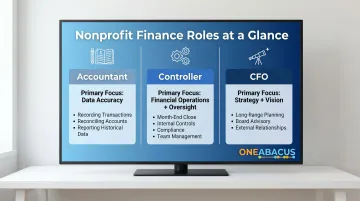
In smaller nonprofits, the controller and CFO roles are often combined into one position. In larger organizations, they are clearly separated. For organizations that need both functions but can't justify two senior hires, a fractional model lets you right-size the support to your actual stage of growth.
Core Responsibilities of a Nonprofit Controller
Budgeting and Financial Planning
The controller leads the annual operating budget process:
- Coordinates input from program departments
- Aligns revenue projections with fundraising goals
- Distinguishes restricted from unrestricted funds
- Develops budgets for specific grants, capital campaigns, and new programs
- Ensures each budget aligns with the overall financial plan and funder requirements
Financial Reporting and Compliance
The controller produces the four core nonprofit financial statements required under GAAP (FASB ASU 2016-14):
- Statement of Financial Position – reports assets, liabilities, and net assets (with and without donor restrictions)
- Statement of Activities – summarizes revenue and expenses for a specific period
- Statement of Cash Flows – reports cash inflows and outflows
- Statement of Functional Expenses – categorizes expenses by nature and function
These statements are essential for board governance and donor transparency. The controller also ensures GAAP compliance and oversees IRS Form 990 filing, ensuring financial data supports accurate, timely tax filing.
Grant and Fund Accounting
Nonprofits with multiple funding sources must track restricted and unrestricted funds separately—a core controller function that prevents misuse of grant dollars and supports funder reporting requirements.
Federal grant compliance is critical. According to the Urban Institute, two-thirds of nonprofits received at least one government grant or contract in 2023, with the average nonprofit generating 25% of total revenue from government sources. The OMB Uniform Guidance (2 CFR Part 200) prescribes how federal financial assistance must be managed, how costs must be treated, and when audits are required.
Audit Preparation and Internal Controls
The controller plays a central role in preparing for independent audits:
- Selects an auditor and manages the audit process
- Assembles Provided-by-Client (PBC) documentation
- Resolves discrepancies in advance
- Implements auditor recommendations afterward
Audit thresholds vary by state and federal requirements:
- Federal: Nonprofits expending $1 million or more in federal funds must conduct a single audit (per updated Uniform Guidance)
- State: 39 states plus DC require audited financial statements tied to revenue thresholds ranging from $100,000 (Mississippi) to $3,000,000 (Washington)
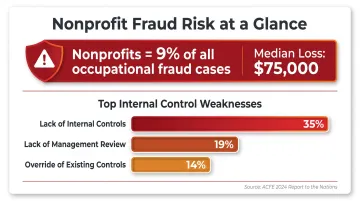
Internal controls are the systems and processes the controller establishes to safeguard assets, prevent fraud, and ensure separation of duties. According to the ACFE's 2024 Report to the Nations, nonprofits represented 9% of all occupational fraud cases, with a median loss of $75,000 per case. The top internal control weaknesses: lack of internal controls (35%), lack of management review (19%), and override of existing controls (14%).
Financial Policy Development and Staff Oversight
Those control gaps point directly to the need for written fiscal policies. The controller creates or strengthens the frameworks that close them:
- Gift acceptance policies
- Conflict of interest policies
- Expense reimbursement guidelines
- Compensation frameworks
Without these policies in place, even well-intentioned staff can make decisions that expose the organization to audit findings, funder concerns, or board liability.
What Makes a Good Nonprofit Controller?
Strong nonprofit controllers combine technical depth with people skills and a genuine stake in the mission. The best candidates bring all three.
Essential Technical Qualifications
- Education: Minimum bachelor's degree in accounting or finance
- Certifications: CPA designation strongly preferred (though not always required)
- Experience: 7–10 years of relevant accounting experience, with at least some in nonprofit finance
- Software proficiency: Hands-on experience with nonprofit accounting platforms such as NetSuite, Sage Intacct, or QuickBooks
Leadership and Communication Skills
Great controllers translate complex financial data for non-finance staff and board members. They must:
- Manage accounting teams effectively
- Present clearly to executive leadership and audit/finance committees
- Collaborate across departments to align financial operations with program goals
- Navigate organizational change and transitions with confidence
Mission Alignment
Technical skill only goes so far. A controller who understands the mission frames budget decisions differently — explaining a funding shortfall in terms of program impact, not just a line-item deficit. That kind of context builds credibility with leadership, staff, and donors alike.
Controllers who connect finance to mission also tend to earn more trust across the organization, making it easier to enforce controls, manage audits, and push for the reporting changes that actually stick.
When Does Your Nonprofit Need a Controller?
Organizational Signals
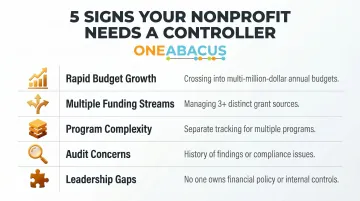
Your nonprofit is likely ready for a controller if you're experiencing:
- Rapid budget growth: Crossing into multi-million-dollar annual budgets
- Multiple funding streams: Managing three or more distinct grant sources
- Program complexity: Separate tracking requirements for multiple programs
- Audit concerns: History of audit findings or compliance issues
- Leadership gaps: No one currently owns financial policy or internal controls
The Risk of No Controller
Operating without controller-level oversight can lead to:
- Financial misstatements that erode donor trust
- Grant disallowances and lost funding
- Weakened board confidence
- Inability to make strategic decisions from clean data
- Increased risk of fraud or compliance violations
Right-Sizing the Role
The scale of oversight you need depends on where your organization stands:
- Under $1 million in annual budget: A part-time or fractional controller is often a cost-effective fit
- $2 million+ with multiple grants and finance staff: A dedicated full-time controller is typically the better choice
According to the National Center for Charitable Statistics, large organizations (over $10 million in expenses) represent just 5.4% of public charities but account for 88.1% of total nonprofit expenditures. At that scale, financial complexity demands controller-level oversight — not just bookkeeping.
Should You Hire or Outsource a Nonprofit Controller?
The Full-Time Hiring Path
Hiring a full-time controller makes sense for larger nonprofits with:
- Sufficient budget to justify a permanent role
- Ongoing complex needs requiring daily oversight
- Enough work volume to fill a full-time position
What the hiring process looks like:
- Craft a detailed job description emphasizing nonprofit finance experience
- Screen for technical qualifications (CPA preferred, GAAP knowledge, grant compliance)
- Assess cultural fit and mission alignment
- Evaluate leadership and communication skills
Salary expectations: According to ZipRecruiter, the average nonprofit controller salary nationally is $119,497/year as of May 2026, with significant variation by organization size, geography, and complexity.
The Fractional or Outsourced Model
For small to mid-sized nonprofits, fractional or outsourced controller services often deliver better value:
- Provides controller-level guidance without the cost of a full salary and benefits
- Scales with budget cycles, grant seasons, or growth phases
- Adjusts up or down as needs shift — no training or onboarding overhead required
- Eliminates payroll costs for a role you may only need part-time
According to YPTC, outsourcing controller and CFO roles saves nonprofits money on payroll, training, and benefits — without sacrificing the financial oversight they need.
Firms like One Abacus Advisory specialize in fractional financial leadership for nonprofits—providing controller and CFO-level guidance tailored to each organization's size, funding complexity, and mission. During a leadership transition at the Philadelphia Zoo, One Abacus stepped in as fractional controller, optimizing the NetSuite environment and tightening month-end close processes. Financial operations stayed on track throughout — with no permanent hire required.
Frequently Asked Questions
What are the duties and responsibilities of a nonprofit controller?
A nonprofit controller oversees financial reporting, budgeting, audit preparation, grant and fund compliance, internal controls, and policy development. At larger organizations, the controller also supervises the accounting team and manages finance committee collaboration.
What is the difference between a nonprofit CFO and controller?
The CFO is primarily forward-looking and strategy-focused—leading long-range planning, advising the board, and steering organizational vision. The controller is operationally focused—ensuring financial accuracy, compliance, and day-to-day oversight of accounting systems and staff.
How much does a nonprofit controller make?
According to ZipRecruiter, the national average is approximately $119,497/year as of May 2026—with cities like Washington, DC averaging $135,315/year. Salaries vary by organization size, geography, sector complexity, and whether the role is full-time or fractional.
What are the duties of an assistant controller at a nonprofit?
An assistant controller typically supports the controller with general ledger management, reconciliations, financial statement preparation, grant tracking, and audit documentation. They handle more tactical tasks, allowing the controller to focus on oversight, compliance, and strategic execution.
What makes a good nonprofit controller?
Strong nonprofit controllers bring technical expertise (CPA preferred, solid GAAP knowledge, nonprofit accounting experience), clear communication skills, and genuine mission alignment—so boards and program leaders can make well-informed financial decisions.
Looking for fractional controller services tailored to your nonprofit's unique needs? One Abacus Advisory provides experienced, hands-on financial leadership without the cost of a full-time hire. From audit preparation and grant compliance to internal controls and reporting optimization, we help nonprofits navigate growth, transitions, and complexity with confidence. Schedule a consultation at oneabacusadvisory.com or contact Lorin Port at lorin@oneabacusadvisory.com or 760-845-3808.