Introduction
Federal government funding represents one of the largest and most stable revenue streams available to nonprofits — according to Candid's 2025 analysis, over 100,000 nonprofits receive a collective $303 billion annually in government grants. Roughly 30% of U.S. nonprofits report receiving some form of government funding, with organizations in human services, education, and public health representing the largest share.
Despite this opportunity, many nonprofits either never apply — intimidated by the complexity — or secure awards only to struggle with compliance burdens, disallowed costs, and audit exposure. The gap between eligibility and readiness is where most organizations stumble.
Being a registered 501(c)(3) is just the starting point. Federal funders expect sophisticated financial infrastructure, documented cost allocation methods, and ongoing compliance oversight that most nonprofits haven't yet built.
This guide walks through what federal funding actually requires — from understanding the grant-versus-contract distinction, to building the financial infrastructure that keeps auditors satisfied and awards renewable.
At a Glance
- Federal funding flows to nonprofits as grants or contracts, each carrying distinct compliance, reporting, and financial management requirements
- Basic eligibility requires active 501(c)(3) status, a registered EIN, and an active SAM.gov account before any federal award can be made
- Grants.gov and SAM.gov are the two primary portals where federal funding opportunities are publicly listed and applications are submitted
- Nonprofits expending $1,000,000+ in federal awards annually (raised from $750,000 as of October 1, 2024) must complete a Single Audit by an independent CPA
- Solid financial infrastructure (fund-level accounting, monthly closes, documented indirect cost allocation) is a prerequisite for federal funding, not an afterthought
Government Grants vs. Contracts: What's the Difference?
Grants and contracts both bring federal dollars into your organization — but they work very differently, and each one places distinct demands on your financial systems and staff.
Federal grants support a nonprofit's mission-aligned program or activity. You control how the work gets done, but must use funds for approved purposes and submit regular performance and financial reports. The relationship is collaborative: the government supports your work because it advances a public purpose.
Government contracts are procurement agreements where the nonprofit delivers specific goods or services to meet a defined government need. Deliverables are tightly scoped, payment is often tied to milestones, and performance accountability is higher. Here, the government is the customer and your organization is the vendor.
Why the Distinction Matters for Financial Management
Contracts typically require more rigorous cost accounting, often require indirect rate agreements with the federal agency, and carry stricter audit exposure. Grants offer more budget flexibility but both fall under Uniform Guidance (2 CFR 200), meaning financial system requirements are substantial for either vehicle.
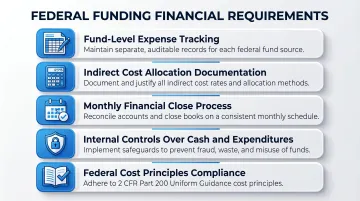
Whether you pursue a grant or a contract, you'll need:
- Fund-level expense tracking by funder, program, and grant
- Documented indirect cost allocation methodology
- Monthly financial close processes
- Strong internal controls over cash and expenditures
- Compliance with federal cost principles (what's allowable vs. unallowable)
Understanding which vehicle fits your organization starts with an honest look at your current financial infrastructure — and whether it can hold up under federal scrutiny.
Types of Federal Funding Available to Nonprofits
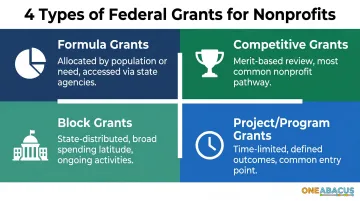
The Four Main Types of Federal Grants
Formula Grants are allocated to states or eligible entities based on predetermined criteria such as population size or demonstrated need. Nonprofits often access these as subrecipients through state agencies rather than directly from the federal government. Examples include the Community Services Block Grant (CSBG) and portions of Temporary Assistance for Needy Families (TANF).
Competitive (Discretionary) Grants are the most common pathway for nonprofits. These are awarded through a merit-based review process in response to a Funding Opportunity Announcement (FOA) or Request for Proposals (RFP). Proposals are scored against evaluation criteria published in the solicitation, and awards go to applicants with the highest scores.
Block Grants provide funding to states with broad latitude for distribution to local nonprofits and programs. Nonprofits typically apply through a state agency or department rather than a federal portal. Block grants fund ongoing activities rather than time-limited projects.
Project/Program Grants are time-limited awards for specific initiatives with defined outcomes. Widely used in human services, public health, and education, these grants are often the entry point for nonprofits new to federal funding.
Common Federal Contract Structures
Beyond grants, nonprofits may also pursue federal contracts — particularly when delivering services under a defined scope. The three most common structures are:
Fixed-Price Contracts set payment in advance regardless of actual costs incurred. This structure works well for clearly defined scopes, but nonprofits carry the risk of cost overruns — so precise budget development before signing is critical.
Cost-Reimbursement Contracts reimburse the nonprofit for allowable, documented costs incurred during performance. Use this structure when project scope is less predictable. It requires:
- Detailed cost tracking and receipts
- Strict adherence to cost principles in the Federal Acquisition Regulation (FAR)
- Regular financial reporting to the federal agency
IDIQ Contracts and Cooperative Agreements offer longer-term stability but require demonstrated capacity. An IDIQ (indefinite delivery/indefinite quantity) contract is an open-ended agreement fulfilled via task orders as needs arise. Cooperative agreements involve direct federal participation in implementation — not just oversight — and are governed by 31 U.S.C. 6305.
Eligibility and Financial Readiness: Is Your Nonprofit Ready?
Basic Eligibility Requirements
Before you can receive any federal award, you must have:
- Active 501(c)(3) status with an IRS determination letter in good standing
- Timely Form 990 filing history demonstrating transparency and compliance
- Active Employer Identification Number (EIN)
- Current registration on SAM.gov with a Unique Entity Identifier (UEI) — the UEI replaced the DUNS number on April 4, 2022
Legal standing is the baseline. Evaluators also scrutinize organizational capacity and past performance — prior experience delivering programs of similar scope, documented outcomes, active partnerships, and professional staffing.
Financial Systems and Infrastructure
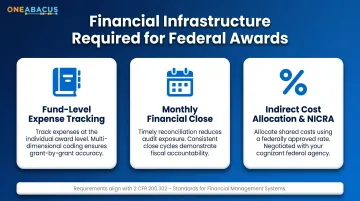
Eligibility gets you in the door — financial readiness determines whether you survive the award. Uniform Guidance (2 CFR 200.302) mandates that nonprofits maintain systems capable of:
- Fund-level expense tracking across at least two dimensions — by expense category (general ledger) and by funder/program/grant. Standard bookkeeping software often can't support this.
- Monthly financial close with full account and credit card reconciliation. Auditors treat an inability to close the books on time as a material weakness.
- Documented indirect cost allocation covering shared costs like rent, payroll, and administration. Higher federal funding volumes may require a negotiated indirect cost rate agreement (NICRA) with a cognizant federal agency (the agency primarily responsible for your organization's federal awards).
Most nonprofits discover these gaps only after they've already started pursuing federal funding. A fractional CFO can conduct a readiness assessment and put the right accounting infrastructure, reporting systems, and cost allocation frameworks in place before you apply.
One Abacus Advisory, for instance, supported the Philadelphia Zoo during a CFO transition — optimizing their NetSuite environment, tightening the month-end close process, and strengthening board reporting to maintain compliance and audit readiness.
How to Find and Apply for Federal Grants and Contracts
Where to Search for Opportunities
Grants.gov is the federal government's central portal for all grant opportunities. Managed by HHS under OMB governance, it houses information on over 1,000 grant programs awarding more than $500 billion annually.
Search by Catalog of Federal Domestic Assistance (CFDA/ALN) number or funding agency, and set up automated alerts for new Funding Opportunity Announcements relevant to your mission.
SAM.gov and USASpending.gov serve complementary functions. SAM.gov is required for vendor registration and lists federal contract solicitations. USASpending.gov is valuable for researching which agencies are currently funding work in your program area — a useful tool for targeted agency outreach before a solicitation is released.
The Application Process
Once you've identified a promising opportunity, the process follows four core steps.
1. Review the solicitation before committing. Analyze eligibility, scope of work, budget structure, evaluation criteria, and formatting requirements. A go/no-go decision up front saves costly staff time on proposals that aren't a fit.
2. Gather required documentation:
- Legal registration proof
- Most recent audited financial statements
- Past performance records
- Required certifications
- Board resolution (if required)
- Active SAM.gov registration
3. Develop a competitive proposal. Strong submissions:
- Align your work directly with the agency's stated mission and priorities
- Present measurable outcomes backed by data from prior programs
- Address organizational capacity — staff, systems, and partners
- Include a detailed budget narrative covering both direct costs and indirect/administrative costs
4. Submit on time and use debriefs strategically. Late submissions are automatically disqualified with no exceptions. If you're not selected, request a post-award debrief from the program officer — this feedback is often the clearest guide to improving your next proposal.
Compliance, Audits, and Managing Federal Funds Responsibly
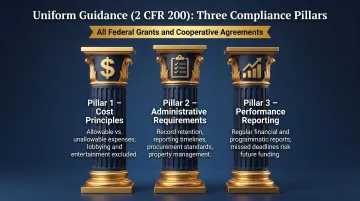
All federal grants and cooperative agreements are governed by Uniform Guidance (2 CFR 200). The regulation establishes three main pillars:
- Cost principles: Defines allowable vs. unallowable expenses — lobbying, entertainment, and certain contingency reserves are generally off-limits.
- Administrative requirements: Covers record retention, reporting timelines, procurement standards, and property management. Noncompliance can result in cost disallowance and clawback of funds.
- Performance reporting: Requires regular submission of both financial and programmatic reports. Missing a deadline can jeopardize future funding.
Single Audit Requirement
Nonprofits that expend $1,000,000 or more in federal awards in a single fiscal year must undergo a Single Audit conducted by an independent CPA at the nonprofit's expense. This threshold was raised from $750,000 effective for fiscal years beginning on or after October 1, 2024.
The Single Audit tests compliance with grant terms, adequacy of internal controls, and proper use of funds. Audit costs are generally an allowable charge to federal awards if included in the original budget. According to GAO's 2024 analysis, approximately 40,000 single audits are submitted annually, covering $1.1 trillion in distributed federal awards — and between 2017-2021, $1.17 trillion in expenditures were linked to findings that were both severe and persistent.
Staying Audit-Ready
Audit readiness requires ongoing financial discipline:
- Monthly closes
- Documented and consistent cost allocations
- Clean separation of restricted and unrestricted funds
- Written procedures for determining cost allowability
- Effective control over all funds, property, and assets
For nonprofits without a full-time CFO, fractional financial leadership from a firm like One Abacus Advisory provides the ongoing oversight needed to maintain compliance without the cost of a senior full-time hire. The firm has supported organizations like Laguna Playhouse through complex audit preparation, ensuring uninterrupted compliance during critical transition periods.
Frequently Asked Questions
Can a non-profit get government contracts?
Yes, nonprofits are eligible to compete for and receive government contracts. Key requirements include active 501(c)(3) status, SAM.gov registration with a UEI, demonstrated organizational capacity, and the ability to meet federal cost accounting and compliance standards outlined in FAR Part 31 and 2 CFR 200.
How much money does the federal government give to nonprofits?
Candid's 2025 research estimates over 100,000 nonprofits receive $303 billion annually in government grants across all levels. The Urban Institute puts federal funding alone at $240.7 billion in 2023 — lower due to post-COVID relief declines. Human services organizations consistently receive the largest share.
What is the easiest federal contract to get?
No single federal contract is universally easy to obtain. That said, subcontracting under an established prime contractor, pursuing cooperative agreements, or starting with smaller state-administered block grant programs are the most accessible entry points for nonprofits with limited federal contracting history.
What are the 4 types of federal grants?
The four main types are formula grants (predetermined allocation criteria), competitive grants (merit-based review), block grants (state-distributed with broad latitude), and project/program grants (time-limited, initiative-specific). Most nonprofits access funding through competitive grants or as subrecipients of formula and block grants administered by state agencies.
Where can I find a list of all federal grants?
Grants.gov is the federal government's official portal for all grant opportunities, searchable by agency, program area, and eligibility type. SAM.gov lists federal contract and procurement opportunities. Both platforms are free to search and require registration to apply.