Introduction
Every staffing decision a nonprofit makes carries weight far beyond a line item on a budget. Organizations face a core tension: every dollar spent on personnel is a dollar not directly advancing the mission — yet the right financial and operational leadership is essential to organizational health, donor confidence, and compliance.
Unlike for-profit businesses, nonprofits operate under unique accountability pressures: IRS reporting obligations, grant restrictions, donor transparency expectations, and often razor-thin margins. Getting the hired vs. outsourced decision wrong doesn't just cost money — it can stall programs, trigger compliance gaps, or erode board trust.
According to the Urban Institute's 2025 National Survey of Nonprofit Trends and Impacts, 46% of staffed nonprofits reported employee vacancies, and 72% said those gaps negatively affected their ability to pursue their missions. Meanwhile, nonprofit turnover rates run nearly double the cross-sector average, driving up both direct and hidden costs.
That's exactly what this article addresses. You'll get a clear breakdown of the true total cost of hiring full-time staff versus outsourcing key roles like financial leadership — including what hidden costs to account for and how to build a decision framework aligned with your organization's revenue, complexity, and risk tolerance.
Key Takeaways
- Full-time hires cost 40–60% more than base salary when benefits, taxes, recruiting, and turnover risk are included
- Outsourcing delivers specialized expertise at predictable costs with no overhead or vacancy risk
- Nonprofits under $2M revenue typically benefit most from outsourced financial leadership
- Hybrid models combine in-house operations staff with fractional strategic leadership for the most cost-effective balance as organizations grow
- The right choice depends on revenue, funding complexity, and how often the role is needed
Hired vs. Outsourced Staff: Quick Comparison
| Factor | Hired Staff | Outsourced Staff |
|---|---|---|
| Total Annual Cost | Base salary + 30–40% benefits burden + recruiting fees + training + software subscriptions + potential turnover costs | Fixed monthly or project-based fee with no additional overhead |
| Flexibility | Long-term commitment with limited ability to scale up or down quickly | Scope adjusts, pauses, or expands based on organizational needs and budget cycles |
| Depth of Expertise | One individual's skill set, which may have gaps in specialized areas like fund accounting or compliance | Access to senior specialists or entire teams at a fraction of full-time cost |
| Risk & Continuity | Turnover creates knowledge loss, coverage gaps averaging 42+ days, and repeat recruiting costs | No single point of failure; continuity is built into the service structure |
| Strategic Value | Best when daily oversight, institutional knowledge, and on-site presence are critical | Ideal when specialized judgment is needed periodically or during key transitions |
The True Cost of Hiring Nonprofit Staff Full-Time
Base salary represents only the starting point when calculating the true cost of a nonprofit employee. The fully loaded cost typically reaches 1.4x to 1.6x gross salary once all employer obligations are included.
Salary Benchmarks
Nonprofit CFO compensation varies dramatically by organization size. According to 36,799 IRS Form 990 records analyzed by Lucido Data, median total compensation is $88,923 nationally, but ranges widely:
- Under $1M revenue: $13,240 median
- $1M-$5M revenue: $66,141 median
- $5M-$25M revenue: $133,459 median
- $25M-$100M revenue: $192,806 median
For nonprofits in the $5M-$25M range, expect to budget at least $133,000 base salary to attract experienced financial leadership — and that's before overhead costs.
Benefits Burden
The BLS Employer Costs for Employee Compensation report (March 2025) shows benefits represent 29.7% of total compensation in private industry and 38.4% in state and local government. Key components include:
- Employer payroll taxes (FICA)
- Health insurance premiums
- Retirement contributions
- Paid time off
- Workers' compensation insurance
Nonprofits tend to mirror government employers in their benefit offerings. A realistic multiplier is 1.3x to 1.4x base salary — meaning a $133,000 CFO salary reaches $173,000-$186,000 in total annual employment cost.
One-Time Hiring Costs
Recruiting a financial leader incurs upfront expenses that catch many nonprofit budgets off guard:
- Job board fees or recruiting agency costs (15-25% of first-year salary for specialized roles)
- Background checks and reference verification
- Onboarding time and initial training
- Lost productivity during the search
SHRM data indicates average cost-per-hire is approximately $4,700, with time-to-fill averaging 42-44 days across sectors. Nonprofits typically exceed these benchmarks due to limited recruiting infrastructure and lower salary competitiveness.
Those upfront costs sting — but they hurt most when they repeat. And with nonprofit turnover running high, they often do.
The Hidden Cost of Turnover
Nonprofit employee turnover hovers between 20% and 22% annually, nearly double the cross-sector average of 12-13%. Small nonprofits with budgets under $2M often exceed 25% turnover.
When a finance employee leaves:
- Institutional knowledge walks out the door with no documentation trail
- Coverage gaps disrupt operations during the 42+ day backfill period
- Recruiting fees and onboarding costs reset
- Remaining staff face increased workload and burnout risk
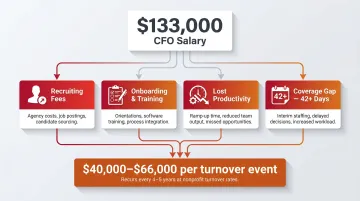
Replacing a nonprofit employee costs approximately 30-50% of their annual salary when factoring in recruiting, onboarding, and lost productivity. For a $133,000 CFO, that's $40,000-$66,000 per turnover event — a cost that recurs every 4-5 years on average given nonprofit turnover rates.
The Salary Competition Challenge
Private sector employers routinely outpay nonprofits for experienced financial talent. That forces a difficult choice: stretch the operating budget to hit market-rate salaries, or hire less experienced candidates and absorb the hidden costs of additional training and closer supervision.
Neither option is free. Both raise the true cost of employment — just in different line items.
The True Cost of Outsourcing Nonprofit Roles
Outsourcing in the nonprofit context includes contracted consultants, managed service providers, and fractional leadership models. Each eliminates the overhead costs tied to employment while delivering specialized expertise.
Fractional CFO Pricing Structure
Fractional CFO engagements typically follow one of two pricing models:
- Monthly retainers: Most engagements range from $5,000–$10,000/month, with the full range spanning $3,000–$15,000 depending on scope and organizational complexity
- Hourly rates: $200–$500 per hour based on experience and specialization
A $7,000 monthly retainer totals $84,000 annually — roughly half the fully loaded cost of a full-time CFO at a $5M-$25M nonprofit, with no benefits, payroll taxes, or recruiting fees to budget.
That cost structure is why organizations like the San Diego Food Bank and Philadelphia Zoo have worked with fractional partners such as One Abacus Advisory — accessing strategic financial guidance, board reporting, and compliance oversight without carrying a full-time hire on the books.
What's Included
The contract price represents the true total cost. Outsourced partners bring:
- Their own tools and software subscriptions
- Current knowledge of regulatory changes and compliance requirements
- Coverage of their own taxes and benefits
- Built-in continuity (no single-point-of-failure risk)
- Access to specialized expertise in areas like fund accounting, grant compliance, and audit preparation
When Outsourcing Costs Approach Full-Time Equivalency
When monthly fees exceed $15,000 ($180,000 annually), full-time alternatives merit evaluation. However, even at this threshold, the expertise level, flexibility, and reduced turnover risk often justify the premium. The right comparison isn't just salary — it's the full cost of hiring, onboarding, and eventually backfilling the role.
Hired vs. Outsourced: Which Model Fits Your Nonprofit?
The right staffing model depends on three variables: annual revenue, funding complexity, and how frequently you need the role performed.
Revenue-Based Decision Framework
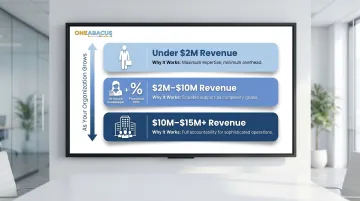
| Revenue Range | Recommended Model | Why It Works |
|---|---|---|
| Under $2M | Outsource | Transaction volume doesn't justify full-time senior staff; budgets rarely support competitive CFO salaries |
| $2M–$10M | Hybrid | In-house bookkeeper for daily transactions paired with a fractional CFO for strategy and reporting |
| $10M–$15M+ | In-house (or hybrid) | Multiple restricted funding streams and complex grant portfolios often require full-time financial oversight |
When to Hire In-House
Choose the hired model when:
- The role requires daily on-site presence
- Real-time oversight of multiple restricted funding streams is essential
- Transaction volume is high enough that outsourced costs would exceed an equivalent full-time salary
- Institutional knowledge and organizational culture fit are critical
When to Outsource
Choose the outsourced model when:
- The need is project-based or periodic — audit prep, grant reporting, system implementation
- Your salary range can't compete with private sector offers for senior talent
- You need flexibility during leadership transitions
- Specialized expertise (fund accounting, CFO-level strategy) is required but not daily
- You want to avoid single-point-of-failure risk from employee departure
The Hybrid Model
The hybrid approach balances cost control with institutional knowledge. For example:
- An in-house bookkeeper covers accounts payable/receivable, payroll, and daily transaction processing
- A fractional CFO handles budget development, board reporting, cash flow forecasting, audit coordination, and strategic financial planning
For many nonprofits in the $2M–$10M range, this split cuts financial leadership costs by 40–60% compared to two full-time hires — without sacrificing coverage at either level.
Real-World Example: Outsourced Financial Leadership in Practice
When the Philadelphia Zoo's CFO and Controller both departed simultaneously, the organization faced a critical leadership gap. Financial stability, board reporting, and day-to-day operational continuity all needed to hold — without a leadership team in place to manage them.
The Zoo engaged One Abacus Advisory to provide fractional CFO and Controller support during the transition. The engagement included:
- Comprehensive accounting assessment to identify operational improvements
- Optimization of the organization's NetSuite environment for enhanced reporting
- Improved month-end close processes and board reporting
- Hands-on support during recruitment, onboarding, and transition of permanent leadership
The fractional model delivered senior financial expertise without the overhead of full-time salaries while eliminating vacancy risk. The Zoo maintained uninterrupted financial operations and strengthened financial literacy across the executive team.

The San Diego Food Bank faced a comparable situation when its Finance Director departed. One Abacus Advisory stepped in with interim leadership that kept month-end close processes on track, so the internal team could stay focused on programs and community impact — not backfilling a vacancy.
If your nonprofit is evaluating whether to hire or outsource a key financial role, connect with One Abacus Advisory for a conversation about financial leadership that fits your organization's stage and budget.
Conclusion
The right staffing model depends on your nonprofit's current revenue, functional needs, and capacity for risk — and that answer shifts as your organization grows.
For most small-to-mid-sized nonprofits, outsourcing financial and operational leadership delivers more expertise, more flexibility, and lower total cost than full-time employment. The hybrid model — combining in-house capacity with fractional strategic leadership — typically becomes the strongest long-term structure as organizations scale.
That decision requires weighing the true cost of employment — salary, benefits, recruiting, and turnover risk — against the true value of specialized expertise. When 72% of nonprofits report that vacancies impair mission delivery and turnover runs twice the cross-sector average, the stability outsourced models provide isn't a secondary benefit. For many nonprofits, it's what keeps the mission moving forward.
Frequently Asked Questions
Is outsourcing cheaper than hiring?
For senior or specialized roles needed only part-time, outsourcing is typically cheaper. A $7,000/month fractional CFO runs $84,000 annually — roughly half the fully loaded cost of a full-time CFO when benefits, payroll taxes, and recruiting are included.
What is a good personnel expense ratio for a nonprofit?
Personnel costs typically account for 65–80% of total expenses for service-oriented nonprofits. Organizations that fall above that range often find relief by outsourcing specialized or senior roles rather than carrying them as full-time overhead.
Is it cheaper to retain employees or hire new ones?
Retaining employees is consistently less expensive. Replacing a staff member costs 30–50% of their annual salary once recruiting, onboarding, and productivity loss are factored in — and up to 200% for senior executives.
How much does outsourced HR cost?
Professional Employer Organizations (PEOs) typically charge 2–12% of total payroll or $40–$160 per employee per month. Fractional CFO and senior finance team services range from $3,000–$15,000 monthly, depending on scope and organization size.
When should a nonprofit outsource financial leadership instead of hiring?
Consider outsourcing when:
- Revenue and transaction volume don't justify a full-time senior hire
- A leadership gap needs immediate filling
- Specialized expertise — fund accounting, grant compliance, CFO-level strategy — isn't available at your salary range
What is a fractional CFO and how does it benefit nonprofits?
A fractional CFO is a part-time, contract-based senior financial leader who delivers CFO-level strategy, reporting, and oversight at a fraction of the cost — making it the right fit for nonprofits that need expert guidance without the overhead of a full-time executive.