Introduction
Many mission-driven nonprofits have big ambitions but no clear roadmap to achieve them. Approximately 40% of U.S. nonprofits lack a current strategic plan, leaving organizations exposed to mission creep, resource drain, and reactive decision-making. Without a structured framework, even the most passionate teams struggle to prioritize efforts, align stakeholders, and measure progress toward impact.
This guide walks nonprofit leaders through the full strategic planning process—from the five stages and core plan components to the financial realities that determine whether a strategy can actually be executed. You'll learn why financial health must shape priorities from day one, how to avoid the pitfalls that derail implementation, and which practices keep plans off the shelf.
TLDR:
- 40% of nonprofits lack a strategic plan—leaving them reactive, under-resourced, and vulnerable to mission drift
- Strategic planning differs from for-profit models: success centers on mission impact, not profit
- Five stages build on each other: prepare, engage, develop, implement, monitor
- Financial health must shape priorities upfront—not after the fact—to ensure feasibility
- Quarterly check-ins, board alignment, and stakeholder buy-in keep plans actionable year-round
What Is Strategic Planning for Nonprofits (and Why Is It Different)?
Nonprofit strategic planning is how an organization decides where it's headed over the next three to five years—and builds the structure to get there. Unlike a business plan, the bottom line isn't revenue. It's mission impact: the measurable difference the organization makes for the communities it serves.
For-profit planning centers on shareholder value and revenue growth. Nonprofit planning is accountable to a much wider circle: board members, funders, donors, and the communities being served. Success means lives changed and services delivered—not quarterly returns. That difference demands a fundamentally different planning framework.
Done well, strategic planning delivers concrete organizational benefits:
- Aligns leadership and staff around shared priorities, reducing siloed decisions
- Builds funder and donor confidence by demonstrating disciplined, measurable impact
- Clarifies how time, money, and talent get allocated across programs
- Gives leaders a principled basis for declining opportunities that dilute focus
Stanford Social Innovation Review researchers identify mission creep as "the greatest threat to nonprofit organizations." A strategic plan is how leadership prevents that drift—every new initiative, partnership, or funding opportunity gets measured against a documented direction before it consumes resources.
The 5 Stages of Nonprofit Strategic Planning
The five-stage framework offers a practical, sequential process that nonprofits of any size can adapt. Each stage builds on the last; skipping stages is one of the most common reasons plans stall or fail during implementation.
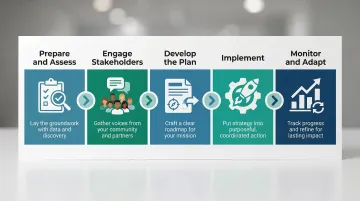
Stage 1: Prepare and Assess
This stage builds internal alignment on why the plan is needed and who needs to be involved. That means forming a planning committee with senior staff, board representatives, and community voices, then conducting a SWOT analysis to surface internal strengths and weaknesses alongside external opportunities and threats.
Before launching the process, confirm these are in place:
- Secure board and executive commitment before launching the process
- Assemble a planning committee with diverse perspectives and decision-making authority
- Review community needs data, funding landscape shifts, and peer organization strategies (sometimes called environmental scanning)
- Document current capacity realities: staffing levels, financial health, systems infrastructure
Research from the International Association for Strategy Professionals reveals that SWOT analysis, while widely used, ranks last in effectiveness among 16 preparation practices. The most effective practices are programs/services assessment, mission/strategy mapping, and stakeholder input gathering. Use SWOT as one input, not the foundation.
Stage 2: Engage Stakeholders
Gathering meaningful input from staff, board members, program participants, donors, and community partners ensures the plan reflects real organizational needs rather than leadership assumptions. Engagement should happen at multiple checkpoints throughout the process, not just at the beginning.
Effective engagement typically includes:
- Conduct one-on-one interviews with board members, major donors, and program staff
- Survey program participants and community members to understand unmet needs
- Host focus groups with frontline staff who understand operational realities
- Share draft priorities and gather feedback before finalizing the plan
Organizations with high capacity are nearly twice as likely to engage stakeholders systematically. When staff and community voices help shape the plan, buy-in develops through participation rather than top-down mandate, and implementation resistance drops as a result.
Stage 3: Develop the Plan
This stage synthesizes research findings and stakeholder input into three to five strategic priorities, each supported by specific, measurable goals. This is also the time to formally review the organization's mission, vision, and values statements and update them if the landscape has shifted.
Core development work includes:
- Translate stakeholder input and environmental analysis into strategic themes
- Define three to five strategic pillars (such as program expansion, financial sustainability, organizational capacity, or community visibility)
- Set objectives and key results (OKRs) that make progress visible and trackable
- Ensure each goal is specific, measurable, achievable, relevant, and time-bound
The Bridgespan Group notes that resource estimation often requires adjusting goals. Teams regularly scale back ambitions once true costs surface. Adjusting scope during development is far less costly than abandoning goals mid-implementation.
Stage 4: Implement
Implementation translates the strategic plan into operational action. This means assigning named owners to each priority, setting timelines, aligning the annual budget with strategic goals, and communicating the plan across the organization so accountability is built in from day one.
Implementation essentials:
- Assign a single owner (with decision-making authority) to each priority
- Break multi-year goals into annual milestones and quarterly objectives
- Align budget allocations to strategic priorities; if funding doesn't follow, priorities won't advance
- Communicate the plan organization-wide with role-specific context for different teams
Implementation is where most plans fail. Research cited by Funding for Good shows that over 60% of strategic plans fail during implementation, often because accountability mechanisms aren't established upfront.
Stage 5: Monitor and Adapt
Quarterly progress reviews, using agreed-upon metrics and a simple dashboard, keep the plan moving between annual updates. Revisit it formally at least once per year to reflect changes in leadership, funding, or the external environment — otherwise, the plan becomes a shelf document rather than a working guide.
A practical monitoring framework covers:
- Establish three to five key metrics per strategic priority
- Review progress quarterly with leadership team and board
- Conduct annual comprehensive review to adjust priorities if needed
- Document lessons learned and course corrections for organizational knowledge
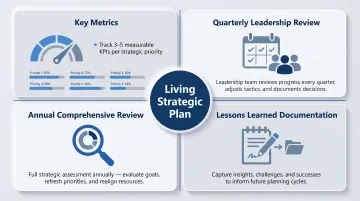
22% of nonprofits report on strategic plan progress inconsistently or not at all, according to the International Association for Strategy Professionals study. Quarterly monitoring closes that gap — and gives boards and funders the transparency they increasingly expect.
What a Nonprofit Strategic Plan Should Include
A strong nonprofit strategic plan does two things: it sets direction and creates the accountability structures to follow through. Public-facing versions may be polished summaries, but internal planning documents need enough operational detail to actually drive decisions—not just inspire them.
Mission, Vision, and Values
These three elements are the filter through which every strategic decision must pass. Strategic planning is the right time to test whether these statements still ring true and revise them if the organization has evolved.
- Mission: States why the organization exists—specific enough that it rules things out, not just in
- Vision: Describes the future your work is building toward—concrete enough to be motivating
- Values: Defines how decisions get made, especially when tradeoffs arise under pressure
Environmental Analysis Summary
A summary of key SWOT findings should be included to show funders and stakeholders that the strategy is grounded in evidence—both internal capacity realities and external factors like community needs, the funding landscape, and peer organizations.
Include:
- Community needs assessment highlights
- Competitive landscape and partnership opportunities
- Funding environment trends
- Internal capacity strengths and gaps
The environmental analysis isn't just due diligence—it's what separates a grounded strategy from one built on assumptions. Those findings should directly shape the priorities that come next.
Strategic Priorities and Measurable Goals
Three to five strategic pillars (such as program expansion, financial sustainability, organizational capacity, or community visibility) supported by specific, measurable objectives give the plan its backbone. OKRs (Objectives and Key Results) make progress visible and trackable across teams and quarters.
Example strategic pillar structure:
- Pillar: Strengthen Financial Sustainability
- Objective: Build operating reserves to three months of expenses by year three
- Key Results: Increase individual donor revenue by 25%; launch earned revenue pilot; reduce reliance on single largest funder from 45% to 33%
Prosper Strategies identifies pillars and OKRs as the most powerful elements at the heart of every nonprofit strategic plan.
Implementation Roadmap
The roadmap makes the plan executable: timelines, named owners for each priority, resource and budget requirements, and a regular reporting structure. Plans without a roadmap become "shelfware" after the planning retreat ends.
Roadmap components:
- Year-by-year implementation timeline
- Named owners for each objective
- Budget allocations and resource requirements
- Quarterly and annual review schedule
- Communication and stakeholder engagement plan
Why Financial Health Must Be Central to Your Strategic Plan
Financial strategy should not be a follow-up exercise after priorities are set. Financial health must be assessed before strategic goals are finalized, because ambitious programmatic strategies that the organization cannot afford are not strategies—they are wish lists.
Conduct a Financial Health Assessment First
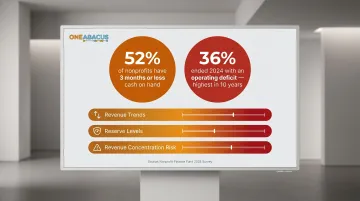
A formal financial health assessment should be part of the planning process. Review multi-year revenue trends, operating reserve levels, program cost-effectiveness, and revenue concentration risk to surface the financial realities that must shape strategic priorities and determine what is actually achievable.
Assessment components:
- Three to five-year revenue and expense trends
- Current operating reserve levels and burn rate analysis
- Program-level cost and revenue analysis
- Revenue concentration by source and funder type
- Cash flow patterns and seasonal variability
The Nonprofit Finance Fund's 2025 survey revealed that 52% of nonprofits have three months or less of cash on hand, and 36% ended 2024 with an operating deficit—the highest level in 10 years of survey data. These financial fragilities must inform which strategic priorities are feasible.
Make Revenue Diversification a Strategic Goal
Revenue concentration—where an outsized share of revenue comes from a small number of sources—creates significant financial vulnerability. Strategic plans should include goals to diversify across grants, individual donors, major gifts, and earned revenue streams to build long-term financial resilience.
Diversification strategies:
- Reduce dependence on any single funding source below 40% of total revenue
- Build individual donor pipeline to complement institutional funding
- Explore earned revenue models aligned with mission
- Develop multi-year funding relationships to reduce annual volatility
Research on revenue concentration shows complex trade-offs: highly concentrated revenue can reduce administrative costs but increases exposure to financial shocks when a major funder exits.
Set Operating Reserves as a Strategic Milestone
A reserve policy (commonly benchmarked at three to six months of operating expenses) should become a named strategic objective for organizations with insufficient reserves. A healthy reserve provides the financial flexibility to execute bold strategies and absorb unexpected disruptions without abandoning the plan.
Reserve policy considerations:
- Determine appropriate reserve target based on revenue volatility and program structure
- Build reserves incrementally through annual surplus targets
- Establish board-designated and unrestricted reserve categories
- Revisit reserve policy annually as organizational risk profile changes
The three-to-six-month guideline is a useful starting point, not a universal standard. Each nonprofit must determine its own appropriate level based on funding stability, fixed costs, and strategic risk tolerance.
Engage Fractional CFO Support When Needed
Most small-to-mid-sized nonprofits don't have a dedicated CFO to lead the financial analysis component of strategic planning. Nearly 7,000 finance positions were available at U.S. nonprofits in a single week in 2023, and only 6.9% of nonprofit financial managers consider themselves "financially expert." That gap has direct consequences for strategic plan quality.
A fractional CFO fills that gap without the cost of a full-time hire. Engaging specialized support—such as One Abacus Advisory's fractional CFO services—ensures that financial data and multi-year projections shape strategic priorities from the outset, rather than being layered on after the fact.
For example, during a leadership transition at the Philadelphia Zoo, One Abacus Advisory conducted a comprehensive accounting assessment, optimized their NetSuite environment, and improved month-end close and board reporting—providing the financial clarity needed to align strategic priorities with organizational capacity.

Best Practices That Keep Nonprofit Strategic Plans Off the Shelf
Three accountability practices separate plans that get executed from plans that gather dust.
Tie Board Meetings to Strategic Priorities
Every board meeting agenda should reference a named strategic priority. Quarterly leadership check-ins with a shared dashboard showing progress against key metrics ensure the plan stays front and center. The National Council of Nonprofits recommends that every board meeting include discussion of strategic direction.
Board alignment tactics:
- Structure board meeting agendas around strategic pillars, not operational reports
- Assign board committees to monitor specific strategic priorities
- Review dashboard metrics quarterly, not just annually
- Celebrate progress milestones to maintain momentum
Create a One-Page "Strategy on a Page"
Distill the full plan into a one-page document that all staff can reference in daily decision-making. This tool should include the mission, strategic pillars, key objectives, and year-one priorities in a scannable format.
One-page plan elements:
- Mission and vision statements
- Three to five strategic pillars with headline objectives
- Year-one priority initiatives
- Key metrics being tracked
Embrace Stakeholder Co-Creation
A one-page plan only works if people believe in what's on it. That's where co-creation matters most.
When staff, board members, and community voices help shape the plan, implementation resistance drops. People who contributed to the strategy are far more likely to act on it.
Co-creation practices that drive execution:
- Conduct listening sessions with frontline staff before drafting priorities
- Involve board members in goal-setting, not just approval
- Share draft priorities with key community stakeholders for input
- Document how feedback shaped the final plan
Build in a formal annual review cycle so the plan can adapt when external conditions shift. The goal is a living document leadership returns to—not one that gets filed away after the board vote.
Common Pitfalls That Derail Nonprofit Strategic Plans
Scope Overload
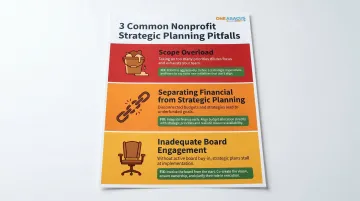
Attempting to pursue too many priorities simultaneously dilutes focus, exhausts staff, and prevents meaningful progress on any single goal. Strong plans make deliberate trade-offs and limit active priorities to three to five focus areas.
Bridgespan Group research identifies the "everything but the kitchen sink" pitfall: plans that are logical lists of helpful things but lack overarching impact goals, trade-offs, and prioritization. These plans read like wish lists rather than strategic documents.
Separating Financial Planning from Strategic Planning
When programmatic ambitions are set without a financial health assessment, organizations routinely overextend—committing to hiring, programs, or expansion the budget cannot support. With 36% of nonprofits ending 2024 with an operating deficit, the risk of this disconnect has never been higher.
Bridgespan calls this the "impossible dream" pitfall — inspirational plans that ignore the time, money, and skills required for execution. Financial constraints must shape strategic priorities during development, not derail them during implementation. At minimum, the planning process should include:
- A realistic revenue forecast for the plan period
- A capacity assessment (staff, systems, infrastructure)
- Explicit acknowledgment of what the organization will not pursue
Inadequate Board Engagement
Boards that receive a finished strategic plan for approval—rather than being involved in shaping it—are less likely to champion implementation, connect the plan to governance decisions, or hold leadership accountable. Board engagement should begin in Stage 1, not at the final vote.
BoardSource's Leading with Intent study found strategic planning remains among the top areas needing board improvement. When boards co-own the strategy from the start, they bring donor relationships, governance authority, and institutional knowledge into the process — assets no staff team can replicate on its own.
Frequently Asked Questions
What should a nonprofit strategic plan include?
A complete plan includes mission, vision, and values statements; a summary of SWOT findings; three to five strategic priorities with measurable goals; and an implementation roadmap that assigns ownership, timelines, and budget alignment. Plans should balance aspirational vision with operational detail.
What are the 5 stages of strategic planning?
The five stages are: (1) Prepare and Assess, (2) Engage Stakeholders, (3) Develop the Plan, (4) Implement, and (5) Monitor and Adapt. Each stage builds on the previous one, and skipping stages raises the risk of implementation failure.
What are the 5 C's of strategic planning?
The 5 C's—Clarity, Commitment, Communication, Collaboration, and Continuous Improvement—offer a principles-based lens for evaluating whether a plan is built to succeed. These principles make clear that strong strategy requires organizational alignment and follow-through, not just good documentation.
What are the 5 P's of strategic planning?
Henry Mintzberg's 5 P's—Purpose, Principles, Priorities, Plans, and Practices—provide a framework for aligning daily operations and resource decisions with long-term strategic direction. Nonprofits find them useful for stress-testing whether strategy actually shows up in how the organization operates day to day.
What is the 33% rule for nonprofits?
The 33% rule refers to the IRS public support test (IRC Section 509(a)(1)), which requires that at least one-third of a nonprofit's total support come from the public or mission-related program revenue to maintain public charity classification. This is a regulatory threshold, not a revenue diversification guideline.
What is the 80/20 rule for nonprofits?
The 80/20 rule describes the pattern where roughly 80% of donations or funding comes from 20% of donors or sources. Strategic plans should explicitly address donor and funding diversification to reduce over-reliance on a small group of supporters and build more resilient funding models.
Want financial leadership built into your strategic planning process? One Abacus Advisory provides fractional CFO support tailored to nonprofit planning cycles—so your financial health informs your priorities from the start. Schedule a consultation to discuss how we can support your next strategic plan.