Introduction
Many nonprofit leaders face a common frustration: they have a mission worth funding, a program ready to scale, and a documented track record — but still can't translate that into funded proposals. Grant success rates typically fall between 10% and 30%, meaning most organizations receive funding for only a fraction of what they submit.
The gap usually isn't program quality. It's that grant writing demands a strategic, disciplined approach — one that aligns compelling narrative with financial credibility and precise funder targeting.
This article is for nonprofit executive directors, development staff, and board members who are either new to grant writing or looking to sharpen their approach. We'll walk through what nonprofit grant writing is, the anatomy of a strong proposal, the step-by-step process, common pitfalls, and the key factors that separate funded proposals from rejected ones.
Key Takeaways
- Successful grant proposals require funder alignment, credible evidence, and a clear organizational track record
- Strong proposals pair a compelling needs statement with SMART outcomes, a realistic budget, and proof of capacity
- From funder research to relationship stewardship, each process step affects your award rate
- Most proposals fail due to poor funder fit, vague outcomes, or no prior contact with the funder
- Clean books and audit-ready financials matter as much as the narrative — funders scrutinize both
What Is Nonprofit Grant Writing — and Why It Matters
Nonprofit grant writing is the process of researching, crafting, and submitting a written proposal to a grantmaking institution — such as a private foundation, corporate funder, or government agency — to secure financial support for a program, project, or operating need. Unlike individual donor fundraising, grant writing involves formalized documentation with strict guidelines and evaluation criteria. It functions more like a structured investment pitch — funders evaluate alignment, credibility, and impact potential before committing dollars.
Grant writing is essential to nonprofit financial health. Foundation giving exceeded $100 billion for the third consecutive year in 2024, representing 19% of all charitable giving in the United States. Government funding makes up approximately 29% of nonprofit revenue, making it the second-largest source after fee-for-service income.
Together, these two funding streams represent access to billions of dollars that simply won't materialize through individual donations or events alone.
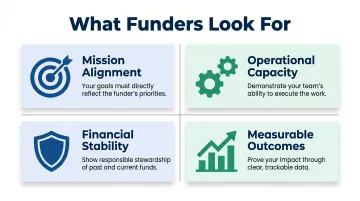
Grant writing is one specific type of fundraising — different from donor appeals, events, or campaigns. It requires organizations to demonstrate not just need and mission alignment, but also operational capacity, financial stability, and measurable outcomes. To compete for this funding, organizations typically need to show:
- Mission alignment with the funder's stated priorities
- Operational capacity to manage and deploy grant funds
- Financial stability that signals responsible stewardship
- Measurable outcomes tied to specific program activities
Core Elements of a Winning Grant Proposal
While every funder has its own format and guidelines, nearly all grant proposals share a common set of structural elements. Mastering these is the foundation of strong grant writing.
Executive Summary / Abstract
This is the written elevator pitch: a brief overview (often one paragraph to one page) that captures who the organization is, what problem is being addressed, what is being proposed, and how much funding is requested.
Although it appears first in the document, write it last — once all other sections are complete — so it accurately reflects the full proposal. Many program officers decide whether to read further based on the executive summary alone.
Statement of Need
This section establishes the "why" — it documents the problem or gap the project addresses using data, community context, and brief human stories. Research shows that combining data with narrative produces the strongest proposals: statistics establish reliability and scale, while stories make the case memorable and emotionally resonant. A single illustrative example from the community served can make the need feel real and urgent to a reviewer.
Critical caveat: The need described must align directly with the funder's stated priorities. A compelling need that falls outside a funder's focus area won't win funding.
Program Goals, Objectives, and Evaluation Plan
Funders want to know exactly what will change and how progress will be measured. That means SMART outcomes — specific, measurable, achievable, realistic, and time-bound. Vague aspirations like "improve community health" won't pass muster. A strong objective looks more like:
- "Reduce food insecurity among 500 households by 30% within 12 months, measured through pre- and post-program surveys."
Evaluation matters deeply. Foundant warns that proposing to design an evaluation plan after funding is awarded is "a huge red flag" to foundations. Every proposal must include pre-defined measurable outcomes and a clear plan for tracking progress.
Budget and Budget Narrative
The budget must tell the same financial story as the narrative — every line item should connect directly to program activities. Funders often request supporting financial documents such as IRS Form 990, audited financial statements, or prior year actuals. Organizations with strong financial infrastructure — including well-maintained books and a defensible budget narrative — signal credibility to reviewers.
This is an area where many smaller nonprofits struggle. For organizations without a dedicated finance team, fractional CFO support from a firm like One Abacus Advisory can strengthen a proposal's financial credibility — ensuring accurate reporting, clean books, and audit-ready systems.
Organizational Background and Sustainability Plan
Funders need to trust the organizations they back. This section establishes track record, capacity, and organizational credibility. Increasingly, funders also require a sustainability plan — a concrete explanation of how the program continues after grant funding ends, whether through earned revenue, diversified funders, or organizational reserves. The underlying question is always the same: will this investment outlast the check?
How the Grant Writing Process Works
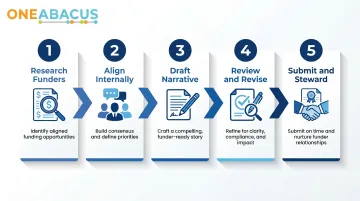
Successful grant writing follows a disciplined process built on research, internal collaboration, drafting, revision, and ongoing funder relationship management. Think of it as a pipeline, not a single task.
Step 1: Research and Identify the Right Funders
The funder research phase involves reviewing each potential funder's giving history, stated priorities, geographic focus, funding cycles, and typical grant size to determine fit before investing time in a proposal. Data from Instrumentl shows that funder type dramatically affects success rates: state and local government grants have a 52% success rate versus just 22% for corporate funders.
Applying to misaligned funders wastes organizational resources. Focus on depth over volume — five highly tailored proposals to well-matched funders will outperform twenty generic ones sent to poorly aligned prospects.
Step 2: Align Internally and Set the Strategy
Before writing begins, key stakeholders — program staff, finance leads, and leadership — should align on the core details:
- Project scope: the specific program or initiative being proposed
- Ask amount: confirmed by finance and grounded in a realistic budget
- Intended outcomes: measurable results you can credibly report on
- Organizational capacity: whether you can manage compliance and reporting if funded
The budget finalized here drives every other section of the proposal, so financial accuracy at this stage is critical.
Step 3: Draft the Proposal Narrative
Use funder guidelines as the structural skeleton and write each required section with the funder's priorities explicitly in mind. Tailor language to match the funder's vocabulary, reference their stated goals, and frame your organization's work in terms of their mission — not just your own. A proposal written for a health equity foundation should sound different from one written for a workforce development funder, even if the underlying program is the same.
Step 4: Review, Revise, and Prepare Attachments
A strong proposal goes through multiple internal review cycles and should be read by at least one person unfamiliar with the program to catch jargon, assumptions, or unclear logic. Most funders require attachments — letters of support, board lists, financial statements — and these often take time to gather, so starting early matters.
Step 5: Submit and Steward the Relationship
Submit a day or two before the deadline and confirm receipt. The post-submission phase is equally important: regardless of outcome, funders value organizations that follow up professionally, request feedback on rejections, and provide timely reports on funded grants. Funder relationships built over time significantly increase future success rates.
Common Mistakes and Misconceptions in Grant Writing
The most prevalent misconception is that grants are "free money" requiring only a well-written narrative. In reality, grants come with compliance requirements, reporting obligations, restricted use rules, and renewal expectations. Nonprofits that fail to manage grants properly face repayment obligations, audit findings, and loss of future funding. Organizations that treat grants as easy wins often underprepare — and either get rejected or win funding they can't properly manage.
Beyond that core misconception, three mistakes consistently derail otherwise capable organizations:
- Submitting cold proposals: Organizations with pre-existing funder relationships — even a brief introductory call with a program officer — have meaningfully higher success rates than those applying without prior contact.
- Generic, recycled narratives: Reusing the same proposal across multiple funders without customizing your narrative and budget to each funder's priorities tells reviewers you haven't done your homework.
- Mismanaging awarded funds: Winning a grant you're unprepared to manage creates compliance failures, audit findings, and damaged relationships that close doors for future funding.
Each of these mistakes is avoidable with the right groundwork — relationship-building before submission, tailored proposals for each funder, and internal systems ready to handle grant administration from day one.
Key Factors That Determine Grant Success
Funder alignment is the single most important factor. Organizations that rigorously vet funders for mission fit, geographic focus, and funding history before applying win at significantly higher rates than those that apply broadly. The principle "if you've met one funder, you've met one funder" holds true — each requires a genuinely tailored approach.
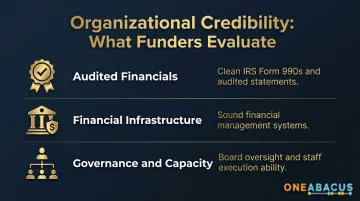
Organizational credibility matters just as much. Funders evaluate the entire organization behind a proposal, not just the program itself. Strong applications typically demonstrate:
- Audited financials and clean IRS Form 990s
- Sound financial management infrastructure
- Board governance and staff capacity to execute
For nonprofits without a dedicated finance team, fractional CFO services like those offered by One Abacus Advisory provide the financial leadership needed to meet this bar — maintaining clean books, preparing audit-ready statements, and building grant-ready budgets.
A compelling, evidence-based narrative makes the difference. Proposals that combine quantitative outcome data with brief human stories of impact consistently outperform those that rely on either alone. Data alone doesn't persuade; stories without data feel anecdotal. The combination builds both credibility and emotional resonance.
Persistence separates long-term grant winners from early quitters. Even well-resourced organizations face rejection rates of 50% or higher. Requesting funder feedback after every rejection, refining the narrative, and reapplying strategically is how nonprofits build grant programs that compound over time — not just survive a single funding cycle.
Frequently Asked Questions
What is the average cost of a grant writer?
Grant writer costs vary widely by experience level, grant complexity, and engagement model. Freelance writers typically charge $25–$250/hour or $500–$10,000+ per project. Retainer arrangements for complex federal grants can run $7,000–$10,000 per month. The Grant Professionals Association's 2025 Compensation and Benefits Report is the most authoritative source for current benchmarks.
What is one common mistake to avoid when writing a grant proposal?
The most common mistake is submitting a generic, unmodified proposal to multiple funders without tailoring the narrative and budget to each funder's specific priorities and guidelines. Funders can tell when a proposal was written for someone else, and it signals that the applicant hasn't researched the funder's priorities — an almost guaranteed path to rejection.
Is a grant the same as a proposal?
No. A grant is the funding award itself, while a proposal (or grant application) is the written document submitted to request that funding. The proposal is the tool used to compete for the grant; a successful proposal results in the award.
What are the three C's of proposal writing?
The three C's are Clear (easy to understand), Concise (short and factual), and Compelling (persuasive and mission-driven). Together, they ensure reviewers can quickly grasp what you're asking for, why it matters, and why your organization is positioned to deliver.
What financial documents do funders typically require with a grant proposal?
Common financial attachments include IRS Form 990, most recent audited financial statements or reviewed financials, a current organizational budget, and sometimes prior-year actuals. Having these documents current, accurate, and audit-ready is essential before applying — and organizations that lack internal finance capacity often benefit from fractional CFO support to ensure these materials meet funder standards.
How do nonprofits demonstrate financial sustainability in a grant proposal?
Funders look for a diversified revenue mix, a concrete plan for sustaining the program after the grant ends, and financial statements showing the organization is fiscally sound — not reliant on grant funding for core operations. Projections backed by strong financial management practices and operating reserves carry the most weight.