Introduction
Nonprofit leaders face pressure from every direction: boards demanding better financial oversight, funders expecting clean audits and detailed grant reporting, regulators requiring increasingly complex compliance documentation. Budgets stay flat. Specialized staff remain hard to recruit.
According to the National Council of Nonprofits, 74.6% of nonprofits reported job vacancies in 2023, with salary competition cited as the top barrier by 72.2% of organizations. Most nonprofits simply can't afford full-time specialists for every operational function — and the compliance and reporting requirements don't shrink to accommodate that reality.
This article explores what outsourcing means for mission-driven organizations, which functions nonprofits most commonly outsource, and why this model has become essential for financial accountability, compliance, and—most importantly—staying focused on mission impact.
What Is Outsourcing for Nonprofits?
Outsourcing means contracting specific organizational functions—such as bookkeeping, payroll, IT management, or financial leadership—to third-party providers rather than hiring full-time staff. The goal is threefold: improve quality, control costs, and access expertise the organization wouldn't otherwise afford.
This is distinct from hiring a freelancer for a discrete project. Outsourcing is an ongoing, structured relationship where the provider acts as a functional extension of your organization. Instead of a contractor who delivers a report and leaves, an outsourced partner integrates into your operations, understands your workflows, and provides continuity over time.
Today's nonprofit outsourcing providers go well beyond generic back-office processing. The best bring deep sector knowledge across areas that directly affect compliance and financial health:
- Nonprofit accounting standards (ASC 958)
- IRS Form 990 preparation
- Donor-restricted fund accounting
- Grant compliance and reporting
Firms like One Abacus Advisory specialize in fractional CFO and COO services built specifically for nonprofits—delivering executive-level financial and operational leadership at a fraction of the cost of a full-time hire.
Why Nonprofits Are Increasingly Turning to Outsourcing
The Talent and Budget Squeeze
Nonprofits compete for highly educated workers—29.1% of nonprofit employees hold graduate degrees, compared to just 10.5% in for-profit sectors—yet they pay 4-7% less than private employers after controlling for qualifications. This structural wage penalty makes it nearly impossible to recruit specialized finance, IT, or HR talent, especially in competitive urban markets.
The result? Chronic vacancies that directly harm mission delivery. The Urban Institute found that in 2025, 72% of staffed nonprofits reported that employee vacancies negatively affected their ability to pursue their missions. Most small and mid-sized nonprofits don't need a full-time CFO or IT director—but they desperately need that expertise. Outsourcing solves this by providing access to senior-level specialists on a fractional, right-sized basis.
The Compliance and Regulatory Burden
Nonprofits face a unique regulatory environment that generalist staff and volunteer bookkeepers are not equipped to handle:
- IRS Form 990 can require up to 16 supplemental schedules covering everything from lobbying activities to tax-exempt bonds
- 39 states plus DC require charitable registration, often with audited financial statements attached
- Nonprofits spending $1 million or more in federal funds must undergo a comprehensive single audit under 2 CFR 200, covering internal controls, grant compliance, and procurement standards
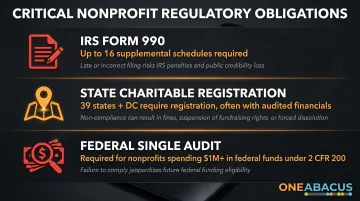
Errors in these areas carry reputational and legal risk. A failed audit can disqualify an organization from future grants; IRS compliance issues can jeopardize tax-exempt status. Outsourced specialists reduce this risk by bringing current, deep expertise in nonprofit-specific reporting requirements.
The Budget Reality
Hiring a full-time finance director or CFO isn't just about salary. Total compensation includes benefits, payroll taxes, training, office space, and turnover costs. The median annual wage for financial managers across all sectors is $156,100, with the 75th percentile exceeding $210,000—far beyond the reach of most nonprofits operating on budgets under $1 million.
Outsourced models convert that fixed overhead into variable, scalable cost. Instead of a full-time salary, you pay for precisely the capacity you need—fractional CFO time during a leadership transition, or grant compliance support during peak reporting periods. Expense aligns with your organizational stage and funding cycles, not a fixed headcount.
The Mission-Focus Argument
When your executive director spends 15 hours a week reconciling bank accounts, troubleshooting payroll errors, or preparing board reports, that's 15 hours not spent on fundraising, program delivery, or community engagement. Outsourcing gives leadership time back for fundraising, programs, and community relationships.
One Abacus Advisory has seen this shift firsthand. After engaging fractional CFO support during a leadership transition, the San Diego Food Bank maintained seamless month-end close processes without disrupting program staff—keeping the team focused on serving the community.
Board and Donor Expectations
Donors want clean financials before committing to major gifts. Foundations require audited statements as a grant condition. Board members demand dashboards, cash forecasts, and risk analysis—and when that reporting isn't there, they notice.
Outsourced specialists help nonprofits meet these expectations by producing board-ready reports, supporting clean audit outcomes, and demonstrating stewardship that builds funder confidence.
What Functions Can Nonprofits Outsource?
Finance, Accounting, and Financial Leadership
For most nonprofits, finance and accounting is where outsourcing delivers the most immediate value. Common services include:
- Bookkeeping and transaction processing
- Accounts payable and receivable
- Payroll administration
- Grant accounting and restricted fund tracking
- Monthly financial reporting and analysis
- Audit preparation and support
- Strategic financial leadership (fractional CFO or COO roles)
Nonprofit-focused financial outsourcing delivers value beyond basic processing. Specialists manage donor-restricted versus unrestricted funds, produce board-ready financial statements, maintain segregation of duties to reduce fraud risk, and ensure compliance with ASC 958 accounting standards.
Fractional CFO and COO services—like those One Abacus Advisory provides—give nonprofits senior-level leadership without the six-figure commitment of a full-time hire. Engagements typically cover budgeting and forecasting, cash flow management, audit preparation, and board reporting, scaled to the organization's stage and complexity.
Information Technology (IT)
IT outsourcing typically covers:
- Helpdesk and user support
- Cybersecurity and threat monitoring
- Cloud infrastructure management
- Database administration
- Software implementation and integration
Data security is especially critical given the sensitivity of donor information. Yet 68% of nonprofits confirmed at least one data breach in the prior three years, and 90% provide no regular cybersecurity training. For the 88% of nonprofits operating on budgets under $500,000, hiring an in-house IT manager is unrealistic—but outsourcing brings professional-level security monitoring and threat response within reach.
Human Resources and Administration
Small nonprofits rarely have dedicated HR staff — and that gap creates real compliance risk. Outsourced HR providers handle the operational load while keeping the organization protected:
- Payroll processing and tax filing
- Benefits administration
- Onboarding and offboarding
- Employment law compliance
- Performance management support
External providers ensure payroll accuracy, maintain compliance with wage and hour laws, and free up program leaders to focus on mission delivery.
Marketing, Communications, and Grant Writing
These functions require specialized skills that program staff rarely have time to develop. Outsourcing to specialists who understand nonprofit storytelling and funding landscapes frees internal teams to focus on service delivery. Common areas include:
- Grant proposal development and research
- Social media management and content creation
- Donor communications and storytelling
- Website design and email campaigns
The Key Benefits of Outsourcing for Nonprofits
Cost Efficiency
Outsourcing converts fixed labor costs into variable, scalable expenses. You pay for the service level you actually need—not a full-time salary during slow periods or vacant positions during transitions.
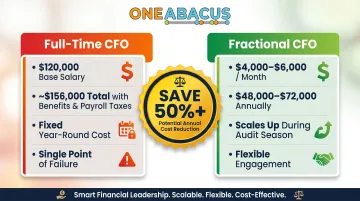
Consider the math: a full-time CFO earning $120,000 annually costs the organization roughly $156,000 after benefits and payroll taxes. A fractional CFO engagement at 15 hours per month might run $4,000–$6,000 monthly ($48,000–$72,000 annually)—delivering senior-level expertise at half the cost while maintaining flexibility to scale up during audit season or major grants.
Access to Specialized Expertise
Outsourced providers bring depth of knowledge that a single in-house generalist can't match. They stay current on:
- ASC 958 nonprofit accounting standards
- Federal single audit requirements (2 CFR 200)
- IRS Form 990 updates and schedule changes
- Grant compliance rules across multiple funders
- Technology platforms like NetSuite, Sage Intacct, and QuickBooks Online
Providers working across many nonprofits carry sector best practices into every engagement. One Abacus Advisory, for instance, draws on cross-client experience to spot inefficiencies, strengthen financial systems, and build controls that most small organizations wouldn't identify working in isolation.
Stronger Internal Controls and Reduced Fraud Risk
Segregation of duties—separating the person who handles money from the person who records transactions—is the single most effective fraud deterrent. Yet it's structurally difficult for small nonprofits to achieve internally.
More than half of all fraud cases stem from lack of internal controls, with nonprofits experiencing a median loss of $76,000 per incident. Outsourcing creates a natural control layer: an external provider processes transactions, prepares reconciliations, and generates reports, while internal staff approve payments and review outputs. This built-in separation reduces both fraud risk and the appearance of impropriety.
Flexibility and Scalability
Outsourced relationships scale up or down as needs change:
- Ramp up finance support during audit preparation
- Add grant compliance expertise when you land a major federal award
- Scale back during staff transitions or funding gaps
- Bring in interim leadership while recruiting permanent hires
Contrast this with the inflexibility of full-time hires during periods of uncertainty. When you're not sure whether a new grant will renew, committing to a $90,000 salary is risky. A scoped engagement or monthly retainer offers the expertise without the long-term obligation.
Organizational Resilience and Continuity
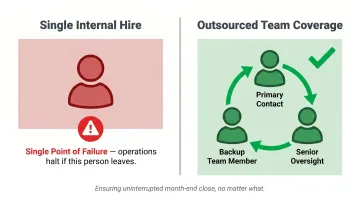
Relying on one internal staff member creates a dangerous single point of failure. When that person leaves—whether for another job, illness, or burnout—operations grind to a halt.
Outsourced firms provide team-based coverage. If your primary contact is unavailable, another team member steps in without disruption. When One Abacus Advisory supported the Philadelphia Zoo during the departure of both their CFO and Controller, the firm provided uninterrupted fractional CFO and Controller coverage, optimized the NetSuite environment, and maintained month-end close processes without missing a beat—the kind of continuity a single internal hire simply cannot provide on their own.
When Does Outsourcing Make Sense for Your Organization?
Common Readiness Signals
Outsourcing is worth exploring when you see:
- Recurring financial reporting errors that erode board confidence
- Staff turnover in key back-office roles, leaving critical functions unstaffed
- An upcoming audit without dedicated finance leadership to manage preparation
- Board requests for stronger financial oversight, dashboards, or cash forecasting
- Rapid growth or funding changes that require more financial sophistication than your current team provides
- Leadership transitions where interim support can stabilize operations while you recruit permanent staff
These situations are exactly where One Abacus Advisory steps in. Past engagements have included leadership departures at the Philadelphia Zoo and San Diego Food Bank, fractional COO support during periods of operational strain, and audit preparation during a crisis period at Laguna Playhouse.
Addressing the "Loss of Control" Concern
Many nonprofit leaders worry that outsourcing means losing visibility into their own finances. In practice, the opposite is often true.
Reputable outsourced partners operate transparently:
- Documented processes and workflows
- Regular reporting cadences (monthly financials, board packages, cash forecasts)
- Direct accountability to leadership and the board
- Clear communication channels and escalation protocols
When One Abacus Advisory steps in, they provide board-ready financial reporting, translate complex data into actionable insights, and collaborate directly with executive directors to ensure alignment. This structure often improves oversight compared to relying on a single internal employee with no backup or peer review.
That transparency also makes a hybrid model practical — one where outsourced leadership works alongside internal staff rather than displacing them.
The Hybrid Model
Outsourcing isn't all-or-nothing. Many nonprofits use a hybrid approach:
- A part-time internal bookkeeper handles day-to-day transactions
- An outsourced fractional CFO provides strategic oversight, board reporting, and audit preparation
- External IT support manages cybersecurity and infrastructure, while an internal coordinator handles user requests
One Abacus Advisory frequently partners with existing finance staff, layering fractional CFO or COO leadership on top of internal teams. During the Philadelphia Zoo engagement, the firm worked alongside the lean internal finance team to optimize systems, improve reporting, and support the recruitment of new permanent leaders. The result was a stronger finance function than either team could have built alone.
Frequently Asked Questions
How much do nonprofit consultants charge per hour?
Hourly rates typically run $150–$300 for mid-level nonprofit accounting or consulting, and $200–$450 for senior fractional CFO or COO work. Monthly retainer arrangements ($3,000–$10,000/month for 10–20 hours) tend to offer better cost predictability for ongoing needs.
What are the four types of outsourcing?
The four commonly cited types are professional outsourcing (accounting, legal, HR), IT outsourcing (infrastructure, cybersecurity, software support), business process outsourcing (payroll, data entry, customer service), and operational outsourcing (facilities, logistics, supply chain). Professional and IT outsourcing tend to deliver the highest impact for nonprofits.
Are NPO employees paid?
Yes. Most nonprofit employees are paid staff, not volunteers. Nonprofits must comply with federal wage and hour laws, including minimum wage and overtime requirements. Payroll and HR administration—ensuring compliance with tax withholding, benefits, and employment law—are among the most commonly outsourced back-office functions for nonprofits seeking to reduce overhead while staying compliant.
What does NPO mean in business?
NPO stands for nonprofit organization—an entity that reinvests surplus revenue into its mission rather than distributing profits to shareholders. This tax-exempt structure carries unique reporting and compliance requirements (Form 990, restricted fund accounting, functional expense allocation) that make specialized financial expertise especially valuable.
What functions do nonprofits most commonly outsource?
Finance and accounting, IT support, HR and payroll, and grant writing top the list. Financial management—bookkeeping, audit preparation, and fractional CFO leadership—carries the most direct impact on compliance, funder confidence, and board oversight.
How do I know if my nonprofit is ready to outsource?
Watch for these signals:
- Vacant CFO, Controller, or IT roles creating coverage gaps
- Recurring compliance, reporting, or audit preparation challenges
- Board requests for stronger financial oversight or dashboards
- Leadership transitions or rapid growth outpacing current staff capacity
If any apply, a short consultation with an outsourced provider can clarify next steps.
Ready to explore fractional financial leadership tailored to your nonprofit's needs? One Abacus Advisory provides fractional CFO and COO services tailored to your organization's stage, challenges, and mission. Schedule a free consultation to discuss how outsourced expertise can strengthen your financial foundation and free your team to focus on impact.