Introduction
Nonprofit leaders know this reality well: talented, mission-driven teams stretched impossibly thin, juggling fundraising, finance, compliance, and operations with no clear path to adding full-time headcount.
67% of nonprofit employees are actively looking for new jobs or planning to leave within a year, according to Candid's Social Impact Staff Retention Project, with 59% citing "too much work and too little support" as their primary reason.
What nonprofit leaders actually need to know is how fractional staffing makes their team stronger — not just what it is.
This article breaks down the concrete advantages fractional staffing delivers to nonprofit teams, when those advantages matter most, and how to apply them to your organization.
Key Takeaways
- Fractional staffing delivers senior-level expertise (CFO, COO, development, operations) at 60-75% less than full-time hire costs
- Removes specialized burdens from full-time staff, cutting turnover and burnout
- Scales support up or down to match funding cycles and evolving needs — no long-term commitments required
- Without it, nonprofits risk leadership gaps, compliance failures, staff exodus, and missed strategic opportunities
- Done right, fractional staffing becomes a sustainable capacity model — not a temporary fix
What Is Fractional Staffing? (Brief Context)
Fractional staffing is a structured engagement where an experienced professional works a defined number of hours or days per week — delivering senior-level expertise at a fraction of full-time cost.
In nonprofits, this model typically shows up in:
- Finance: CFO, Controller, Senior Finance Director
- Operations: COO, operations management
- Development: Fundraising leadership, grant analysts
- Human Resources: CHRO, HR strategy and compliance
- Technology & Systems: Technology implementation, process optimization
Used well, fractional staffing is a deliberate capacity strategy — not a stopgap. It works best when organizations enter the engagement with clear scope: what the role will own, what decisions it will inform, and what a successful first six months actually looks like.
Key Advantages of Fractional Staffing for Nonprofits
The advantages below are grounded in operational and financial outcomes nonprofit leaders actually track: cost efficiency, team capacity, decision quality, and mission delivery. Each advantage compounds over time when applied consistently with clear expectations.
Advantage 1: Access to Senior Financial and Operational Expertise Without Full-Time Cost
One of fractional staffing's most significant advantages is access to C-suite-caliber leadership (CFOs, COOs, development directors) for a fraction of full-time cost.
How this works in practice:
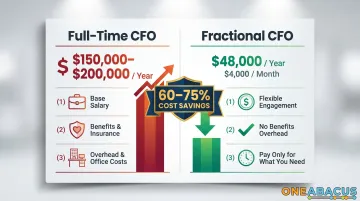
Instead of a $150,000+ annual CFO salary plus benefits (Bureau of Labor Statistics reports median financial manager wages at $161,700 as of May 2024), a nonprofit can engage a fractional CFO for approximately $3,000 to $5,000 per month—delivering the same strategic financial oversight and board-level reporting at dramatically reduced cost.
The math: A full-time CFO costs roughly $150,000–$200,000 annually including benefits. A fractional CFO at $4,000/month costs $48,000 annually, a savings of 60–75%.
Why this matters to nonprofits specifically:
For nonprofits constrained by overhead ratios and donor scrutiny on administrative costs, accessing senior financial leadership fractionally means strengthening fiscal health and transparency without inflating overhead lines. This affects:
- Board confidence in financial strategy
- Audit readiness and compliance
- Funder credibility and grant reporting accuracy
- Multi-year financial modeling and cash flow planning
These are areas where under-resourced finance functions create costly errors. The IRS reports that missing or incomplete schedules are the most common errors causing Form 990 rejections, and Harvard Kennedy School research found that smaller nonprofits and those new to government grants have significantly higher rates of adverse audit findings.
KPIs impacted:
- Overhead ratio
- Cost per program dollar
- Audit finding rates
- Financial reporting turnaround time
- Budget variance
- Funder compliance rate
This advantage has the highest impact during growth phases, funding transitions, leadership departures, or when a board requests stronger financial oversight but the organization cannot yet justify a full-time hire.
Advantage 2: Sharpening Full-Time Team Focus and Preventing Burnout
Fractional staffing doesn't just fill gaps. It removes the hidden tax placed on full-time team members expected to cover specialized areas outside their core strengths, draining both time and effectiveness.
How this works in practice:
A fractional specialist (for example, a fractional operations lead or senior finance team member) absorbs the technical, high-stakes work that a generalist executive director or program director was carrying alone. This frees them to focus on community relationships, fundraising, and mission delivery.
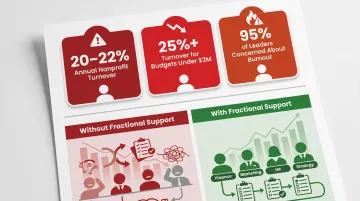
Nonprofit burnout is a well-documented risk. Annual nonprofit turnover rates reach 20–22%, compared to 12–13% in other sectors, according to Social Impact Architects. Small nonprofits with budgets under $2M exceed 25% turnover, and the Center for Effective Philanthropy found that 95% of nonprofit leaders express concern about staff burnout.
The financial consequences are steep. Replacing an employee costs 30–50% of their annual salary, according to Social Impact Architects. The Bridgespan Group puts the cost of replacing a senior development officer at up to 9 times their annual salary.
The impact on output quality:
- A development director not buried in compliance spreadsheets can spend more time cultivating donors
- An executive director not managing payroll errors can focus on board relationships and strategic planning
- Specialized fractional staff reduce likelihood of financial errors, missed grant deadlines, or compliance failures that occur when generalists are stretched too thin
KPIs impacted:
- Staff retention rate
- Executive director bandwidth (hours on strategic vs. operational tasks)
- Grant compliance rate
- Donor retention rate
- Program output quality
The impact is most acute in small core teams (under 10–15 FTEs) carrying cross-functional responsibilities, or when a key staff member departs and the remaining team is absorbing the gap unsustainably.
Advantage 3: Organizational Agility — Scale Support to Match Evolving Needs
Unlike full-time hires, fractional staffing is inherently flexible. Scope, hours, and focus can be adjusted as the organization's needs shift , which suits nonprofits whose funding levels, program demands, and strategic priorities shift from year to year.
How this works in practice:
During a capital campaign or audit period, a nonprofit can increase fractional CFO hours. During quieter operational phases, they can scale back , without the fixed cost of full-time salary or the disruption of terminating an employee.
Why the flexibility matters now:
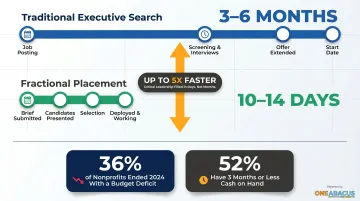
Nonprofits operate in environments of funding uncertainty. The Nonprofit Finance Fund's 2025 survey found that 36% of nonprofits ended 2024 with an operating deficit (the highest level in 10 years), 52% have 3 months or less of cash on hand, and 84% receiving government funding expect cuts. A staffing model that flexes with budget cycles is structurally more sustainable than one locked into fixed headcount commitments.
Speed matters during transitions:
Traditional nonprofit executive searches take 3–6 months on average, according to industry data from vChief and the Bridgespan Group. Fractional placements typically occur within 10–14 days. This mission continuity difference is critical during leadership transitions.
Organizations can also shift which fractional specialist they engage as priorities evolve, for example moving from COO support to CFO focus. Without a full hiring cycle each time, leadership adjustments become strategic decisions rather than reactive scrambles.
KPIs impacted:
- Time-to-fill for leadership gaps
- Operational continuity during transitions
- Staff cost as percentage of budget
- Strategic plan implementation rate
This advantage becomes most visible during leadership transitions, organizational restructuring, rapid program growth, or when the organization is still assessing whether a full-time role is ultimately justified.
What Happens When Fractional Staffing Is Absent
Without fractional support, nonprofits default to either overloading full-time staff or leaving critical roles unfilled. The consequences compound over time:
Financial Blind Spots Grow
Inconsistent or delayed financial reporting erodes board trust and funder confidence. Organizations struggle with cash flow forecasting, budget accuracy, and audit preparation—creating real risk of compliance failures and lost funding.
Strategic Plans Collect Dust
Reactive firefighting replaces strategic work when leaders are stretched across too many domains. The CompassPoint "Daring to Lead 2011" study found that only 35% of executive directors rated themselves "very effective" at HR management, and 39% reported lacking healthy work-life balance.
Difficulty Scaling
Organizations plateau or stall because they lack senior infrastructure to support growth. The Bridgespan Group reports that 43% of C-suite roles had to be filled within a two-year period, with only 30% filled by internal promotion—roughly half the rate of for-profit organizations.
Rising Costs Over Time
The downstream cost of errors, turnover, and missed funding opportunities often exceeds what fractional support would have cost. Mission Edge estimates that replacing a senior leader runs 50% to over 200% of their annual salary—a steep price for organizations already operating on thin margins.
Each of these gaps is preventable. Fractional staffing gives nonprofits the senior-level capacity to address them without the overhead of a full-time hire.
How to Get the Most Value from Fractional Staffing
Fractional staffing delivers strongest results when the engagement is scoped clearly from the start—defined priorities, agreed-upon deliverables, and shared understanding of what success looks like.
Essential elements:
- Set milestones at 90 days, 6 months, and 1 year: which financial processes need stabilizing, what reports the board needs, and which compliance deadlines are non-negotiable
- Build in regular review cycles — monthly check-ins, board reporting touchpoints, and feedback loops prevent the engagement from becoming passive or siloed
- Treat fractional leaders as part of the team, not outside vendors, giving them access to stakeholders, systems, and real decision-making context
One Abacus Advisory structures fractional CFO and COO engagements around a "right-sized" model: scope and hours are calibrated to each organization's actual maturity and needs, not a fixed retainer. That approach has proven out across organizations including the San Diego Food Bank, Philadelphia Zoo, and Laguna Playhouse.
The Philadelphia Zoo engagement illustrates what this looks like in practice. During a leadership transition, One Abacus provided fractional CFO and Controller support, optimized the organization's NetSuite environment, and built financial literacy across the executive team — maintaining continuity and leaving the organization stronger than it found it.

Conclusion
Fractional staffing's real value for nonprofits lies in three reinforcing advantages: access to senior expertise at affordable cost, protection of full-time team focus and resilience, and organizational agility to scale support as needs change.
Fractional staffing is not magic, and it is not right for every role or every organization. For nonprofits navigating tight budgets, shifting strategy, or the simple reality that a small team cannot cover everything, it offers a practical middle ground. Rather than overcommitting to full-time hires or going without critical expertise, the model lets organizations right-size their support.
If your team is stretched thin or a capability gap is quietly slowing your mission, fractional staffing is worth a serious look.
Frequently Asked Questions
How much do nonprofit fundraising consultants charge?
Nonprofit consultants typically charge $159 per hour on average, according to the 2025 Nonprofit.ist Consultant Cost & Compensation Survey, with annual billing averaging $124,000. Fractional financial leadership typically runs $3,000–$5,000 per month, offering predictable costs and ongoing senior-level engagement — a better fit for organizations that need sustained support, not one-off projects.
What is the fastest way to raise money for a non-profit?
Tactics like major donor outreach and matching gift campaigns can accelerate giving, but execution depends on having the right infrastructure in place. Fractional financial and operational leadership ensures your organization can track revenue, manage cash flow, and report results accurately — so fundraising efforts translate into sustainable growth rather than short-term spikes.
What is the 80/20 rule for nonprofits?
In nonprofit fundraising, roughly 80% of donations typically come from 20% of donors — a principle known as donor concentration. Fractional financial staff give small teams the reporting rigor to identify and track that top-tier segment, so leadership can focus attention where it matters most.
What are the 3 C's of fundraising?
The 3 C's typically refer to Culture, Capacity, and Competency — the core organizational elements behind effective fundraising. Fractional staffing builds the operational and financial capacity piece, freeing senior leaders to focus on relationship-driven work instead of administrative tasks that drain their time.