Introduction
Nonprofit leaders face a unique challenge: unlike for-profit businesses with clear revenue models tied to customer value, nonprofits operate in a world where the people they serve rarely fund the programs that help them. This disconnect leaves many leaders uncertain about which funding strategy to pursue, how to scale sustainably, and why some organizations sustain themselves year over year while others with comparable missions stay trapped in a perpetual funding crisis.
Choosing the right financial model means matching your funding approach to your mission, scale, and community — and building a structure that supports long-term organizational health.
Without that clarity, nonprofits scramble from opportunity to opportunity, creating donor confusion, program instability, and leadership burnout.
This article breaks down the key nonprofit funding models, the four financial components of a sustainable business model, critical benchmarks every leader should track, and best practices for building a funding strategy that actually works.
Key Takeaways
- Nonprofits run two separate businesses at once: a program operation serving beneficiaries and a funding operation securing resources, each requiring distinct infrastructure
- The right funding model depends on who controls the money and what motivates them to give — not which opportunities simply appear available
- A sustainable financial model rests on four pillars: revenue mix, infrastructure investment, true program costs, and capital structure
- Key benchmarks: 3–6 months of operating reserves, intentional revenue concentration limits, and full-cost visibility across programs
Why Nonprofit Financial Models Differ from Business Models
In a for-profit business, creating value for a customer generates revenue directly. You sell a product or service, the customer pays, and the transaction is complete. Nonprofits operate differently: the beneficiary — the person served — rarely funds the value being created.
Two quick examples illustrate the gap:
- A homeless shelter serves individuals without housing, but funding comes from foundations, government contracts, and individual donors
- A youth mentoring program serves at-risk teens, but revenue flows from corporate sponsors and fundraising events
That gap creates what Propel Nonprofits calls the "two-business" reality: nonprofits run a program business and a fundraising business simultaneously, each requiring different infrastructure, expertise, and relationships. One Abacus Advisory sees this challenge regularly with clients navigating growth and transitions — organizations that excel at delivering programs often struggle to build the parallel funding infrastructure needed to sustain them.
Without a clearly defined funding model, nonprofits in growth phases face chaotic fundraising scrambles, program instability, and misaligned donor expectations. Research from Stanford Social Innovation Review found that roughly 90% of the 144 nonprofits that reached $50M+ in revenue had a single dominant funding source, averaging over 90% of total revenue. The lesson: strategic focus wins.
The Major Nonprofit Funding Models: A Practical Framework
Nonprofit funding models can be categorized primarily by three factors: the source of funds, the decision-maker controlling those funds, and what motivates them to give. Understanding which model aligns with your mission is the first step toward sustainable growth.
Individual Donor-Driven Models
Three primary models rely on individual donors, each with distinct characteristics:
Heartfelt Connector appeals to broad audiences through emotional resonance. Organizations like Make-a-Wish Foundation and Susan G. Komen Foundation mobilize thousands of small-dollar donors through volunteer-driven events, peer-to-peer campaigns, and compelling stories. This model suits causes with mass appeal — children, disease research, disaster relief.
Beneficiary Builder turns past recipients into donors. Universities, hospitals, and museums thrive on this model because alumni and former patients feel personally transformed. Princeton University and Cleveland Clinic exemplify this approach, building major gift programs around gratitude and shared identity.
Member Motivator engages communities whose members benefit directly from the cause. Saddleback Church and the National Wild Turkey Federation succeed because donors see themselves as part of a movement that serves their values, lifestyle, or community.
Government and Institutional Funding Models
Individual donors fund relationships — government contracts fund services. The tradeoff: predictability comes with compliance infrastructure most nonprofits are ill-equipped to absorb.
Public Provider delivers services under existing government programs with defined rules and RFP processes. Organizations like Texas Migrant Council operate in this space, delivering essential social services with government funding. The catch: 76% of nonprofits are unable to recover an indirect cost rate above 10%, while true overhead rates typically range 25-35%. The gap must be subsidized.
Policy Innovator develops novel, cost-effective approaches and convinces government to fund new programs. Youth Villages pioneered evidence-based foster care interventions, securing government support for alternatives that didn't exist before. This model requires both program innovation and policy advocacy capacity.
Beneficiary Broker competes for voucher-based government services where beneficiaries choose providers. Iowa Student Loan and Metropolitan Boston Housing Partnership thrive in markets where clients have options and providers compete on service quality.
Foundation, Corporate, and Mixed Models
These four models sit at the intersection of philanthropy, markets, and networks — each suited to organizations with specific asset types or structural advantages.
| Model | How It Works | Example Organizations |
|---|---|---|
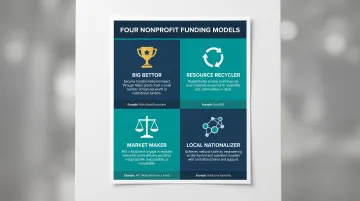
| Big Bettor | Secures major grants from a small number of wealthy individuals or foundations; requires alignment with funder priorities and tolerance for concentration risk | Conservation International, Stanley Medical Research Institute |
| Resource Recycler | Redistributes surplus in-kind corporate donations to people in need | AmeriCares, Greater Boston Food Bank |
| Market Maker | Fills gaps where market forces exist but for-profit delivery is legally or ethically inappropriate | Trust for Public Land, American Kidney Fund |
| Local Nationalizer | Scales nationally through locally funded chapters, balancing autonomy with brand consistency | Big Brothers Big Sisters, Teach for America |
The pattern across all these models is consistent: a 2024 study of 297 organizations that reached $50M+ found that more than 90% raised the bulk of their money from a single funding category. Choosing your primary model — and resisting the urge to diversify prematurely — is one of the highest-leverage decisions a nonprofit leader can make.
The Four Components of a Sustainable Nonprofit Business Model
Propel Nonprofits describes a healthy nonprofit financial model as four interdependent gears — move one and all others shift. Leaders should regularly assess all four to diagnose weaknesses and plan ahead for their next model. Each component below reveals a different pressure point worth examining.
Revenue Mix
Diversification is often the first instinct, but each new revenue type requires its own infrastructure, expertise, and relationships — effectively launching a new business. Most nonprofits manage one or two dominant revenue sources effectively. Spreading too thin creates instability rather than resilience.
Diagnostic questions matter:
- What is your dominant revenue source?
- How stable is it year-over-year?
- Can secondary sources scale with existing capacity, or do they require new staff, systems, and expertise?
Infrastructure and Expenses
Nonprofits often underinvest in administrative infrastructure to preserve program ratios, but cutting governance, financial management, and development capacity creates fragility. Personnel typically accounts for more than 60% of nonprofit expenses, so structural redesign often means rethinking roles, not just cutting headcount.
Over one-third of organizations reported zero fundraising costs on Form 990, a statistical impossibility that reflects the "starvation cycle": nonprofits underreporting overhead to satisfy donor expectations, then underfunding the very systems needed to grow sustainably.
This is precisely where fractional CFO engagements add structural value. A part-time financial executive — like the model One Abacus Advisory uses — provides executive-level financial leadership without the full-time overhead, helping organizations invest in infrastructure without inflating their cost base.
True Program Costs
The true cost of a program includes direct costs plus allocated shared costs: occupancy, technology, HR, accounting support. When programs are priced below true cost, the gap must be subsidized through unrestricted contributions or reserves.
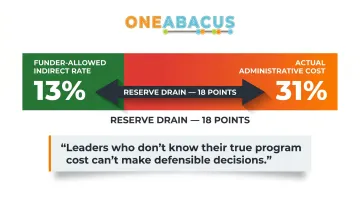
One Bridgespan client discovered they were spending 31% of a grant's value on administration while the funder allowed only 13% for indirect costs. That 18-point gap was quietly draining reserves. Leaders who don't know their true program cost can't make defensible decisions about which programs to grow, maintain, or exit.
Capital Structure
Nonprofits build capital slowly through surpluses, campaigns, and donations, but many have assets tied up in buildings or restricted endowments with little actual liquidity. Unrestricted working capital is essential for financial flexibility and strategic investment.
Key questions:
- What are your two largest assets — are they liquid?
- How much cash is readily available in unrestricted funds?
- Could you operate for three months without new revenue?
Financial Benchmarks and Rules Every Nonprofit Leader Should Know
Certain financial benchmarks help nonprofit leaders evaluate their model's health and communicate credibly with boards and funders. None are absolute, but each one tells a story about organizational risk.
Operating reserves: The Council of Nonprofits recommends maintaining 3-6 months of operating expenses in reserve. Yet 52% of nonprofits have 3 months or less cash on hand, and 18% have one month or less. Organizations below this threshold face vulnerability during funding gaps or economic downturns.
Program expense ratio: Funders and watchdog organizations like Charity Navigator evaluate what percentage of total expenses go directly to programs versus administration and fundraising. BBB Wise Giving Alliance recommends spending at least 65% of total expenses on program activities. Chasing favorable ratios by underfunding infrastructure creates long-term risk — the starvation cycle in action.
Revenue concentration risk: 44% of nonprofits report mid-stream changes to government contracts, including cuts to agreed-upon payments — a reminder of what happens when any single source dominates your revenue mix. The largest nonprofits may have achieved scale through concentration, but for most organizations, losing a dominant funder is an existential threat.
Cash flow and liquidity: Track months of cash on hand and distinguish between restricted and unrestricted funds. Only 36% of nonprofits received more than half of their funding as unrestricted in FY2021. An organization can look financially healthy on paper while struggling to cover payroll — because restricted funds can't fill unrestricted gaps. Knowing your liquidity position, not just your fund balance, is what keeps operations stable.
Here's how these four benchmarks compare at a glance:
| Benchmark | Standard / Target | Common Risk |
|---|---|---|
| Operating reserves | 3–6 months of expenses | 18% of nonprofits hold ≤1 month |
| Program expense ratio | ≥65% to programs | Underfunding infrastructure (starvation cycle) |
| Revenue concentration | No single source dominant | Gov't contract cuts mid-stream |
| Unrestricted cash | >50% of funding unrestricted | Liquidity crises despite healthy balance sheet |
Funding Strategy Best Practices for Long-Term Sustainability
Match model to mission and growth stage: Smaller nonprofits can raise flexibly from multiple sources, but as organizations scale, they must identify and invest in a primary funding model aligned with their mission and the decision-makers who control relevant funding pools. Trying to run multiple funding models without focus is a common cause of stagnation.
Build scenario-based forecasts: Effective financial planning goes beyond an annual budget. Organizations should develop conservative, moderate, and optimistic projections that model the financial impact of programming decisions, funding changes, and economic shifts. This gives boards and leadership a shared framework for proactive decision-making — not reactive responses to surprises. One Abacus Advisory helps nonprofit clients build these forecasts, translating complex financial data into board-ready insights that strengthen governance.

Invest in financial leadership proportional to complexity: As nonprofit financial models grow more complex — mixing grants, government contracts, earned income, and major gifts — organizations need strategic financial leadership to manage them. 36% of nonprofits ended 2024 with an operating deficit, the highest in 10 years of survey data, and 86% cited inflation as an operational impact.
For many nonprofits, a fractional CFO is the right-sized solution: the expertise of a seasoned finance executive without the overhead of a full-time hire. One Abacus Advisory's fractional CFO services are tailored to nonprofits navigating growth, transitions, or model changes — providing the financial clarity that boards and donors rely on.
Frequently Asked Questions
What are the funding models for nonprofits?
Nonprofit funding models fall into four broad categories: individual donor-driven, government-funded, foundation and corporate-supported, and mixed models. The right fit depends on your mission, your organization's scale, and which decision-makers control the funding you're best positioned to pursue.
What are common financial rules and benchmarks for nonprofit financial models?
Key benchmarks include maintaining 3-6 months of operating expenses in reserves, spending at least 65% of expenses on programs, limiting reliance on any single funding source to reduce concentration risk, and tracking months of unrestricted cash on hand. These metrics help leaders evaluate financial health and communicate credibly with boards.
How do nonprofits achieve financial sustainability?
Sustainability starts with matching your primary funding model to your mission and maintaining adequate reserves. From there, understanding the true cost of programs — including overhead — and investing in financial leadership ensures you can grow without outpacing your infrastructure.
What is revenue diversification for nonprofits and why does it matter?
Revenue diversification reduces dependency on any single funding source, protecting against sudden funding loss. That said, each revenue type requires its own infrastructure, expertise, and relationships — so adding sources indiscriminately creates operational strain. One or two well-chosen secondary streams typically offer the best balance of resilience and focus.
How do you know when your nonprofit needs a CFO?
Signs include growing complexity across revenue streams, difficulty producing accurate forecasts, board concerns about financial transparency, preparing for significant funding or audits, or navigating a leadership transition. A fractional CFO is often the most practical solution for mid-size nonprofits, providing executive-level expertise without full-time overhead.