Introduction
Nonprofits operate in an increasingly complex environment where mission clarity, program growth, and stakeholder alignment all demand senior-level strategic thinking. Yet most organizations face a critical gap: 49% of nonprofits operate without a written strategic plan, according to research cited by Funding for Good. Meanwhile, 74.6% of nonprofits reported job vacancies, with 66.3% identifying budget constraints as a primary barrier to hiring, according to the National Council of Nonprofits' 2023 Workforce Survey.
The structural dilemma is straightforward: boards provide governance but lack operational strategy expertise, while executive directors are consumed by daily operations, fundraising, and compliance. No one owns long-term strategic direction. The cost shows up quickly:
- Mission drift as programs expand without a coherent framework
- Reactive decision-making driven by funding cycles instead of organizational goals
- Stalled program growth from misaligned priorities
- Diminished funder confidence when strategy can't be clearly articulated
This guide covers what a fractional Chief Strategy Officer (CSO) does in the nonprofit context, the benefits they deliver, signs your organization needs one, and how to hire the right person.
Key Takeaways
- Fractional CSOs provide part-time strategic leadership to nonprofits without full-time executive costs
- Core responsibilities include strategic planning, program evaluation, board alignment, and growth initiatives
- Best fit for small-to-mid-sized nonprofits that need strategic direction without the cost of a full-time C-suite hire
- Ongoing embedded partners who grow with your organization over time
What Is a Fractional Chief Strategy Officer for Nonprofits?
A Fractional Chief Strategy Officer is an experienced strategy executive who works with a nonprofit part-time or on retainer—bringing executive-level strategic planning and leadership without the cost of a full-time hire.
The CSO Title (and Why It Matters for Nonprofits)
In for-profit contexts, "CSO" sometimes refers to a Chief Sales Officer or Chief Sustainability Officer. For nonprofits, it means Chief Strategy Officer: the person responsible for organizational strategy, mission alignment, and long-term direction.
That distinction matters when you're hiring. Make sure the role is scoped around planning and mission-level decisions, not sales pipelines or environmental reporting.
Fractional vs. Consulting: A Critical Difference
A strategy consultant delivers a report and moves on. A fractional CSO embeds in your leadership team—attending board meetings, guiding decisions through uncertainty, and adjusting strategy as your organization evolves. The relationship spans months or years, not weeks.
How the Fractional CSO Fits into a Nonprofit Executive Team
Many nonprofits build a full leadership bench by combining fractional roles at the right scale:
| Role | Primary Focus |
|---|---|
| Fractional CSO | Long-term strategy and mission alignment |
| Fractional CFO | Financial planning, compliance, and sustainability |
| Fractional COO | Day-to-day operations and infrastructure |
Firms like One Abacus Advisory specialize in fractional financial leadership for nonprofits, often pairing with fractional CSOs to make sure strategic direction is grounded in financial reality.
Typical Engagement Structure
- 8–20 hours per week, depending on organizational complexity
- Engagements run from defined 6-month planning cycles to multi-year retained relationships
- Best fit: small-to-mid-sized nonprofits, organizations in transition, and those scaling programs or entering new funding stages
Why Nonprofits Need Strategic Leadership — But Can't Always Afford It Full-Time
Nonprofits face a structural funding squeeze. While overhead budgets and leadership compensation needs have risen to compete with the for-profit sector, philanthropic funding has remained largely flat. According to the National Council of Nonprofits, 70.5% of nonprofits anticipated charitable giving would decrease or remain flat, while 72.2% identified salary competition as a recruitment barrier.
The Overhead Constraint
Research from the Ford Foundation and BDO found that financially healthy nonprofits operate with a 29% indirect cost rate per grant—yet many foundations historically limited indirect cost coverage to just 5%, 10%, or 15%. Over a decade, only 1% or less of foundation grants aimed at investing in grantee staff, according to a Fund the People study.
The Leadership Gap
- Boards: Composed of volunteers with governance responsibilities, not operational strategy expertise
- Executive Directors: Consumed by day-to-day operations, fundraising, compliance, and crisis management
- Result: No dedicated owner of long-term strategic thinking
When no one owns strategy, the organization pays for it — in drift, in missed opportunities, and in funder confidence. The costs show up across the organization:
- Mission drift as opportunities dictate direction rather than intentional planning
- Reactive decision-making without a shared roadmap
- Inability to scale programs strategically
- Loss of funder confidence when impact questions can't be answered
- Difficulty attracting or retaining senior talent
The Growing Shift Toward Fractional Leadership
Post-pandemic, nonprofits have reorganized leadership teams, and the fractional model has evolved from an interim solution to a board-approved, sustainable staffing approach. Writing in Forbes Business Council, Larry Bomback notes that funders are increasingly favoring lean, strategic leadership structures — ones that produce cleaner reporting, stronger strategy, and better outcomes per dollar.
What Does a Fractional CSO Do for a Nonprofit?
Strategic Planning and Mission Alignment
The fractional CSO's primary responsibility is owning the organization's multi-year strategic plan. This includes:
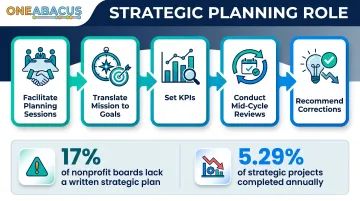
- Facilitating planning sessions with board and staff
- Translating mission into measurable goals
- Ensuring every major initiative anchors to organizational purpose, not opportunistic funding
- Setting KPIs tied to programmatic and organizational outcomes
- Conducting mid-cycle reviews and recommending course corrections
BoardSource recommends a strategic planning cycle of 3 to 5 years, with annual reviews to stay agile. Yet 17% of nonprofit boards still lack a written strategic plan, and just 51% of board members report a "very good" understanding of their organization's programs.
A fractional CSO tracks whether the plan is producing intended outcomes, identifies when priorities shift, and adjusts the roadmap accordingly. This prevents the common nonprofit problem of completing only 5.29% of strategic projects each year—less than half the cross-sector average.
Program Evaluation and Growth Strategy
A fractional CSO evaluates existing programs through frameworks like theory of change:
- Assessing whether current programs produce intended outcomes
- Identifying where to invest, scale, sunset, or redesign initiatives
- Making evidence-based recommendations for resource allocation
According to the Annie E. Casey Foundation, theory of change serves as a roadmap for social change, making explicit the assumptions about how change unfolds and ensuring every initiative contributes to a bigger goal.
Critical growth questions—when to expand geographically, launch new programs, build partnerships, or pursue mergers—require more than gut instinct. A fractional CSO uses program data and stakeholder input to inform these decisions, preventing mission drift and keeping growth sustainable.
Board and Stakeholder Strategy Support
Translating program evaluation into board-level insight is where strategy either takes hold or stalls. A fractional CSO bridges that gap by keeping governance and external relationships anchored to the same strategic direction.
Board-Level Strategic Governance:
- Presenting data-informed updates at board meetings
- Facilitating board retreats focused on strategic direction
- Helping directors understand their role in strategy vs. operations
- Building shared vision between leadership and volunteers
External Stakeholder and Funder Strategy:
- Developing messaging around impact
- Aligning grant applications with strategic priorities
- Building coalition or partnership strategies that expand organizational reach
- Creating funding diversification strategies
This work directly addresses the gap where only 53% of nonprofit leaders believe grantmakers understand their challenges, despite 93% of grantmakers believing they do, according to the Center for Effective Philanthropy.
Key Benefits of Hiring a Fractional Chief Strategy Officer
Cost Efficiency
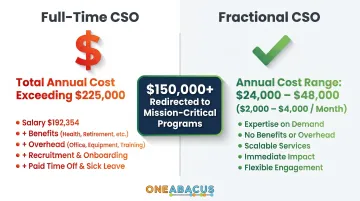
The average full-time Chief Strategy Officer salary is approximately $192,354 per year for nonprofits, according to Indeed. Add benefits, onboarding, and overhead, and the total cost often exceeds $225,000 annually.
By contrast, fractional engagements typically range from $2,000–$4,000 per month for 10–20 hours of strategic time, allowing nonprofits to redirect $150,000+ toward mission-critical programs.
Cross-Sector Expertise
That cost difference buys more than just strategic hours. A fractional CSO working across multiple nonprofits simultaneously brings pattern recognition that's hard to build internally. They've seen what works at food banks, performing arts organizations, public health nonprofits, and others facing similar crossroads—and apply those lessons in ways a leader promoted from within the organization often can't.
Scalability and Flexibility
Fractional engagements can expand during high-demand periods:
- Strategic planning cycles
- Capital campaigns
- Leadership transitions
- Major funding changes
They scale back during stable operations, unlike a full-time hire at a fixed cost structure.
Signs Your Nonprofit Needs a Fractional Chief Strategy Officer
Your organization likely needs a fractional CSO if you're experiencing these signals:
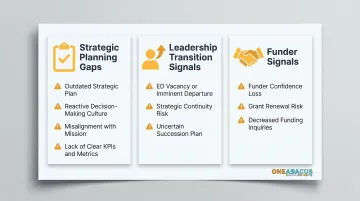
Strategic Planning Gaps:
- Strategic plan hasn't been updated in more than three years
- Staff and board make decisions reactively rather than from a shared roadmap
- Program growth is stalled or happening without clear prioritization
- 48% of nonprofit leaders spend less than a day per month on strategy, according to 48% of nonprofit leaders spend less than a day per month on strategy, according to Harvard Business School research cited by Funding for Good
Leadership Transition Signals:
- Executive director vacancy or board turnover has left a strategic gap
- No one is actively holding the organization's long-term direction during the leadership change
- Median nonprofit ED tenure is only 5–7 years, and replacement costs run 50%–200% of annual salary (BoardSource and SHRM), making strategic continuity during transitions essential
Funder Signals:
- Key funders are asking harder questions about impact, sustainability, or long-term direction
- The organization struggles to answer those questions with confidence
- Grant renewals are at risk when funders lose confidence in strategic clarity
If several of these signals sound familiar, a fractional CSO can provide the strategic structure your organization needs without the cost of a full-time hire.
How to Find and Hire a Fractional Chief Strategy Officer for Your Nonprofit
Step 1: Define Scope Before Searching
Before beginning your search, answer these questions:
- What strategic problems need solving? (e.g., plan development, program evaluation, board alignment)
- How many hours per week are needed?
- What's the budget range?
- What does success look like at 6 and 12 months?
Answering these upfront prevents scope creep and wasted interview cycles later.
Step 2: Prioritize the Right Credentials and Experience
Look for candidates with:
- Direct nonprofit sector experience (not just for-profit strategy backgrounds)
- Familiarity with nonprofit governance structures
- Experience facilitating board-level strategic planning
- Expertise in your mission area (arts, health, human services, etc.)
- Strong references from comparable nonprofit clients
Step 3: Consider a Complementary Fractional Leadership Structure
Strategic plans stall without financial infrastructure to back them up. A fractional CSO sets organizational direction while a fractional CFO ensures the budget actually supports it — two roles that work in tandem.
When building this kind of complementary team, look for a financial partner with deep nonprofit experience. One Abacus Advisory, for example, has worked with organizations like the San Diego Food Bank and Philadelphia Zoo on financial oversight during periods of growth and transition. A partner like that can ensure your strategic goals are grounded in financial reality from day one.
The financial leadership role in this structure typically covers:
- Budgeting tied directly to strategic priorities
- Board-ready financial reporting that tracks plan progress
- Compliance and audit readiness as programs scale
- Cash flow forecasting to support new initiatives
Frequently Asked Questions
What is a fractional CSO?
A fractional CSO is a part-time or retained Chief Strategy Officer who provides senior-level strategic planning and leadership to an organization without a full-time commitment. In the nonprofit context, CSO most often refers to Chief Strategy Officer rather than Chief Sales or Sustainability Officer.
What is a fractional COO for a nonprofit?
A fractional COO manages a nonprofit's day-to-day operations on a part-time basis. This role focuses on operational execution, infrastructure strengthening, and workflow management—distinct from a fractional CSO, which focuses on long-term strategic direction rather than operational implementation.
How much does a fractional CEO cost?
Fractional nonprofit executives typically cost $2,000–$4,000 per month for 10–20 hours of strategic time. That's a fraction of a full-time executive salary and benefits package, which often exceeds $200,000 annually.
What is a mission-driven organization?
A mission-driven organization prioritizes advancing a social, cultural, or community purpose over generating profit. Strategic leadership is especially critical for these organizations since every decision should align resources with mission impact, not revenue maximization.
What is an example of a mission-driven organization?
Well-known mission-driven nonprofits include Feeding America (hunger relief), Habitat for Humanity (affordable housing), and the Kennedy Center for the Performing Arts (cultural programming). Each operates under complex funding constraints and stakeholder demands that benefit from senior strategic leadership.
How long does a fractional CSO engagement typically last for a nonprofit?
Engagements range from a defined project—such as a 6-month strategic planning cycle—to an ongoing retained relationship spanning multiple years. Many nonprofits start with a scoped engagement and extend it as organizational needs evolve.