This guide covers the legal duties behind financial oversight, what effective oversight looks like in practice, the specific role of the finance committee, which metrics boards should track, and when to bring in outside fractional financial leadership.
TLDR — Key Takeaways
- Every board member—regardless of background—holds fiduciary responsibility for the nonprofit's financial health
- Three legal duties (Care, Loyalty, Obedience) define the foundation of board oversight under state nonprofit law
- Active oversight means reviewing budgets, financial statements, compliance filings, and internal controls—not just at annual reviews, but consistently
- Finance committees lead deeper review, but full-board accountability cannot be delegated away
- Nonprofits lacking in-house financial leadership should consider fractional CFO support to build clear, board-ready financial reports
Why Nonprofit Financial Oversight Requires a Higher Standard
Nonprofits differ structurally from for-profit businesses: there are no private owners. The organization belongs to the public, funded by donations and grants. All surplus must be reinvested toward the mission, which is why the IRS grants tax-exempt status—and why oversight obligations are heightened. According to the National Council of Nonprofits, "Board members are the fiduciaries who steer the organization towards a sustainable future by adopting sound, ethical, and legal governance and financial management policies, as well as by making sure the nonprofit has adequate resources to advance its mission."
Without an owner to self-police, the board is the primary accountability mechanism—and when boards fail to engage, the consequences are concrete: misuse of restricted funds, compliance violations, and Form 990 inaccuracies that trigger IRS scrutiny, donor distrust, and reputational harm.
Disengaged oversight also creates the conditions where fraud takes hold. Nonprofits represented 9% of occupational fraud cases globally, with a median loss of $75,000 per case and an average of $639,000. When executives commit the fraud, the median loss climbs to $250,000.
The Three Legal Duties Every Board Member Carries
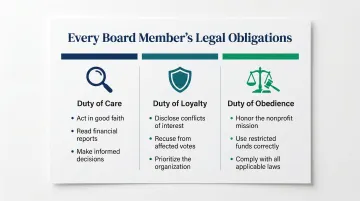
Every nonprofit board member—regardless of financial background—carries three legal duties under state nonprofit law: Duty of Care, Duty of Loyalty, and Duty of Obedience. Understanding what each requires in practice is the starting point for sound financial governance.
Duty of Care
The Duty of Care requires board members to act in good faith, with reasonable diligence, and in the best interest of the organization. Practically, this means:
- Reading financial reports before every meeting
- Attending regularly and asking substantive questions
- Making decisions based on information, not assumptions
Breaches include excessive absences or making decisions without understanding relevant information.
Duty of Loyalty
The Duty of Loyalty requires board members to put the organization's interests above personal or outside interests. From a financial lens, this means:
- Disclosing conflicts of interest
- Recusing yourself from affected votes
- Never authorizing transactions that personally benefit you or your business
Breaches include hiring a board member's company without disclosure or competitive bidding, or allowing family to use organizational space rent-free.
Duty of Obedience
The Duty of Obedience requires the board to ensure the organization stays true to its stated mission and legal obligations. Financially, this means:
- Ensuring funds are spent in alignment with the mission
- Honoring donor intent and using restricted grant funds only for designated purposes
- Complying with federal, state, and local laws
Breaches include spending a restricted donation on a different project or knowingly allowing safety or compliance violations to persist.
Lack of financial expertise does not reduce these obligations. A board that delegates all oversight to the Treasurer—without independent review or substantive engagement—leaves itself exposed if financial problems surface. Each member carries personal liability, which means collective engagement with financial matters isn't optional.
What Financial Oversight Actually Looks Like in Practice
Financial oversight is an ongoing board responsibility, not a one-time task. It rests on three pillars: policy development, financial sustainability, and compliance.
Policy Development and Internal Controls
The board is responsible for establishing and monitoring key financial policies that create guardrails against fraud and misuse:
- Conflict of interest policy with annual disclosure and enforcement
- Whistleblower policy allowing confidential reporting of financial impropriety
- Document retention and destruction policy covering integrity and archiving
- Investment policy governing how funds are managed
- Operating reserve policy defining target reserve levels
- Segregation of duties ensuring no single person controls all aspects of financial transactions
The IRS explicitly asks about these policies on Form 990 Part VI, including whether the organization has a written conflict-of-interest policy, whether it requires annual disclosure, and how it monitors and enforces compliance.
Budget Oversight and Financial Sustainability
The board must review and approve the annual operating budget, not rubber-stamp management's numbers. Ask substantive questions:
- Are revenue assumptions realistic given current funding environment?
- How are expenses allocated across programs vs. overhead?
- Does this budget align with our strategic goals?
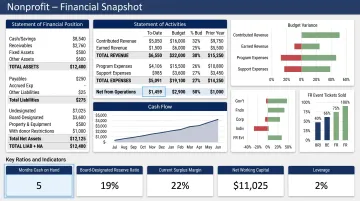
Review financial statements at every meeting. Challenge variances that lack clear explanations.
The numbers make the case for vigilance: according to the NFF 2025 State of the Nonprofit Sector Survey, 52% of nonprofits have three months or less of cash on hand, and 36% ended 2024 with an operating deficit, the highest rate in 10 years of survey data. Active liquidity monitoring isn't optional — it's a board's frontline defense against organizational crisis.
Compliance and Annual Filings
Strong budget oversight sets the foundation for compliance. The board must review and approve the IRS Form 990 before it is filed — this responsibility belongs to the full board, not management alone. The 990 is a public document that signals financial health and governance quality to donors, regulators, and the public. Charity Navigator and other watchdogs scrutinize 990s when rating organizations.
If your nonprofit requires an independent audit (based on revenue thresholds or funder requirements), the board should be directly engaged with the audit firm—not passively receiving the final report.
Minimum financial review every board member should perform:
- Review the annual 990 before filing
- Review the annual audit report (if applicable)
- Review periodic financial statements at each board meeting — track trends, flag anomalies, and hold management accountable for unexplained variances
The Finance Committee: Leading Deeper Financial Scrutiny
The finance committee leads deeper review and acts as the bridge between management and the full board—but it does not replace full-board accountability. Finance committee findings must always be brought back to the entire board for discussion.
Specific finance committee responsibilities:
- Reviewing financial statements in detail each month (not just summaries)
- Developing and monitoring financial KPIs
- Conducting detailed preliminary review of the annual budget before full board approval
- Spearheading communication with external auditors
According to a 2015 BoardSource survey, 80% of nonprofits report having finance committees, but only 24% have separate audit committees.
The Audit Committee's Distinct Role
The audit committee provides independent oversight of financial reporting and serves as the primary liaison to external auditors. Its core responsibilities include:
- Monitoring internal controls and flagging weaknesses
- Reviewing financial statements for accuracy and completeness
- Overseeing the external audit process, free from management influence
- Serving as the designated body for financial complaints under the organization's Whistleblower Policy
The National Council of Nonprofits emphasizes that "to ensure that the audit process is free from interference or influence by management," audit committee members should be independent of the nonprofit's management.
That said, smaller nonprofits may combine finance and audit functions under one committee. The key independence principle—that the committee operates separately from management—must still be preserved regardless of structure.
Key Financial Metrics Every Board Member Should Track
Board members don't need to read every line of a financial statement. What matters is tracking the right indicators — and knowing what to ask when the numbers look off. These five metrics should appear at every board meeting:
Operating Reserve Ratio
- Months of operating expenses covered by unrestricted cash
- Target: 3–6 months
- The NFF 2025 Survey found 52% of nonprofits hold three months or less of cash, and 18% hold one month or less. Thin reserves create real existential risk when a major funder pulls back.
Program Expense Ratio
- Percentage of total spending going directly to programs vs. overhead
- Target: Charity Navigator expects 70%+; BBB Wise Giving Alliance recommends 80%
- Donors and funders use this ratio to assess whether spending reflects the mission.
Revenue Diversification
- Dependence on any single funder or revenue stream
- Target: No single funder should exceed ~30% of total revenue
- The NFF 2025 Survey found 84% of nonprofits receiving government funding expect cuts — concentration in a single source is a structural vulnerability boards need to see clearly.
Current Ratio
- Current assets divided by current liabilities; target is 1.0 or higher. A ratio below 1.0 means the organization may struggle to meet near-term financial obligations.
Budget-to-Actual Variance
- Are revenues and expenses tracking to plan? Large unexplained variances signal forecasting gaps or management issues that warrant a direct conversation with staff.
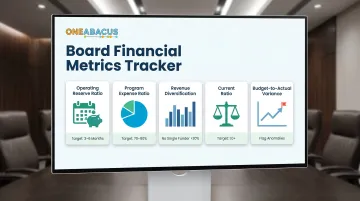
Present these metrics visually and consistently at each meeting. If management delivers numbers without trend comparisons or plain-language context, boards should ask for both.
When to Bring in Fractional Financial Leadership
Many nonprofits face a governance gap: boards are expected to provide robust financial oversight, but smaller or mid-size nonprofits often lack a qualified CFO on staff to prepare the right reports, build internal controls, or translate financial data into strategic language the board can use.
According to Lucido Data analysis of 36,799 Form 990 filings, median nonprofit CFO total compensation is $88,923 overall, but ranges from just $13,240 for organizations under $1 million in revenue to $280,000 for organizations over $100 million. Small-to-mid-size nonprofits cannot afford a full-time CFO at market rates—but they still need that expertise.
A fractional CFO fills this gap by providing the financial infrastructure, reporting frameworks, and strategic guidance boards need to do their jobs effectively — at a cost appropriate for the organization's size. Firms like One Abacus Advisory specialize in fractional CFO and COO services built specifically for nonprofits, helping boards at organizations like the San Diego Food Bank, Laguna Playhouse, and Philadelphia Zoo gain clear, actionable financial visibility.
During the Philadelphia Zoo's leadership transition, One Abacus provided interim CFO support, optimized their NetSuite environment, and improved board reporting — giving the organization stable financial footing through a period of significant change.
Fractional CFO services typically include:
- Board-ready financial reporting and KPI dashboards
- Audit preparation and compliance support
- Internal controls setup and monitoring
- Finance committee support and presentation
- Cash flow forecasting and scenario modeling
- Budget development and variance analysis

For boards navigating budget constraints, leadership transitions, or rapid growth, fractional financial leadership offers a practical path to the oversight infrastructure nonprofits need — without committing to a full-time hire before the organization is ready.
Frequently Asked Questions
What are the financial responsibilities of a nonprofit board of directors?
Nonprofit boards must approve annual budgets, review financial statements at every meeting, ensure compliance with tax and regulatory requirements, oversee internal controls, and ensure all spending aligns with the mission. These responsibilities apply to every board member, not just the Treasurer.
Do nonprofit board members have fiduciary responsibilities?
Yes. All board members carry fiduciary responsibility under three legal duties: Care, Loyalty, and Obedience. Professional background does not exempt anyone — these duties apply regardless of role or expertise.
What are the three legal responsibilities of a nonprofit board?
- Duty of Care: Acting with reasonable diligence and informed judgment
- Duty of Loyalty: Placing the organization's interests above personal ones and disclosing conflicts
- Duty of Obedience: Ensuring the organization follows its mission, bylaws, and applicable laws
Who holds a nonprofit board accountable?
Nonprofit boards answer to the IRS (via Form 990 compliance), state attorneys general, funders, donors, and the general public. Nonprofits are considered public trusts, so accountability extends well beyond internal stakeholders.
What should a committee on board oversight do for a nonprofit?
A finance or audit committee handles deeper monthly financial review, develops financial policies, coordinates with external auditors, monitors internal controls, and brings recommendations to the full board. The committee supports board accountability — it doesn't replace it.
What are the 7 functional responsibilities of a nonprofit board?
The commonly cited responsibilities are: determining mission and purpose, supporting executive leadership, ensuring financial health, providing strategic planning input, ensuring legal and ethical integrity, building the board itself, and serving as an ambassador for the organization.