Introduction
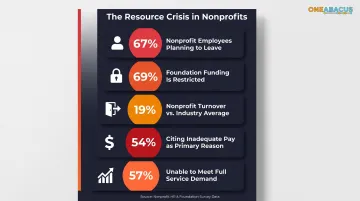
Passion drives nonprofit work, but it rarely delivers projects on time or on budget. According to the Nonprofit Finance Fund's 2024 survey, 57% of nonprofits cannot meet the full demand for their services, with 76% reporting increased demand over the past two years. The pressure comes from multiple directions: lean teams, strict grant deadlines, volunteer coordination, and restricted funding that locks down flexibility precisely when you need it most.
Understaffing compounds the problem: 59% of nonprofits report significantly more difficulty filling positions than in prior years, and sector turnover sits at 19% compared to 12% elsewhere. For-profit organizations can often bend timelines and redirect resources when projects slip. Nonprofits typically cannot — grant requirements are fixed, and the staff to absorb the slack often isn't there.
These constraints don't make strong project management impossible — they make it essential. This guide provides a practical framework built around how nonprofits actually operate. You'll learn how to set clear goals, assign roles effectively, control budgets, communicate with stakeholders, and manage risks within the funding and staffing realities your organization faces.
Why Nonprofit Project Management Is Different
Nonprofit project management doesn't fit neatly into corporate frameworks designed for revenue targets and stable budgets. Mission-driven organizations measure success differently—not in profit margins, but in outcomes like meals served, youth mentored, or policy changes achieved. This fundamental shift requires rethinking how projects are planned, executed, and evaluated.
Structural Differences That Matter:
- Success means demonstrating impact to funders—meals served, lives changed—not maximizing shareholder value
- Volunteers and part-time staff replace reliable full-time headcount, making capacity planning unpredictable
- Donor-imposed restrictions dictate exactly how money can be spent, limiting financial flexibility mid-project
The National Council of Nonprofits reports that nonprofits earn more than 80% of their revenue through fees for services (49%) and government grants (32%). This means project budgets aren't discretionary—they're predetermined by external funders with compliance requirements that create risk if violated.
Compounding Resource Constraints:
Nonprofits operate under pressure that for-profit project managers rarely face:
- 67% of nonprofit employees are actively looking for new jobs or planning to leave within a year, per Candid's 2024 survey
- 69% of nonprofits report most foundation funding is restricted to specific programs, leaving little room to reallocate when plans change
- Communities expect immediate crisis response even when projects are already underway—scope creep is often unavoidable
- At 19%, nonprofit turnover is well above the 12% rate in other sectors, creating knowledge gaps mid-project
- 54% of employees cite inadequate pay as a reason for leaving, making consistent staffing a recurring challenge
What Qualifies as a "Project" in Nonprofit Settings
A project is a defined initiative with a clear start point, end point, and specific deliverables—distinct from recurring operations like weekly food distributions or monthly donor outreach.
Common nonprofit project examples:
- Launching a new youth mentorship program with defined curriculum and enrollment targets
- Running a capital campaign to raise $500,000 by year-end
- Overhauling your website to improve donor engagement
- Implementing a new donor management system across all departments
- Conducting a program evaluation to measure three-year outcomes
Treating these as formal projects—rather than ongoing work—creates accountability, clarifies roles, and keeps deliverables on track.
Building a Nonprofit Project Planning Framework
Strong project management starts with structure. High-performing nonprofits use a clear hierarchy that connects big-picture strategy to daily tasks, so every team member can see how their daily work connects to the mission.
The Project Hierarchy Framework
Strategy → Programs/Plans → Projects → Milestones → Tasks
This five-level hierarchy ensures alignment from board-level strategy down to individual to-do lists:
- Strategy - Your organization's 3-5 year strategic plan
- Programs/Plans - Major initiatives that advance strategic goals (e.g., "Youth Employment Program")
- Projects - Time-bound efforts within programs (e.g., "Launch summer job training cohort")
- Milestones - Key checkpoints that mark phase completion (e.g., "Curriculum finalized by June 1")
- Tasks - Individual action items assigned to specific people (e.g., "Draft week 1 lesson plans")
Skipping levels creates chaos. When tasks connect directly to strategy without intermediate layers, teams lose context. When projects launch without clear milestones, progress becomes impossible to track. The hierarchy keeps everyone oriented toward the same outcomes.
Setting SMART Objectives for Nonprofit Projects
SMART goals (Specific, Measurable, Achievable, Relevant, Time-bound) work for nonprofits, but you must distinguish between three types of results:
- Outputs — Direct products of your activities (workshops held, meals served, brochures distributed)
- Outcomes — Changes in participant behavior, knowledge, or condition (students improving reading levels, families achieving food security, community members voting)
- Impact — Long-term systemic change (reduced poverty rates, policy reform, cultural shifts)
Track all three. Outputs prove you did the work. Outcomes show it worked. Impact demonstrates lasting change. Funders increasingly demand outcome and impact data, not just output counts.
Example SMART objective: "Train 100 unemployed youth (ages 18-24) in job readiness skills, with 70% securing employment or enrolling in college within six months of program completion by December 31, 2026."
Role-Clarity Frameworks: MOCHA, RACI, and DID
Confusion about who does what kills projects. Role-clarity frameworks eliminate overlap and ensure accountability.
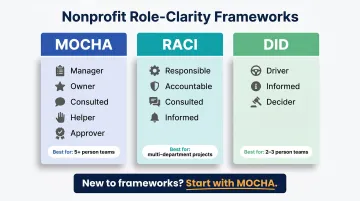
MOCHA Framework:
Developed by The Management Center, MOCHA assigns five roles:
- Manager - Supervises the Owner and provides support
- Owner - Personally responsible for completion (one person only)
- Consulted - Provides input before decisions are made
- Helper - Assists the Owner with specific tasks
- Approver - Reviews and signs off on deliverables
Best for: Medium to large nonprofits with 5+ people involved in a project, or when clarifying "invisible labor" is important for equity.
RACI Framework:
A classic project management tool assigning four roles:
- Responsible - Does the work
- Accountable - Ultimately answerable for completion (one person only)
- Consulted - Provides expertise or input
- Informed - Kept updated on progress
Best for: Complex projects with multiple departments or external partners requiring formal accountability.
DID Framework:
A simplified alternative for small teams:
- Driver - Owns the work
- Informed - Stays updated
- Decider - Makes final calls
Best for: Small nonprofits with 2-3 people managing a project where formal frameworks feel excessive.
If you're new to role-clarity frameworks, MOCHA is the best starting point for most nonprofits — it explicitly names the Manager role, which prevents the common pattern of Owners being left unsupported when projects get complicated.
Mission Alignment Check: Protecting Against Scope Creep
Before greenlighting any project, run a mission alignment check. Stanford Social Innovation Review calls mission creep "the greatest threat to nonprofit organizations," noting that external and internal stakeholders can easily lead you astray.
Ask these questions before starting any project:
- Does this align with our current strategic plan?
- Is funding identified and secured (or realistically achievable)?
- Can we define measurable outcomes that prove success?
- Do we have the internal capacity to execute this well?
- Can results be sustained after the project ends, or will it create unsustainable expectations?
A "no" to any question is a red flag — and that includes fully funded opportunities.
SSIR's case study of the Rural Development Institute illustrates this precisely: RDI turned down a USAID contract because it fell outside their core mission. By staying focused on land rights for poor farmers, they helped 400 million people take ownership of 270 million acres — on a $2 million annual budget.
Milestones vs. Goals: Visual Tracking for Stakeholder Alignment
Goals define what you want to achieve. Milestones mark when you'll know you're on track.
- Goal: "Train 100 youth in coding by September 30"
- Milestones: "Curriculum finalized by May 15," "Instructor hired by June 1," "First cohort enrolled by July 1"
Milestones are checkpoints, not outcomes. They signal phase completion and trigger the next set of tasks.
Visual milestone tracking—through Gantt charts or timeline views—keeps all stakeholders (board, staff, funders, volunteers) oriented to project progress without requiring them to read detailed task lists. A quick glance shows whether you're on track, at risk, or off course.
Financial Management and Budget Control in Nonprofit Projects
Nonprofit financial management carries constraints that corporate budgets don't face. Restricted funds, funder compliance requirements, and multiple simultaneous grants all demand careful oversight — typically from a small finance team juggling many responsibilities.
Building a Project Budget from Scratch
Step 1: List all project activities - What needs to happen for this project to succeed?
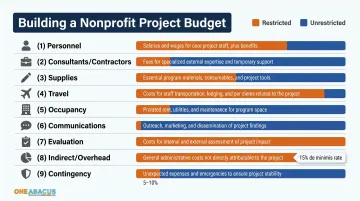
Step 2: Estimate costs across standard categories:
- Personnel — salaries and benefits for staff time (calculate hourly rates × estimated hours)
- Consultants/Contractors — external expertise such as trainers, evaluators, or designers
- Supplies — materials directly used in project delivery
- Travel — mileage, airfare, lodging for project-related trips
- Occupancy — rent and utilities (often calculated as a percentage allocation)
- Communications — phone, internet, printing, postage
- Evaluation — data collection, analysis, and reporting costs
- Indirect/Overhead — administrative costs not directly tied to activities (the de minimis rate is now 15% for nonprofits without negotiated rates)
- Contingency — reserve for unexpected costs (typically 5–10% of total)
Step 3: Document budget assumptions - For every line item, note how you calculated it. Funders scrutinize assumptions during grant reporting, and your successor will need this documentation when you leave.
Restricted vs. Unrestricted Funds: Compliance Fundamentals
Under FASB ASU 2016-14, nonprofits classify net assets into two categories:
Net Assets Without Donor Restrictions — unrestricted funds available for general use, including board-designated reserves (which boards can un-designate at any time)
Net Assets With Donor Restrictions — funds subject to donor-imposed stipulations limiting use by purpose, time, or requiring permanent maintenance (endowments)
Critical rule: Restricted funds must be spent exactly as donors specify. Misallocation is a compliance violation with serious financial and reputational consequences.
Create a fund allocation matrix at project start:
| Budget Line Item | Restricted Fund Source | Unrestricted Fund Source | Total |
|---|---|---|---|
| Program Manager Salary | Grant A: $30,000 | General Fund: $15,000 | $45,000 |
| Evaluation Consultant | Grant B: $10,000 | — | $10,000 |
This matrix ensures every expense codes to the correct funding source, preventing compliance violations before they happen.
Integrating Grant Timelines into Project Schedules
Grant deadlines aren't suggestions—they're contractual obligations. Build these directly into your project timeline:
- Grant start and end dates — hard boundaries for allowable expenses
- Interim reporting deadlines — when funders expect progress updates
- Final reporting deadlines — when you must submit outcomes and financial reports
- Data collection checkpoints — when you need to gather metrics for reports
- Budget modification windows — deadlines for requesting budget changes from funders
Build in a two-week buffer before every reporting deadline. This allows time for data gathering, internal review, and corrections without last-minute panic. Missing a reporting deadline can jeopardize future funding—even if your program outcomes are strong.
Tracking Project Expenses: Monthly Budget-vs-Actual Discipline
Best practices for ongoing expense tracking:
- Code every expense to both a budget line item and a funding source. Dual coding prevents misallocation and simplifies funder reporting.
- Generate budget-versus-actual reports monthly — don't wait until quarter-end or year-end to check spending.
- Flag variances early. Both overspending (burns through funds too fast) and underspending (may require returning unspent grant funds) create problems.
- Integrate financial tracking with progress reporting. If you're 50% through the timeline but only 30% through the budget, something needs explanation.
Many nonprofits don't have the in-house capacity for this level of financial rigor — particularly during growth periods or leadership transitions. A fractional CFO can embed this oversight without the cost of a full-time hire. One Abacus Advisory works with nonprofits in exactly these situations, helping teams maintain compliance and financial discipline across multiple funders.
Managing Stakeholders, Volunteers, and Communication
Different stakeholders need different information, delivered in different formats, at different frequencies. A single communication approach rarely works for all of them.
Stakeholder Communication Planning
Create a simple stakeholder communication matrix that documents:
| Stakeholder Group | Information Needed | Frequency | Format | Responsible Person |
|---|---|---|---|---|
| Board Members | Project status, key decisions needed, budget summary, risk flags | Monthly | One-page summary | Executive Director |
| Funders | Outcomes achieved, budget utilization, participant stories | Quarterly + final | Formal report per grant requirements | Program Director |
| Program Staff | Task assignments, deadline changes, resource availability | Weekly | Team meeting + email recap | Project Manager |
| Volunteers | Task instructions, mission connection, schedule updates | Before each shift | Email + in-person briefing | Volunteer Coordinator |
Different groups require different depths of detail. Your board shouldn't receive the same task-level updates that program staff need. Funders shouldn't receive internal operational updates meant for staff.
Board-Level Project Reporting: The One-Page Rule
Board members govern, they don't manage. They need strategic oversight, not granular task lists.
Effective board reports fit on one page and include:
- Current status in plain terms: on track, at risk, or off track (color coding works well)
- Specific decisions or approvals the board needs to make
- High-level budget snapshot — percentage of budget used versus timeline elapsed
- Top 2-3 risks that could derail the project
- A brief story connecting project progress to mission impact
If your board report doesn't fit on one page, it likely won't get read. BoardSource's Leading with Intent research found that boards score high on financial oversight but consistently struggle with long-term strategic planning. Concise, well-structured reports give them what they need to do both.
Volunteer Management Within Project Frameworks
75.7 million Americans formally volunteered through organizations between 2022 and 2023, but average volunteer hours dropped from 96.5 hours annually to 70 hours. You have more volunteers giving less time. That shift requires tighter coordination on your end.
Best practices for volunteer project management:
- Match tasks to skills during onboarding — not every volunteer can do every task
- Give defined time commitments: "Every Tuesday 2–4 PM for six weeks" is far clearer than "help when you can"
- Connect each task to mission impact, even routine ones like data entry or envelope stuffing
- Build recognition into the project cadence — don't save thank-yous for year-end events
- Track volunteer hours against the $36.14 per hour valuation rate for 2025 to demonstrate in-kind value to funders
Volunteers show up because of mission, not obligation. Clear expectations, reliable communication, and genuine recognition are what keep them coming back.

Communication Tactics That Strengthen Project Execution
Three habits strengthen day-to-day project communication:
- Time integrity: Start meetings on schedule, send agendas in advance, and honor committed deadlines
- Specificity: Replace vague terms ("soon," "ASAP") with concrete ones ("by Friday at 5 PM")
- Clear prioritization: Separate urgent tasks (deadline-driven) from important ones (high-impact) so reactive work doesn't crowd out strategic execution
Risk Management and Compliance
Nonprofits face a distinct risk landscape that corporate project managers rarely encounter. Understanding where those risks live — and having a plan before they materialize — is what separates resilient organizations from reactive ones.
Nonprofit-Specific Risk Categories
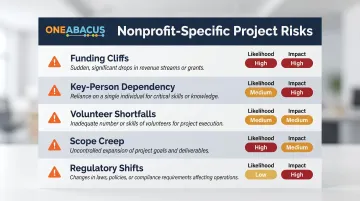
Funding cliffs are the most acute threat. According to the Urban Institute's 2026 research, between 60% and 86% of nonprofits receiving government grants would operate at a loss without that funding. Nearly 20% could run out of cash within three months of losing government support — putting 2.8 million jobs at risk.
Other high-priority risks include:
- Key-person dependency: When funder relationships or specialized knowledge live with one person, their departure can derail the project. Nonprofit turnover rates (around 19%) make this risk serious.
- Volunteer shortfalls: Unlike employees, volunteers can disappear without notice. Build backup coverage for any role that's essential to delivery.
- Scope creep from boards or funders: Well-meaning stakeholders suggest "small additions" that compound into major changes. Formal change control processes are your defense.
- Regulatory shifts mid-project: Government grant requirements can change after award. Monitor compliance throughout the project lifecycle, not just at kickoff.
- Reputational exposure: Program failures, data breaches, or financial mismanagement affect future funding directly. According to ACFE's Report to the Nations, nonprofits lose roughly 5% of annual revenue to occupational fraud, with a median loss of $76,000 per incident.
The Risk Register: A Practical Tool
Identifying risks is step one. Tracking them systematically is what keeps them from becoming crises. For each identified risk, document:
| Risk Description | Likelihood (Low/Med/High) | Impact Severity (Low/Med/High) | Mitigation Strategy | Contingency Plan | Owner |
|---|---|---|---|---|---|
| Key funder eliminates program after Year 1 | Medium | High | Diversify funding sources; cultivate 3 new prospects | Reduce program scale; use reserves to bridge gap | Development Director |
Review your risk register monthly. Risk profiles change as projects evolve — a low-probability risk in Month 1 might become high-probability by Month 6.
Building Compliance into Daily Operations
Compliance isn't an end-of-grant scramble. Build it into everyday habits:
- Save receipts in a central shared drive using clear, consistent naming conventions tied to project tasks
- Log volunteer hours in real time using the appropriate valuation rate — retroactive tracking is unreliable and auditors notice
- Record beneficiary data through standard intake forms so reporting stays consistent across staff and sites
- Maintain a change log documenting any scope, budget, or timeline modifications that could affect donor or funder reporting
Under OMB Uniform Guidance (2 CFR Part 200), nonprofits receiving $1 million or more in federal awards must undergo a single audit. That threshold increased from $750,000 in 2024, pulling thousands of additional organizations into scope.
The most common violations — misrepresenting how funds were spent, falsifying grant applications, failing to comply with grant conditions — share one thing in common: they're all preventable with disciplined daily habits rather than end-of-year scrambles.
Choosing the Right Project Management Tools
Technology can't fix poor leadership or weak communication, but the right tools reduce administrative friction and improve team visibility.
Nonprofit Discount Programs
Many popular project management platforms offer nonprofit pricing:
| Platform | Nonprofit Discount | Best For |
|---|---|---|
| Asana | 50% off paid plans | Task management and workflow automation |
| Monday.com | 10 free seats + 70% off additional | Visual project boards and collaboration |
| Trello | 75% off paid plans | Simple kanban boards for small teams |
| Basecamp | 10% off for 501(c)(3)s | All-in-one project communication |
According to NTEN's 2024 Digital Investments Report, 45% of nonprofits believe they're spending too little on technology, with budget constraints cited as the top barrier (77%). Nonprofit discounts make professional tools accessible.
Matching Methodology to Project Type
- Waterfall: Best for grant-funded projects with fixed scope and deadlines — such as producing a research report by a contracted delivery date
- Agile: Suits new program design where beneficiary feedback should shape outputs, such as piloting a service model with ongoing adjustments
- Kanban: Fits continuous operational programs without fixed end dates, such as managing a food pantry's day-to-day intake and distribution
Most nonprofits use a hybrid approach in practice: fixed overall structure (grant timeline and budget) with flexible internal execution (adapting activities based on what works).
Frequently Asked Questions
Do nonprofits have project managers?
Some larger nonprofits employ dedicated project managers, but most rely on program directors, operations staff, or executive leadership to manage projects. The project management function exists in nearly every nonprofit—the title often does not.
What is the management structure of a nonprofit organization?
Nonprofits typically operate with a board of directors providing governance, an executive director leading operations, and program or functional directors managing delivery. Project management layers on top of this structure, assigning temporary roles and accountabilities within specific initiatives.
What strategies can nonprofits use to build strong relationships with stakeholders?
Strong stakeholder relationships rest on four practices:
- Consistent communication tailored to each stakeholder group
- Impact reporting that shows outcomes, not just outputs
- Volunteer engagement with clear roles and expectations
- Transparent financial accountability
How are nonprofits using technology to improve operations?
Nonprofits increasingly rely on three categories of tools: project management software for task tracking and collaboration, financial systems for budget and compliance reporting, and donor management platforms. Many vendors offer nonprofit pricing or open-source alternatives to reduce cost barriers.
What are the biggest challenges in nonprofit project management?
The most common challenges include limited and restricted funding, high staff turnover and resulting knowledge loss, volunteer coordination complexity, competing organizational priorities, and the difficulty of measuring mission-driven outcomes rather than simple profit metrics.
What project management frameworks work best for nonprofits?
MOCHA provides cross-team clarity for medium-to-large projects, RACI defines accountability in complex initiatives, and DID works well for small teams of 2-3 people. The best framework is whichever one your organization consistently uses across all projects—inconsistent application undermines any framework's value.