Introduction
Nonprofit organizations are under unprecedented operational strain. 36% of nonprofits ended 2024 with an operating deficit — the highest in 10 years — while 85% expect service demand to increase in 2025. Meanwhile, 74.6% of nonprofits report job vacancies, with 51.7% experiencing more vacancies than before the pandemic. These pressures create a dangerous environment: growing program demand collides with tighter funding and leaner teams, forcing nonprofits to do more with less.
When resources are this stretched, operational tools can't be an afterthought. Nonprofit management systems get plenty of attention in software demos, but their real value shows up in the daily grind: grant tracking, financial close, board reporting, and compliance. This article examines the concrete, day-to-day improvements these systems create — and what they mean for organizations already running at capacity.
Key Takeaways
- Nonprofit management systems centralize financial data and give leadership real-time visibility into organizational capacity — replacing fragmented spreadsheets and manual workarounds
- Daily wins include faster financial reporting, fewer data errors, compliance readiness, and staff time redirected to mission-critical work
- Without these systems, nonprofits fall into reactive firefighting, inaccurate data, and missed compliance deadlines
- Systems deliver value when configured to your organization's needs and actively reviewed, not installed and forgotten
- Experienced nonprofit financial leadership helps organizations get faster, deeper value from these systems
What Is a Nonprofit Management System?
A nonprofit management system is any integrated platform or combination of tools — such as an ERP, fund accounting software, or CRM — used to manage financial, operational, and programmatic activities in one place. These systems replace fragmented spreadsheets and disconnected databases with a single source of operational truth.
Where these systems are typically applied:
- Fund accounting and restricted grant tracking
- Donor and fundraising management
- Grant compliance and reporting
- Payroll and HR administration
- Board-level financial dashboards
- Audit preparation and regulatory compliance
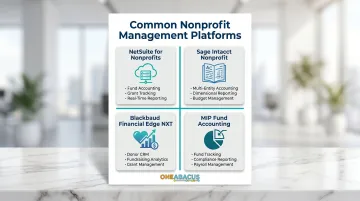
Common platforms include NetSuite for Nonprofits, Sage Intacct Nonprofit, Blackbaud Financial Edge NXT, and MIP Fund Accounting. These systems are purpose-built for nonprofit fund structures, enabling separate tracking of restricted vs. unrestricted funds, program-level accounting, and donor-specific reporting.
The right system doesn't just organize data — it gives finance teams and executive directors the visibility to make faster decisions, stay ahead of audits, and demonstrate accountability to funders.
Key Advantages of Nonprofit Management Systems
The advantages below focus on measurable, operational outcomes — not theoretical gains. These are tied to metrics nonprofit leaders and boards actually track: cost, time, risk, and reporting quality. Each advantage compounds over time; the longer systems are actively used and reviewed, the greater the return on initial investment.
Advantage 1: Real-Time Financial Visibility Across All Funds
This advantage is the ability to see fund-level financial data — including grant balances, restricted vs. unrestricted funds, and budget vs. actuals — in real time, without relying on manual spreadsheet updates.
How management systems create this visibility:
Management systems replace siloed spreadsheets and disconnected tools with a single source of truth. Finance teams, program staff, and leadership access consistent, up-to-date data from the same platform. For example, when One Abacus Advisory optimized the NetSuite environment for the Philadelphia Zoo during a leadership transition, the improvements enhanced reporting capabilities and operational efficiency, enabling the executive team to make informed decisions with confidence despite a lean internal finance team.
Why this is an advantage:
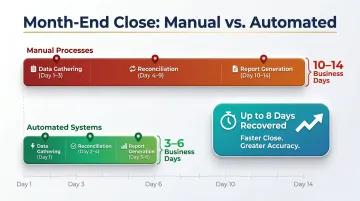
Without this visibility, financial close takes far longer and board reporting requires hours of manual reconciliation. A healthy nonprofit month-end close takes 5 to 10 business days, but organizations with manual processes can need up to two weeks. Teams with full automation close in as few as 3 to 6 days.
When leadership can see fund positions in real time, they make faster, more confident decisions on program spending, grant drawdowns, and hiring — rather than waiting for end-of-month reports. For organizations working with fractional CFOs like those at One Abacus Advisory, a well-configured management system means strategic conversations happen on current data rather than stale spreadsheets.
KPIs impacted:
- Time-to-close (monthly financial close cycle)
- Reporting turnaround time
- Budget variance accuracy
- Board meeting preparation hours
When this advantage matters most:
This is critical when managing multiple restricted grants simultaneously, going through an audit, preparing for a leadership transition, or scaling programs — situations where fragmented data creates real risk. The Blackbaud Institute found a clear correlation where organizations with higher levels of technology integration are more likely to report revenue growth.
Advantage 2: Workflow Automation That Recovers Staff Time
This advantage is the ability to automate repetitive, manual tasks — such as data entry, invoice approvals, donor acknowledgment letters, payroll allocation across cost centers, and report generation — freeing staff to focus on mission-critical work.
How management systems create this advantage:
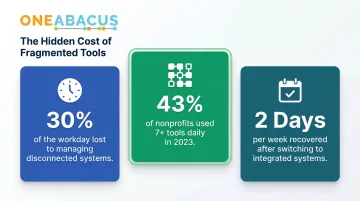
By replacing manual steps with rules-based automation, integrated data flows, and scheduled report delivery, the same output requires far less human effort. Organizations that transitioned to cloud-based solutions report gaining 2 days per week by eliminating manual work and redundancies.
The operational impact:
Nonprofit employees spend on average 30% of their day managing data between different, disconnected systems. This drains capacity from program delivery. In 2023, 43% of nonprofits used 7 or more tools daily — each requiring separate logins, data entry, and reconciliation that compound across every staff member's workday.
Staff time is a nonprofit's largest expense category. Any reduction in administrative burden directly lowers the cost of operations without reducing output. Automation also reduces data entry errors, improving audit accuracy, grant reporting, and donor record integrity.
KPIs impacted:
- Staff hours per administrative task
- Error rates in financial data
- Cost per transaction
- Donor retention (linked to timely, accurate acknowledgment)
When this advantage matters most:
This has the highest impact during periods of growth, staff turnover, or when operating with a lean team — conditions where manual processes break down fastest.
Advantage 3: Built-In Compliance Controls and Audit Readiness
This advantage is having audit trails, approval workflows, fund accounting controls, and documentation practices embedded directly into daily operations — rather than assembled in a panic before an audit or IRS 990 deadline.
How management systems create this advantage:
By enforcing segregation of duties, logging all transaction activity, maintaining grant compliance documentation, and generating the reports auditors and regulators need in a consistent, reproducible format. For organizations managing federal grants or preparing for a first formal audit, this infrastructure is often the difference between a clean finding and a costly remediation process.
Why this is an advantage:
For nonprofits, compliance failures — even minor ones — can trigger funder scrutiny, jeopardize grant renewals, or damage board confidence. Having controls built into daily workflow means compliance is continuous, not periodic.
The compliance stakes are significant:
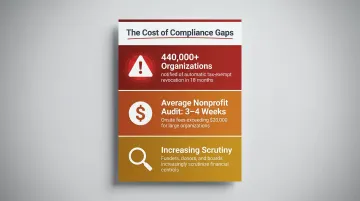
- Organizations that miss their Form 990 filing for three consecutive years automatically lose tax-exempt status — more than 440,000 organizations were notified of automatic revocation in a single 18-month period
- The average nonprofit audit takes 3 to 4 weeks, with onsite fees exceeding $20,000 for large organizations
- Donors, grant-makers, and board members increasingly scrutinize financial controls — strong systems signal operational maturity and protect funding relationships
KPIs impacted:
- Audit finding frequency
- Cost of audit preparation
- Grant compliance rate
- Time spent on IRS 990 preparation
- Board confidence scores (if tracked)
Where this makes the biggest difference:
This is critical for nonprofits managing federal or state grants, those preparing for a first formal audit, or organizations in a growth phase where informal controls are no longer sufficient. For organizations spending $750,000+ in federal funds annually (increasing to $1 million for fiscal years beginning on or after October 1, 2024), a Single Audit under 2 CFR Part 200 is mandatory.
What Happens When a Nonprofit Management System Is Missing or Ignored
Most operational dysfunction in nonprofits traces back to missing or broken systems, not flawed strategy. When management infrastructure is absent or ignored, the consequences compound quickly:
Financial reporting becomes unreliable:
- Monthly close takes 2+ weeks instead of 5–10 days
- Leadership and boards make decisions on outdated data
- Financial reports require manual reconstruction each cycle
- Cash flow becomes impossible to forecast with confidence
Error rates rise:
- Fund tracking errors increase audit risk
- Grant reporting inaccuracies jeopardize renewals
- Organizations risk inadvertently misspending restricted dollars
- 78% of nonprofit professionals spend at least 25% of their workday managing multiple disconnected systems
These errors don't stay contained — they ripple directly into staff time and organizational capacity.
Staff capacity is consumed by administrative firefighting:
- Teams spend disproportionate time chasing down data
- Reconciling spreadsheets becomes a monthly ritual
- Re-entering information across disconnected tools wastes hours
- 43% of nonprofit organizations used 7 or more tools daily in 2023
Growth becomes risky:
- Scaling programs without operational infrastructure is dangerous
- Taking on new grants adds complexity the organization can't manage
- Smaller organizations trigger risk flags on 65% of NTEN Tech Accelerate survey answers, compared to 34% for organizations with 150+ staff
Leadership transitions are harder:
- Institutional knowledge lives in individual staff members
- System-supported processes don't exist
- New leaders inherit chaos instead of clarity
How to Get the Most Value from Your Nonprofit Management System
Having a management system is not the same as using it well. Organizations that see the greatest operational improvement configure their system to match their specific fund structure and workflows — not just accept default settings.
Three practices separate organizations that get real value from their system versus those that just own one:
- Configure for your actual fund structure — not generic defaults
- Build regular review cycles that force interpretation, not just storage
- Pair the system with financial leadership that can turn data into decisions
Work with implementation partners or fractional financial leaders who understand nonprofit fund accounting. Generic ERP configurations rarely account for restricted funds, grant-specific reporting, or program-level tracking. One Abacus Advisory's NetSuite optimization work, for example, covers system configuration, workflow automation, and reporting enhancements built around nonprofit fund structures and compliance requirements.
Set up regular financial reviews — monthly close reviews, quarterly grant reconciliations, and board-level dashboards — so data drives decisions consistently. A dashboard no one reviews is just overhead.
A well-configured system still depends on experienced leadership to translate outputs into strategy. Whether that's a full-time CFO or a fractional CFO and COO, having someone who can interpret and act on financial data matters most during implementation, audits, or leadership transitions. When the San Diego Food Bank's Finance Director departed, One Abacus stepped in to maintain uninterrupted month-end close processes — letting the internal team stay focused on mission delivery.
Conclusion
A nonprofit management system's real value is The value of a nonprofit management system comes from what it makes possible day-to-day: faster decisions, fewer errors, and compliance that doesn't require constant manual effort. Control, clarity, and consistency follow from active use — not from the software sitting on a shelf.
The benefits covered here — financial visibility, time recovered through automation, and built-in compliance — build on each other over time. Early investment in proper setup and staff adoption pays off across every reporting cycle, audit, and funding renewal that follows. Organizations that revisit and refine their systems regularly get compounding returns; those that treat implementation as a finish line tend to stall.
That's where external expertise makes a difference. A fractional CFO or COO can help nonprofits configure these systems correctly from the start, identify gaps before they become audit findings, and keep operations aligned with mission — without the overhead of a full-time hire.
Frequently Asked Questions
How do nonprofit management systems improve day-to-day operations?
These systems centralize financial and operational data, automate repetitive tasks, and give leadership real-time visibility into performance. The result is fewer manual errors, less firefighting, and decisions grounded in accurate information rather than outdated spreadsheets.
What is a good operational efficiency ratio?
For nonprofits, a commonly referenced benchmark is spending 65-85% of total expenses on program activities, with the remainder covering management and fundraising. The right ratio varies by mission type, size, and funding model, but higher program ratios generally signal effective resource allocation.
What are the three factors of operational efficiency?
The three core factors are process (how work gets done), people (whether staff have the tools and clarity to do it), and technology (whether systems support or hinder both). For nonprofits, the biggest gaps typically show up when technology lags behind the complexity of the organization's operations.
What types of tools count as nonprofit management systems?
Common tools include ERP platforms (NetSuite, Sage Intacct), fund accounting software (MIP Fund Accounting), donor CRMs, payroll and HR platforms, and grant management tools. These deliver the most value when integrated — not running as separate, disconnected systems.
How do you know when your nonprofit has outgrown its current systems?
Watch for these warning signs:
- Financial close consistently takes more than two weeks
- Staff spend significant time reconciling data across multiple spreadsheets
- Grant compliance requires significant manual effort before each audit
- Leadership can't get a clear cash flow picture without asking several people
Can small nonprofits benefit from management systems, or are they only for large organizations?
Small nonprofits benefit significantly — even a basic integrated system reduces manual errors and audit risk. Right-sized solutions exist for organizations at every stage, and early adoption often costs far less than the inefficiencies it eliminates.