Introduction
36% of nonprofits ended 2024 with an operating deficit — the highest rate recorded in a decade. Among repeat respondents, the deficit rate surged from 13% in 2021 to 37% in 2024. This financial strain translates directly into operational reality: unfilled positions that stretch remaining staff to the breaking point, technology upgrades deferred until systems fail, and an over-reliance on restricted grant funding that leaves organizations with no flexibility when circumstances change.
Scaling a nonprofit isn't inherently expensive. It becomes costly when decisions are made reactively, when financial oversight gaps allow small inefficiencies to compound, or when growth happens without the infrastructure to support it. The organizations struggling most often aren't doing more — they're doing more without a system behind them.
This article breaks down where scaling costs originate — across staffing, technology, and funding structure — and how to address each area before small gaps become budget-breaking problems.
Key Takeaways
- Scaling creates compounding costs that quietly strain budgets and erode service quality
- Major cost drivers include staffing decisions, technology procurement timing, and insufficient financial visibility
- Better pre-growth decisions reduce costs more effectively than cutting spend mid-expansion
- Solid financial processes stop cost overruns from hardening into permanent structural problems
- Fractional leadership and outsourcing expand capacity without equivalent cost increases
How Operational Costs Build Up When Nonprofits Scale
Scaling costs rarely appear as a single budget line. They accumulate gradually: an incremental hire here, a software upgrade there, new compliance requirements, facility expansions. Each decision seems justified in isolation, but collectively they create budget pressure that catches leadership off guard.
These costs hide at first. Understaffed teams absorb early growth through overtime and informal workarounds, masking the real cost until burnout forces a reckoning. Nearly 75% of nonprofits reported persistent job vacancies in 2023, with 50% indicating vacancies were more prevalent than before the pandemic. When stretched teams finally break, the cost of replacing burned-out staff and rebuilding institutional knowledge dwarfs what proper planning would have required.
Two patterns drive cost accumulation during scaling:
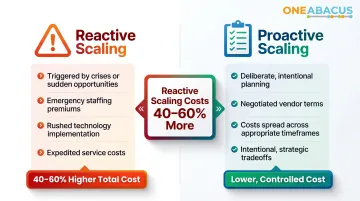
- Reactive scaling happens when organizations accept grants or contracts without accounting for implementation costs — triggered by crises or sudden opportunities rather than planning
- Proactive scaling still carries risk, but costs are underestimated rather than unexamined, typically due to limited financial modeling capacity or unfamiliarity with similar growth cycles
Reactive scaling typically costs 40–60% more — emergency staffing, rushed technology implementations, and expedited services all carry a premium that planned growth avoids. Proactive scaling lets organizations negotiate better terms, spread costs across appropriate timeframes, and make deliberate tradeoffs before urgency forces their hand.
Key Cost Drivers for Nonprofit Scaling
Staffing Decisions Dominate Scaling Costs
Staffing is the single largest cost driver during growth. The nonprofit sector's turnover rate sits at approximately 19% compared to 12% in other sectors. Nearly 7 in 10 nonprofit employees reported in a 2025 survey that they would be looking for a new job that year.
The tendency to create full-time positions for what may only require part-time or specialized capacity creates downstream costs that many organizations fail to anticipate:
- Benefits packages that can add 25-40% to base salary
- Onboarding and training investments that take 6-12 months to recoup
- Turnover costs when growth slows or funding shifts unexpectedly
44% of nonprofits plan to add staff in 2025, with an average expected headcount increase of 15%. Meanwhile, 66% expect to pay higher salaries due to competitive hiring and inflation. Organizations that expand headcount without clear role definition or realistic revenue projections risk payroll obligations that extend well beyond staffing — and into every other area of operations.
Technology Procurement Compounds Costs Over Time
Most nonprofits purchase software tools piecemeal as needs arise rather than selecting scalable platforms from the outset. This accumulates costs in three predictable ways:
- Duplicate systems performing overlapping functions
- Integration costs to make incompatible systems communicate
- Migration expenses when the patchwork eventually becomes unmanageable
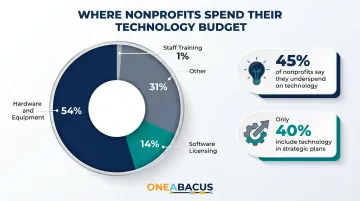
45% of nonprofits say they are not spending enough on technology, yet only 40% include technology explicitly in their strategic plans. The budget breakdown tells the story: 54% of technology spend goes to hardware and equipment, while software licensing receives just 14% and staff training a mere 1%. Organizations invest in physical infrastructure while underinvesting in the platforms and skills that actually drive efficiency during scaling.
Compliance and Reporting Obligations Increase Non-Linearly
As organizations grow, compliance and reporting demands increase faster than program size. 76% of nonprofits receiving government funding are unable to recover their full costs due to caps on indirect cost reimbursement.
This gap forces organizations to subsidize government contracts with unrestricted funds — the opposite of sustainable scaling.
Most scale-up budgets don't account for the added cost of financial oversight capacity. Organizations assume existing staff can absorb increased reporting requirements, only to discover that grant complexity grows exponentially with funding volume. A $500,000 government contract typically requires 3-5 times more reporting and compliance work than five $100,000 foundation grants.
Cost-Reduction Strategies for Scaling Nonprofits
Strategies for reducing scaling costs fall into three categories: changing decisions before growth begins, improving how operations are managed during growth, and restructuring the broader organizational context.
Strategies That Reduce Costs by Changing Decisions
Decisions made at the outset of scaling determine an outsized share of eventual costs. Course-correcting early is far cheaper than absorbing consequences later.
Scope Programs Before Scaling Them
Conduct a financial feasibility review before expanding any program. Identify fixed versus variable cost components and determine the minimum viable scale for cost-efficiency. College Summit redesigned its program model and served 600% more schools with only a 60% increase in budget. The YMCA adapted a clinical diabetes prevention program to a group model, cutting cost-to-serve by 75%.
Key steps include:
- Analyzing per-unit costs at current scale
- Setting target unit costs based on available funding at larger scale
- Identifying which cost elements scale linearly and which create efficiencies
- Avoiding expansion of programs that carry embedded inefficiencies
Right-Size Staffing Through Role Design
Many nonprofits default to creating full-time roles when scaling. Structuring positions with clear scope reduces payroll commitment and provides flexibility if funding shifts.
Options include:
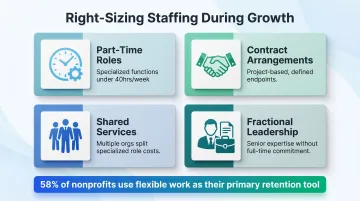
- Part-time roles for specialized functions that don't require 40 hours weekly
- Contract arrangements for project-based work with defined endpoints
- Shared-service arrangements where multiple organizations split costs for specialized roles
- Fractional leadership that provides executive expertise without full-time commitment
58% of nonprofits now use flexible work arrangements as their primary retention tool, recognizing that role design affects both cost and talent acquisition.
Make Technology Decisions With Scalability Criteria
Evaluate technology platforms against long-term needs, not just current requirements. Nonprofit-specific platforms often reduce configuration costs because they're pre-built for common nonprofit workflows.
Evaluation criteria should include:
- User capacity limits and pricing models at 2x and 5x current size
- Integration capabilities with existing and planned systems
- Training requirements and staff learning curve
- Total cost of ownership over 5 years, including implementation and maintenance
Avoid Mission Creep as a Cost Decision
Accepting funding for programs outside your core mission may appear to increase revenue but generates unreimbursed operational costs. Selecting grants aligned with your existing infrastructure keeps hidden delivery costs in check.
Before accepting restricted funding, model the true cost of delivery including:
- Staff time for program management and reporting
- Facilities and equipment required
- Indirect costs often capped by funders
- Opportunity cost of staff attention diverted from core mission
Strategies That Reduce Costs by Changing How Scaling Is Managed
Poor management of scaling operations often costs more than the scaling itself. These approaches improve financial control and visibility as organizations grow.
Implement Cash Flow Forecasting and Scenario Modeling
52% of nonprofits have 3 months or less cash on hand; 18% have 1 month or less. Scaling organizations need rolling cash flow projections to anticipate gaps between grant disbursements and operational obligations.
Fractional CFO engagements — such as those offered by One Abacus Advisory — typically include rolling cash flow projections, practical budgeting frameworks, and forecasting tools tailored to a nonprofit's funding cycles. This gives leadership actionable visibility throughout the fiscal year, not just at audit time.
Document Processes Before Scaling Them
Replicating undocumented workflows across a larger organization amplifies inefficiencies. Standardize and document core processes before scaling so each new hire or location inherits a cost-efficient operating model.
Priority processes to document:
- Month-end close procedures
- Grant application and reporting workflows
- Vendor payment approval chains
- Program delivery protocols
- Donor acknowledgment procedures
Establish Financial KPIs Tied to Operational Milestones
Define specific metrics before scaling to create early warning signals for budget deviation. Track cost per program participant, overhead ratio, and revenue per full-time equivalent (FTE) to allow leadership to course-correct before overruns become structural.
Strategic advisory support can help nonprofits establish these metrics, align financial strategy with mission goals, and deliver board-ready analysis that leadership can act on — not just report from.
Use Restricted Versus Unrestricted Fund Accounting Discipline
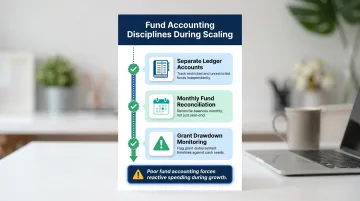
During scaling, nonprofits often inadvertently use unrestricted reserves to cover costs associated with restricted programs. This creates cash flow crises that force reactive spending. Proper fund accounting prevents this and preserves financial flexibility.
Common fund accounting disciplines to enforce:
- Tracking restricted and unrestricted funds in separate ledger accounts
- Reconciling fund balances monthly, not just at year-end
- Flagging grant drawdown timelines against operational cash needs
Build a Regular Financial Review Cadence for Leadership
Monthly or quarterly financial reviews — not just annual audits — give executive directors and boards the visibility needed to make spending decisions aligned with scaling priorities. Regular reviews also create a documented decision trail, which strengthens board governance and funder confidence during periods of growth.
Strategies That Reduce Costs by Changing the Operational Context
The management strategies above address what happens inside your organization. These approaches go a level further — restructuring how leadership capacity is resourced, how partnerships are leveraged, and how funding mix is managed.
Leverage Strategic Partnerships and Shared Services
Partnerships with peer nonprofits, fiscal sponsors, or community intermediaries distribute scaling costs. The Keystone Alliance reduced combined administrative overhead from 11.6% to 7.9% in the first year of shared back-office operations.
Shared services allow smaller organizations to access economies of scale without individual growth. Research from Social Impact Commons shows nonprofits using fiscal sponsors often cut overhead costs by approximately 50%, freeing resources for programs.
Diversify Revenue to Reduce Reliance on High-Compliance Funding
Two-thirds of nonprofits received at least one government grant or contract in 2023, with 20% receiving more than half their revenue from government sources. Organizations disproportionately dependent on government or large foundation grants face elevated reporting and compliance costs.
Building a mix of unrestricted individual donations or earned revenue provides operational flexibility that lowers the total cost of growth. Unrestricted funding from private foundations comprises less than 40% of total grants, making diversification critical for sustainable scaling.
Access Fractional Financial Leadership Instead of Full-Time Executive Hires
Scaling nonprofits often face a gap between the financial leadership they need and what a full-time CFO or COO hire costs. In New York City, nonprofit CFO salaries range from $120-129K for organizations under $2M in budget to $240-249K for organizations over $50M.
One Abacus Advisory's fractional CFO and COO services deliver strategic financial oversight during growth at a fraction of full-time costs — with nonprofit-sector expertise and right-sized engagement. Fractional CFO engagements cover financial oversight, reporting, budgeting, forecasting, cash flow management, audit preparation, and mission-aligned strategy. Fractional COO engagements address the operational side: establishing management rhythms, overseeing internal controls, managing grant portfolios, and modernizing administrative infrastructure.
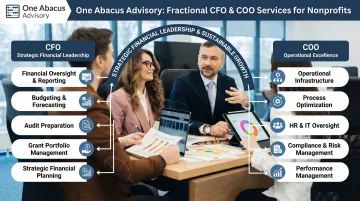
Organizations including the Philadelphia Zoo and San Diego Food Bank have used this model during critical growth periods — maintaining continuity without the cost of a full-time executive hire.
Adopt Cloud-Based Financial and Operational Systems Early
Transitioning to cloud platforms for fund accounting, reporting, and program management before scaling removes the cost and disruption of mid-growth migrations. Cloud systems position organizations to add users, locations, or programs without proportional technology investment.
One Abacus Advisory specializes in optimizing NetSuite for nonprofits — consolidating financial operations into a unified, scalable system. Work with the Philadelphia Zoo, for example, improved reporting capabilities and reduced data redundancies, delivering measurable gains in operational efficiency without a system overhaul mid-growth.
Conclusion
Efficient scaling comes down to one discipline: identifying where operational costs originate — pre-scale decisions, management gaps, or contextual factors — and addressing those root causes before they compound.
For nonprofits, cost-efficient scaling is continuous financial discipline, not a one-time initiative. Organizations that build financial oversight, process clarity, and right-sized leadership structures into their scaling strategy protect both their mission and their long-term organizational health. Nonprofits that get this right don't just survive growth — they emerge from it with stronger systems, clearer accountability, and a financial foundation built to last.
Frequently Asked Questions
What does it mean to scale a nonprofit?
Scaling a nonprofit means expanding the organization's capacity to serve more people or communities without a proportional increase in operating costs. This differs from simple growth, which typically requires parallel increases in staffing and budget. Scaled impact might mean serving 100 times more beneficiaries with only twice the organizational size.
What are scaling strategies for nonprofits?
The main categories include technology-enabled service delivery, process standardization, strategic partnerships, and restructuring leadership capacity through fractional or shared services. The most effective strategies depend on where the organization's current bottlenecks lie — whether in operations, leadership capacity, or resource constraints.
How can a nonprofit scale without increasing overhead costs?
Keeping overhead in check requires right-sizing staffing decisions, selecting scalable technology early, leveraging shared services or fractional leadership, and maintaining strict alignment between programs accepted and existing operational capacity. Many successful scaling organizations use flexible staffing arrangements and cloud-based systems to add capacity without proportional cost increases.
What are the biggest financial mistakes nonprofits make when scaling?
The most common errors include:
- Scaling before financial processes are documented
- Accepting restricted funding without modeling its overhead impact
- Hiring full-time staff ahead of sustainable revenue
- Lacking real-time financial reporting during growth phases
These mistakes often compound, creating structural deficits that take years to correct.
When should a nonprofit consider hiring a fractional CFO or COO?
Fractional financial leadership makes sense when an organization needs strategic oversight but can't yet justify a full-time executive hire. Common triggers include audit preparation, leadership transitions, rapid program expansion, and complex grant or government contract portfolios.
How do nonprofits fund their operational scaling efforts?
Funding sources include capacity-building grants, general operating support from individual donors, earned revenue diversification, and strategic use of unrestricted reserves. A diversified funding mix reduces risk — and since unrestricted foundation grants make up less than 40% of total grants on average, cultivating individual donors and earned revenue is essential.