Introduction
Nearly three out of four nonprofits (74.6%) reported job vacancies in 2023, with approximately one-third facing vacancy rates of 20% or higher, according to the National Council of Nonprofits. Despite being among the most mission-driven workers in the labor force, nonprofit employees consistently score lower on engagement surveys than their for-profit counterparts. The vacancy numbers reflect that gap directly.
Unlike corporate employers who can compete on salary and perks, nonprofits face unique pressures: lean budgets, high emotional demands, and the complexity of managing both paid staff and volunteers under one culture. After controlling for education and experience, nonprofit workers earn 4-7% less than for-profit peers, creating a persistent wage penalty that makes retention harder.
Engagement strategy, however, plays to nonprofits' strengths. When built around purpose, recognition, and transparency, it can close the gap that compensation alone cannot. This article covers five practical strategies nonprofit leaders can use to boost engagement — no large budget required.
TLDR:
- Connect every role to measurable mission impact through storytelling and strategic inclusion
- Build systematic recognition into weekly rhythms, not just ad hoc praise
- Counter burnout with realistic workload boundaries and leadership modeling
- Build growth pathways through mentorship and internal mobility
- Lead with financial transparency to build trust and informed decision-making
Why Nonprofit Employee Engagement Requires a Different Approach
Nonprofit engagement is fundamentally different from corporate engagement. Employees choose this sector because they're purpose-driven — yet disengagement still hits when the connection to mission erodes. Research shows that employees with a strong sense of purpose at work are 5.6 times more likely to be engaged. However, only about one-third of U.S. employees report strong work purpose, and 45% say they work primarily to collect a paycheck.
Structural engagement risks hit nonprofits harder:
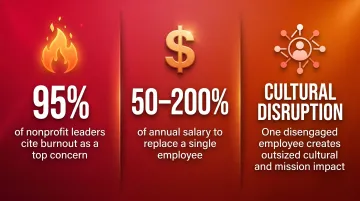
- 95% of nonprofit leaders cited burnout as a top concern, and 50.2% of nonprofits identified stress and burnout as a barrier to recruitment and retention
- Replacing an employee costs 50–200% of their annual salary, with Gallup estimating turnover drains 15–20% of total organizational payroll
- In lean nonprofit environments, one disengaged staff member has an outsized effect on culture, morale, and mission delivery
Compensation matters, but it's rarely what keeps purpose-driven employees engaged. Nonprofits that retain strong teams focus on what actually moves the needle: meaningful impact, genuine recognition, sustainable workloads, growth opportunities, and transparent leadership.
Connect Employees to Mission and Measurable Impact
Mission connection isn't automatic, even in purpose-driven organizations. Employees in administrative or back-office roles — finance, IT, HR — are especially likely to feel disconnected from the cause unless leaders actively bridge that gap.
Tactics to deepen mission connection:
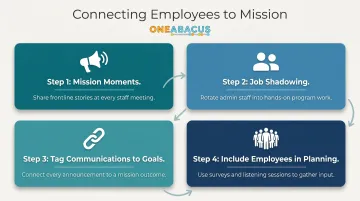
- Hold regular "mission moments" — share frontline outcomes and client success stories at staff meetings so all employees see program impact, not just fundraising numbers
- Offer periodic job shadowing or volunteer rotations so administrative staff experience direct program work and understand how their support roles enable mission delivery
- Tag organizational communications back to strategic goals — when announcing new hires, policy changes, or budget decisions, connect them to mission outcomes
- Include employees in strategic planning as active contributors through surveys, listening sessions, and task forces — not just as observers
Impact Storytelling as an Engagement Tool
Share client success stories, program milestones, and community data internally — not just in donor reports. When staff across all departments see the outcomes their work supports, the connection between daily tasks and mission delivery becomes tangible.
One Abacus Advisory observed this dynamic with clients like the Philadelphia Zoo and San Diego Food Bank: clearer financial reporting and operational visibility gave leadership better tools to communicate program impact across teams, which strengthened alignment from the back office outward.
Clarity About Individual Role Contribution
Managers should regularly connect one-on-one conversations to how each employee's specific work advances shared goals. A finance manager processing grants isn't "just doing accounting" — they're ensuring program funding flows to communities that need it. Make that connection explicit and consistent.
Build Recognition Into Your Nonprofit's Operating Rhythm
Recognition is one of the highest-impact, lowest-cost engagement levers available to nonprofits — and one of the most commonly neglected. Only one in three U.S. workers strongly agree they received recognition or praise for doing good work in the past seven days. Those who feel unrecognized are twice as likely to say they will quit within a year.
Closing that gap requires moving from ad hoc recognition — which happens when it occurs to you — to systematic recognition built into weekly meetings, performance check-ins, and organizational communications. Nonprofits need the latter to make recognition consistent and culturally embedded.
Practical, low-cost formats to start with:
- Peer-to-peer shoutouts in team meetings
- A dedicated recognition channel in Slack or email updates
- Personalized thank-you notes from leadership (handwritten carries extra weight)
- Public acknowledgment tied to core values, not just performance metrics
- Celebrations of mission milestones that highlight individual contributions
Note that preferences vary: some staff value public praise, while others prefer a private word. Ask team members how they like to be recognized and honor those preferences.
Make Recognition Stick
Recognition lands hardest inside a culture where people feel psychologically safe and respected. Research shows that employees who lack a sense of belonging are up to 12 times more likely to be disengaged — a risk no lean nonprofit team can afford.
For recognition to reinforce that sense of belonging, it needs to be:
- Authentic — specific to the person and the contribution, not generic praise
- Equitable — distributed across roles, not concentrated on high-visibility staff
- Personalized — delivered in the way the recipient actually values
- Mission-connected — tied to organizational values and outcomes, not just output
That last point matters most in a nonprofit context. When recognition is linked to mission impact, employees feel seen for the work they came to do.
Support Wellbeing and Actively Counter Burnout
Burnout is a structural threat in nonprofits, not just an individual issue. Half of all nonprofits cited stress and burnout as a driver of workforce shortages. Compassion fatigue, resource constraints, and emotional labor compound over time, especially for frontline staff working directly with vulnerable populations.
Concrete wellbeing strategies that don't require large budgets:
- Enforce PTO policies and actively discourage "working vacations"
- Say no to scope creep and unrealistic timelines before they take root
- Train managers to ask "how are you?" as a real question, not a formality
- After intensive program periods (fundraising campaigns, events), schedule lighter weeks for teams to recharge
These policies also signal organizational values. When leaders model healthy boundaries — not emailing at 10pm, actually taking time off, respecting weekends — it communicates that people are valued beyond their output. That signal makes engagement sustainable and breaks the burnout-turnover cycle.
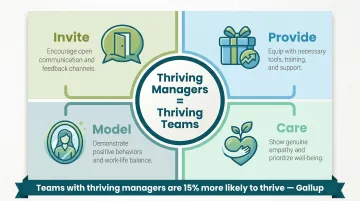
Leadership behavior has a measurable downstream effect. Gallup research shows that when a manager is thriving in their own wellbeing, their direct reports are 15% more likely to be thriving six months later. In practice, that means managers need to do four things:
- Invite honest conversations about how staff are really doing
- Provide flexibility and access to support resources
- Model the healthy practices they're asking their teams to follow
- Care with genuine concern, not just managerial obligation
Create Pathways for Growth — Even on a Limited Budget
Professional development is a top driver of engagement, particularly for employees under 35. Learning and development ranks among the top three reasons Gen Zs and millennials choose to work for their current employer. Yet only 35.8% of nonprofits have implemented career advancement opportunities as a retention strategy.
Growth doesn't require large training budgets. Leaders can reframe the conversation around creating opportunities to learn, lead, and stretch within the organization.
Low-cost development formats:
- Host "lunch and learn" sessions where team members share expertise on tools, processes, or sector trends
- Run a quarterly book club tied to one leadership or mission-relevant title
- Pair junior and senior staff across departments for skill development and knowledge transfer
- Encourage attendance at free or low-cost webinars — many sector associations offer virtual events year-round
Prioritize Internal Mobility
When a role opens, give current employees the first opportunity to apply. This signals that dedication is rewarded and supports succession planning — a critical need for lean nonprofits with limited bench depth.
Use Simple Development Plans
Even a one-page goal-setting document reviewed quarterly helps employees feel seen and invested in. Meaningful growth conversations don't require a formal HR system — just consistency and follow-through from managers.
When people systems outgrow what internal capacity can manage, structured outside support can help. One Abacus Advisory works with nonprofits on HR operations, onboarding design, and organizational development — building the infrastructure that makes growth conversations and retention strategies stick.
Lead With Transparency to Build Trust and Engagement
Transparency is a foundational engagement driver in nonprofits. Employees who feel kept in the dark about organizational strategy, financial health, or leadership decisions disengage rapidly — especially in mission-driven environments where stakes feel personal.
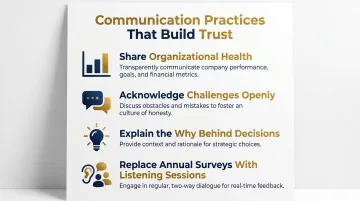
Communication practices that build trust:
- Share organizational health and strategic direction in monthly or quarterly all-staff updates
- Acknowledge challenges and unknowns openly rather than projecting false confidence
- Explain the "why" behind difficult decisions — when budget cuts or program changes happen, context prevents resentment
- Replace one-way annual surveys with regular listening sessions that include visible follow-up
Financial transparency is where many nonprofits leave engagement value on the table. When employees understand how the budget works, what drives program decisions, and how resources are allocated, they feel included rather than managed.
Trust in nonprofits is higher than in any other sector (57% of Americans report high trust), yet many organizations don't leverage this advantage internally.
For organizations without dedicated financial leadership, a fractional CFO can give leaders the board-ready reporting and operational visibility they need to communicate confidently with staff. One Abacus Advisory has worked with organizations including the Philadelphia Zoo, San Diego Food Bank, and Laguna Playhouse — helping each build the financial clarity that supports honest, grounded communication with their teams.
Employees don't need access to every line item. They need enough context to understand where the organization is headed and trust that leadership is making decisions thoughtfully.
Frequently Asked Questions
What are the 4 types of employee engagement?
The four types are cognitive (mental focus), emotional (passion and connection), physical (energy and initiative), and social (connection to colleagues and culture). In nonprofits, emotional engagement tends to run highest due to mission alignment, while physical engagement is most at risk from burnout.
What are the 4 pillars of employee engagement?
The four pillars are meaningful work, strong management, a positive work environment, and growth opportunities. Nonprofits naturally lead on meaningful work but must build the other three through deliberate leadership and operational investment.
What are the 5 C's of employee engagement?
The 5 C's are Care, Connect, Coach, Contribute, and Congratulate — covering wellbeing, purpose alignment, development, decision-making participation, and recognition. For nonprofits, Care and Connect carry the most weight given the emotional demands of mission-driven work.
What are the 3 Ps of employee engagement?
The 3 Ps are Purpose, People, and Progress. Purpose carries extra weight in the nonprofit sector, as mission-driven motivation is the primary engagement driver. People (relationships with colleagues and managers) and Progress (visible advancement toward goals) support purpose but don't replace it.
What are some fun employee engagement activities for nonprofits?
Strong options include mission impact celebrations, team volunteer days, peer recognition programs, lunch-and-learns, and low-cost team-building like trivia or potlucks. The best activities reinforce mission connection while building relationships and marking team wins.