Introduction
The tension is familiar to nearly every nonprofit Executive Director: programs are expanding, donor expectations are rising, compliance demands are multiplying — and your team is already stretched thin. You're the default owner of everything that doesn't have a clear home: staff accountability gaps, vendor negotiations, board reporting deadlines, process breakdowns that cascade into mission delays. A full-time Chief Operating Officer would solve this, but the budget reality makes that hire feel impossible.
According to the Center for Effective Philanthropy's 2024 State of Nonprofits survey, 95% of nonprofit leaders express concern about burnout — 33% say they are "very much" concerned about their own. Nearly 60% cite lack of staff capacity as one of their organization's biggest challenges.
When operations consume leadership bandwidth, missions stall. A fractional COO may be the structural answer, not a luxury add-on.
What follows is a practical framework for understanding the role, recognizing the gaps that signal you need it, and deciding whether the fractional model fits your organization's stage and budget.
Key Takeaways
- A fractional COO delivers senior operational leadership on a part-time basis without full-time salary costs
- Most nonprofits need targeted operational expertise at critical moments, not a full-time executive on payroll
- Cost savings, flexibility, and cross-sector expertise combine in the fractional model — rarely found in a single full-time hire
- For organizations facing growth, transitions, or operational ceilings, a fractional COO is a structural necessity — not an optional expense
What Is a Fractional Nonprofit COO?
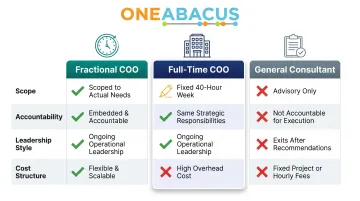
A fractional COO is a senior operational executive who works with a nonprofit on a part-time, retained, or project basis. Unlike a consultant who delivers recommendations and exits, a fractional COO functions as an embedded leader — owning implementation, driving accountability, and working directly with staff and leadership.
Key distinctions:
- vs. Full-time COO: Same strategic responsibilities, scoped to actual organizational needs rather than fixed 40-hour-per-week overhead
- vs. Interim COO: Not a temporary gap-filler — fractional roles provide ongoing operational leadership that scales as organizational complexity grows
- vs. General consultant: A fractional COO is accountable for execution and results, not just advisory recommendations
What this looks like inside a nonprofit:
The fractional COO translates the Executive Director's vision into operational systems. This includes overseeing cross-functional alignment across finance, HR, programs, and compliance, and ensuring day-to-day operations serve the mission rather than work against it.
For organizations experiencing operational strain during growth phases, leadership transitions, or major funding pushes, this embedded leadership builds the infrastructure that prevents chaos from overtaking strategy.
One Abacus Advisory brings over 25 years of financial and operational leadership experience exclusively in the nonprofit sector. Having worked with organizations like the San Diego Food Bank, Philadelphia Zoo, and Laguna Playhouse, that sector-specific depth means every recommendation is grounded in how nonprofits actually function.
The Operational Gap Nonprofits Can't Afford to Ignore
Many nonprofits fall into a growth trap: founded by mission-driven leaders, they scale programs without scaling operations. The Executive Director becomes the default owner of everything lacking a clear home — vendor management, staff accountability, board reporting, process breakdowns. Operational complexity accumulates until it becomes a crisis.
How this gap compounds over time:
- Talented staff can't deliver their best work when roles and accountability structures are unclear
- Initiatives launch but don't scale because the operational infrastructure can't support growth
- Leadership bandwidth gets consumed by operational firefighting instead of fundraising, strategy, and community engagement
The data confirms this pattern. Research from the Center for Effective Philanthropy shows that 76% of nonprofit leaders report staff burnout is impacting their organization's ability to achieve its mission, with 25% reporting moderate to significant impact. Meanwhile, 59% of employees planning to leave their nonprofit cited "having too much responsibility and not enough support" as a top reason.
That burnout isn't just a staffing problem — it's a signal that the operational gap has become a mission gap. When systems don't work, the consequences ripple outward:
- Programs fail to reach the people they're meant to serve
- Funders notice inconsistencies in reporting and start asking harder questions
- Boards push back on organizational capacity
- Staff leave for organizations with clearer structures
Internal inefficiency and mission delivery aren't separate problems. They're the same problem.
A fractional COO addresses this gap structurally. Rather than patching problems reactively, this role builds the operational infrastructure that allows a nonprofit to grow without creating chaos at the leadership level.
What a Fractional COO Actually Does for Your Nonprofit
Building Scalable Operational Systems
Many nonprofits grow faster than their internal processes can support. A fractional COO audits existing workflows, identifies the bottlenecks that stall program delivery, and designs systems that can absorb program growth without increasing burden on leadership.
At the Philadelphia Zoo during a major leadership transition, One Abacus Advisory optimized the NetSuite environment to enhance reporting and operational efficiency, improved month-end close processes, and strengthened board reporting — all of which increased confidence in financial results during a critical period.
Driving Team Accountability and Performance
When roles and expectations are unclear, talented people underperform. A fractional COO establishes accountability structures:
- Clear ownership and decision rights
- Defined performance expectations
- Regular feedback rhythms
- Reduced dependency on the ED as the constant bottleneck
Strategic Planning and Execution
Strong internal accountability only matters if it's pointed in the right direction. A fractional COO connects team execution to the board's strategic vision, turning multi-year plans into actionable roadmaps with milestones, resource alignment, and built-in course-correction. These become working tools, not documents that sit on a shelf.
Financial-Operational Integration
In nonprofits, operations and finance are deeply intertwined. Cash flow affects program delivery, budget variances have mission implications, and grant compliance requires operational discipline. Some fractional advisors, like One Abacus Advisory, offer integrated fractional COO and CFO support, ensuring financial oversight and operational execution stay aligned rather than operating in isolation.
Supporting Executive Directors Directly
One of the least-discussed benefits is what fractional COO support does for the person at the top. An ED freed from operational firefighting shows up differently for the board, for staff, and for the community. That shift is measurable: stronger staff retention, more focused fundraising conversations, and a culture that isn't constantly absorbing leadership stress from above.
Fractional COO vs. Full-Time COO: An Honest Comparison
Cost Comparison
A full-time nonprofit COO carries significant cost. According to PNP Staffing Group's 2024 Nonprofit Salaries and Staffing Trends report, nonprofit COO base salaries vary by organization budget and region:
| Budget Size | West | Midwest | Northeast | South |
|---|---|---|---|---|
| Under $2M | $110-119K | $100-109K | $120-129K | $100-109K |
| $2.1M-$10M | $120-129K | $120-129K | $155-164K | $150-159K |
| $10.1M-$20M | $160-169K | $160-169K | $190-199K | $125-134K |
| $20.1M-$50M | $190-199K | $180-189K | $210-219K | $200-209K |
| $50.1M-$100M+ | $200-209K | $160-169K | $250-259K | $240-249K |
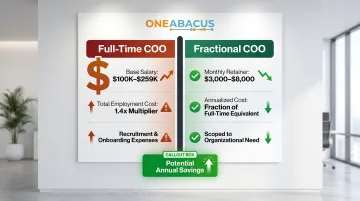
These figures represent base salary only. When factoring in benefits, payroll taxes, and overhead, the U.S. Bureau of Labor Statistics reports total employer costs run approximately 1.4x base salary. A COO earning $130,000 in base salary represents roughly $182,000 in total annual cost — before recruitment, onboarding, or professional development expenses.
By contrast, fractional COO engagements typically run $3,000–$8,000 per month depending on scope — structured around what the organization actually needs, not a fixed headcount.
Depth of Engagement vs. Availability
A common objection: "Won't part-time mean less commitment?"
Fractional COOs are embedded, accountable leaders, not advisors on the margins. Most nonprofits at the growth stage don't need 40 hours per week of COO attention. A fractional engagement might deliver 20–30 focused hours monthly — enough to drive systems improvements, lead operational meetings, and keep leadership aligned. The value lies in the quality and focus of engagement, not hours logged.
Flexibility and Scalability
The fractional model can be scoped to a specific phase:
- A growth initiative requiring systems modernization
- A leadership transition demanding operational continuity
- A major funding push requiring enhanced accountability
Scope scales up or down as organizational needs shift. A full-time hire is a fixed commitment regardless of whether the workload justifies it, and carries real risk if the fit turns out to be wrong.
When a Full-Time COO Actually Makes Sense
The fractional model isn't forever. Indicators that suggest a nonprofit has reached the complexity where a full-time COO hire becomes appropriate include:
- Revenue consistently exceeding $5M annually
- Staff count of 75+ employees
- Multiple programs, services, or locations requiring coordination
- ED spending more than 60% of time on daily operations
Engaging a fractional COO first helps define the role's scope, surface operational gaps, and make that eventual full-time hire far more likely to succeed.
Signs Your Nonprofit Needs a Fractional COO — and How to Find the Right One
Diagnostic Signals
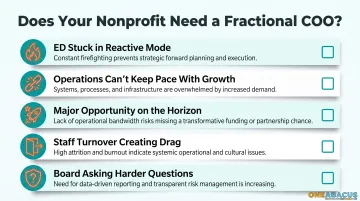
Your nonprofit has moved from "would benefit from" to "genuinely needs" fractional COO support when:
- The ED is consistently reactive rather than strategic — operational firefighting consumes time that should go to fundraising and vision
- Operations cannot keep pace with programmatic growth — staff report process bottlenecks, unclear ownership, and mounting administrative burden
- A major opportunity is on the horizon — a large grant, program expansion, or funding push requires infrastructure you don't currently have
- Staff turnover or performance issues create drag — talented people are leaving or underperforming due to unclear expectations and inadequate support
- The board is asking harder questions — questions about organizational accountability, financial controls, or operational capacity that leadership can't confidently answer
What to Look For
Not every fractional COO is equipped for nonprofit work. When evaluating candidates, prioritize:
- Nonprofit-specific experience over general business operations background — the dynamics of donor accountability, restricted funding, and volunteer management are different from for-profit operations
- Collaborative leadership over advisory expertise — look for someone who works directly with teams, not just leadership; implementation matters more than recommendations
- Pattern recognition from similar organizations — a COO who has guided nonprofits through comparable growth stages or operational challenges accelerates results
One Abacus Advisory, for example, has partnered with organizations including the San Diego Food Bank, Philadelphia Zoo, and Laguna Playhouse — supporting each through transitions, infrastructure builds, and operational challenges unique to their stage and sector.
What a Strong Engagement Kickoff Looks Like
Once you've found the right fit, how the engagement begins tells you a lot. The right fractional COO starts with listening:
- Interviewing key staff to understand current workflows
- Mapping processes to identify where the organization is holding itself back
- Assessing capacity and culture before proposing solutions
Avoid partners who arrive with pre-packaged frameworks built before they've understood your mission and operations.
Frequently Asked Questions
What is a fractional COO for a nonprofit?
A fractional COO is a senior operational leader who works with a nonprofit on a part-time or project basis, functioning as an embedded executive responsible for turning strategy into execution, building operational systems, and supporting the ED — without the cost of a full-time hire.
What is the difference between a fractional COO and a full-time COO?
Both roles carry the same strategic operational responsibilities, but the fractional model is scoped to the organization's actual needs and budget — typically a set number of hours or days per month — making it cost-effective for nonprofits that need senior leadership without a full-time C-suite salary.
How much does a fractional COO for a nonprofit cost?
Pricing varies based on scope, hours, and experience level. Most fractional engagements are structured as monthly retainers, giving nonprofits predictable costs at a fraction of full-time COO employment overhead — often well under half the total employment cost of a salaried hire.
How much does a COO of a nonprofit make?
According to current salary data, full-time nonprofit COO base salaries range from approximately $100,000 at small organizations to $259,000 at large nonprofits in major metro areas. Total employment cost including benefits and overhead runs approximately 1.4x base salary.
When should a nonprofit hire a fractional COO?
Consider fractional COO support when one or more of these conditions apply:
- Operational complexity has outpaced internal capacity
- A major growth phase or significant funding opportunity is approaching
- The organization is navigating a leadership transition
- The Executive Director's time is consumed by operations rather than strategy
For nonprofits that have outgrown their operational infrastructure but can't justify full-time C-suite overhead, fractional COO support offers a practical path forward. When mission delivery is at risk because operations can't keep pace, the cost of inaction tends to outweigh the cost of bringing in the right leadership — at the right scope.