Introduction
Two nonprofits serve the same community with nearly identical missions and equally passionate teams. Five years later, one is expanding programs and building reserves. The other is closing its doors.
What makes the difference? The answer lies in sustainability—but not the kind that comes from chasing the next grant cycle.
The nonprofit sector is under real financial pressure. 36% of nonprofits ended 2024 with an operating deficit—the highest level in a decade—while 85% expect service demand to increase in 2025. Meanwhile, 52% of nonprofits have three months or less of cash on hand, leaving almost no cushion when disruption hits.
Sustainability isn't just survival. It's the intentional work of building systems, culture, and financial structures that let missions grow through economic shifts and leadership changes alike.
This guide organizes 20 practical strategies into four core pillars: financial health, leadership and operations, revenue diversification, and strategic planning. Each section addresses a distinct pressure point—so whether your organization is in crisis mode or planning for the next decade, you'll find a clear starting point.
Key Takeaways
- Sustainability requires intentional action across financial management, leadership, fundraising, and strategy
- Build financial resilience through diversified revenue, operating reserves, and regular financial reviews
- Distributed leadership and succession planning reduce vulnerability when key staff transition out
- Treat your strategic plan as a living document — revisit it regularly and tie goals to measurable outcomes
- Organizations that implement these strategies together sustain their mission through funding shifts, leadership changes, and growth
What Does Nonprofit Sustainability Really Mean?
Nonprofit sustainability extends well beyond fundraising totals. It encompasses financial stability, operational resilience, strong governance, mission clarity, and the capacity to adapt over time. Organizations that view it purely as a funding problem miss the structural, cultural, and strategic elements that determine whether a mission endures.
Short-term survival means plugging funding gaps year after year, reacting to crises, and hoping next year's grants come through. Long-term sustainability means building systems that function regardless of who leads the organization or what economic conditions emerge. The difference comes down to whether your organization is built to react or built to last.
The Four Pillars of Organizational Resilience
This guide organizes strategies around four interconnected pillars:
- Financial Health — reserves, forecasting, budgeting, and senior financial expertise
- Leadership and Operations — succession planning, distributed ownership, and technology infrastructure
- Revenue and Fundraising — diversification, donor retention, and strategic grants management
- Strategic Planning — living strategic plans, partnerships, and impact measurement
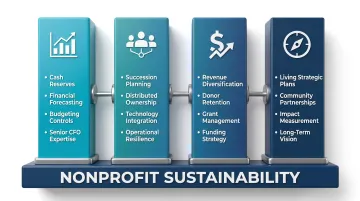
The strongest nonprofits build across all four at once. A gap in any single pillar — even a well-funded one — creates fragility that surfaces under pressure.
Financial Strategies for Long-Term Stability
Strategy 1 — Build and maintain an operating reserve
Financial experts recommend that nonprofits maintain between three and six months of operating expenses in reserve. Yet 52% of nonprofits currently hold three months or less, with 18% having just one month of cash on hand.
An operating reserve acts as a financial shock absorber during funding disruptions, allowing organizations to maintain programs while securing replacement revenue. To build one:
- Multiply monthly operating expenses by 3 to 6 to set your target, adjusting for revenue volatility
- Start by setting aside 1-2% of annual revenue, increasing as capacity allows
- Document reserve targets and usage guidelines for board approval
- Build reserves through surplus operating revenue, not restricted grants
Organizations without reserves face difficult choices when a major grant ends or a key donor departs—cutting staff, eliminating programs, or borrowing to cover payroll.
Strategy 2 — Conduct regular financial health assessments
Many nonprofits review financials only at year-end or during audits. This reactive approach misses early warning signs of trouble. Quarterly financial health assessments turn data into proactive decisions.
Key indicators to track quarterly:
- Liquidity ratio: Current assets divided by current liabilities (target: 1.5 or higher)
- Months of cash on hand: Unrestricted cash divided by average monthly expenses
- Revenue concentration risk: Percentage of revenue from any single source (flag if above 25-30%)
- Program cost ratio: Program expenses divided by total expenses
Research shows that 85% of nonprofit boards approve annual budgets, but only 30% meet with auditors in executive session without staff present. Regular financial health reviews ensure boards fulfill their oversight responsibilities with meaningful engagement rather than rubber-stamping reports.
One Abacus Advisory helps nonprofits implement quarterly financial reviews that give boards clear, actionable insights—so financial data drives real decisions rather than sitting in a binder until the next audit.
Strategy 3 — Build multi-year budgets and rolling cash flow forecasts
Single-year budgets create blind spots. They don't reveal whether next year's projected revenue can sustain this year's new hires. Multi-year projections and 12-month rolling cash flow forecasts solve this problem by forcing leadership to think beyond the current fiscal year.
How to implement multi-year financial planning:
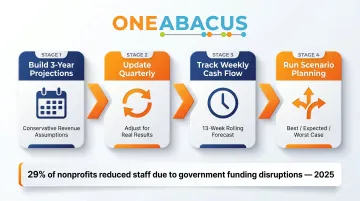
- Build three-year budget projections using conservative revenue assumptions and realistic expense growth
- Update projections quarterly as actual results and external conditions shift
- Track actual cash weekly with rolling 13-week forecasts to stay ahead of gaps
- Run best-case, expected, and worst-case scenarios to prepare for multiple outcomes
Organizations experiencing government funding disruptions in 2025 faced immediate challenges—21% were already serving fewer people by mid-year, and 29% had reduced staff. Multi-year planning helps organizations spot these risks early and adjust before cutting programs.
Strategy 4 — Explore earned income and social enterprise models
Earned income now represents the largest revenue source in the nonprofit sector, generating $1 trillion annually—approximately 50% of all nonprofit revenue. Fee-for-service programs, training workshops, licensing mission-aligned products, or operating social enterprises can supplement donated revenue and reduce dependence on grants.
Examples of earned income models:
- Charging for specialized training or consulting services
- Licensing curriculum or intellectual property
- Operating thrift stores or resale operations (like Habitat for Humanity's 825 ReStore locations)
- Offering fee-based membership programs
Critical considerations:
- Ensure activities align with your 501(c)(3) mission to maintain tax-exempt status
- Calculate true costs—many earned income ventures lose money initially
- Avoid mission drift by keeping earned income closely tied to core programs
Strategy 5 — Invest in the right financial leadership
Senior financial expertise is often the first gap mid-sized nonprofits hit. Executive directors and boards end up making high-stakes decisions without adequate analysis—not by choice, but by necessity. 74.6% of nonprofits reported job vacancies in 2023, with finance and accounting roles among the hardest to fill.
Compounding the problem: only 41% of nonprofits can pay all full-time staff a living wage, making it difficult to compete for CFO-level talent in any traditional hiring process.
Fractional CFO services offer a practical path forward. One Abacus Advisory provides nonprofits with executive-level financial leadership—covering board reporting, cash flow management, and audit preparation—without the cost of a full-time hire.
This approach allows growing organizations to access the financial expertise they need during leadership transitions, rapid growth, or audit preparation without overextending limited budgets.
Leadership and Operational Resilience Strategies
Strategy 6 — Build succession plans for key leadership roles
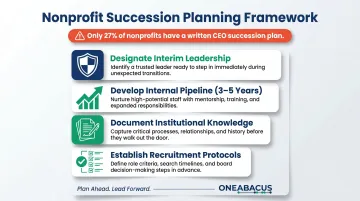
Over-reliance on a single executive director or development director is one of the most common—and preventable—sustainability risks. Yet only 27-29% of nonprofit organizations have a written succession plan for their CEO, and just 27% have an emergency backup plan for unexpected departures.
The consequences are severe: in 80% of nonprofit mergers studied, an executive director had recently left or was soon to depart, demonstrating how destabilizing unplanned transitions can be.
What a documented succession plan includes:
- Designate interim leadership before an unexpected departure forces the decision
- Develop an internal pipeline over 3-5 years so leadership transitions are planned, not reactive
- Document critical institutional knowledge and key relationships that currently live in one person's head
- Establish step-by-step protocols for recruiting, onboarding, and transitioning new leaders
Organizations that build succession plans reduce transition disruption and position themselves to retain institutional knowledge when key leaders move on.
Strategy 7 — Distribute leadership and empower staff
The most resilient nonprofits train staff and volunteers at every level to own pieces of the mission. Distributed leadership reduces single points of failure and surfaces ideas that executive leadership might miss.
How to distribute leadership effectively:
- Delegate decision-making authority to program managers and department leads
- Create cross-functional teams for major initiatives
- Train emerging leaders through mentorship and stretch assignments
- Document processes so knowledge isn't locked in one person's head
Organizations that distribute authority find they respond faster to operational challenges—and retain strong mid-level staff who might otherwise leave for roles with more ownership.
Strategy 8 — Cultivate a change-ready, adaptive culture
Nonprofits that survive disruption are those that treat change as a strength, not a failure. Organizations with adaptive cultures view adjusting strategy, retiring outdated programs, and piloting new approaches as normal parts of mission advancement.
Ways to model adaptability at the leadership level:
- Frame setbacks as learning opportunities in staff meetings and board reports
- Celebrate thoughtful risk-taking even when pilots don't succeed
- Build regular program evaluations into annual cycles
- Encourage staff input on improving processes and programs
The nonprofits that navigate funding cuts, leadership changes, and sector shifts most effectively are those that have already practiced adapting—before the pressure arrives.
Strategy 9 — Leverage technology to build operational capacity
Tools like CRMs, accounting platforms, volunteer management software, and AI-assisted automation reduce administrative burden and create the data infrastructure needed to scale. Yet up to two-thirds of nonprofits express concerns about underutilizing digital platforms, and 59% of nonprofit employees don't receive regular coaching on digital safety.
Key technology investments:
- Centralize donor data, track engagement, and automate communications through a CRM system
- Improve financial reporting accuracy with platforms like NetSuite, Sage Intacct, or QuickBooks Online
- Simplify volunteer scheduling and communication with purpose-built management software
- Reduce repetitive tasks in grant reporting, donor acknowledgments, and data entry through automation
For nonprofits already using platforms like NetSuite or Sage Intacct, the gap is often not the software itself but how it's configured. One Abacus Advisory helps nonprofits get more from these systems through workflow automation, tailored configuration, and user training so finance teams can work with less friction and more reliable data.
Strategy 10 — Strengthen board governance and engagement
An engaged, financially literate board is a critical sustainability asset. Yet both CEOs and board chairs gave their boards a B- grade for financial oversight and a C- for fundraising. Only 33% of boards actively engage in advocacy for their missions.
Best practices for stronger governance:
- Set term limits to bring in fresh perspectives and prevent governance stagnation
- Require quarterly review of key financial indicators, not just annual budget approval
- Establish finance, development, and governance committees so oversight is focused and accountable
- Offer ongoing training on nonprofit finance, fundraising, and fiduciary responsibilities
- Conduct annual board self-assessments to identify gaps before they become problems
Boards focused on strategic rather than operational issues received significantly higher performance grades, demonstrating that governance clarity drives organizational effectiveness.
Fundraising, Revenue Diversification, and Donor Engagement Strategies
Strategy 11 — Audit and diversify existing revenue streams
Revenue concentration creates existential risk. Financially healthy nonprofits ensure no single revenue stream exceeds 25-30% of total revenue. Yet many organizations depend heavily on one or two major sources.
In 2025, one in three nonprofits experienced government funding losses, delays, or stop-work orders. For affected organizations, government funding represented 42% of total revenue—a dangerous concentration that left them scrambling when cuts arrived.
How to audit and diversify revenue:
- Map revenue by source — government grants, foundations, individual donors, corporate sponsors, and earned income
- Flag any source above 30% for immediate attention
- Set targets for reducing concentration over 2-3 years
- If grants dominate, grow individual giving; if donations dominate, explore earned income
The Opportunity Agenda, a 20-year-old nonprofit, dissolved in 2025 after approximately 73% of its revenue became restricted, exhausting its financial runway despite receiving a $4 million MacKenzie Scott grant in 2020. Revenue concentration can sink even well-funded organizations.
Strategy 12 — Launch or grow recurring and monthly giving programs
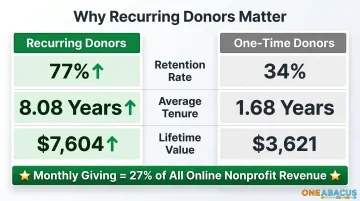
Monthly donors are the most valuable supporters in your database. Recurring donor retention rates reach 77% compared to just 34% for one-time donors, with average active tenures of 8.08 years versus 1.68 years for non-recurring donors and lifetime values of $7,604 versus $3,621. On top of that, 50% of recurring donors make additional one-time gifts above their scheduled donations.
How to launch or expand monthly giving:
- Create a branded monthly giving program with a compelling name
- Offer multiple entry points ($10, $25, $50+ per month)
- Make sign-up simple on donation pages and in email appeals
- Steward monthly donors with exclusive updates and recognition
- Thank monthly donors frequently—they deserve special appreciation
Monthly giving now accounts for 27% of all online revenue for nonprofits, with monthly revenue growing 12% year-over-year. For extra-large nonprofits, monthly giving represents 37% of online revenue, demonstrating its potential at scale.
Strategy 13 — Pursue grants strategically, not opportunistically
Many nonprofits chase any available grant regardless of mission alignment or reporting burden. This opportunistic approach wastes time on low-probability applications and can lead to mission drift when organizations shape programs around funder priorities rather than community needs.
Strategic grants management practices:
- Build a grants calendar tracking deadlines, reporting requirements, and renewal dates in one place
- Calculate staff time required versus award amount to prioritize high-value opportunities
- Connect with program officers before submitting—cold applications rarely succeed
- Only pursue grants that advance your strategic priorities
- Monitor which funders renew and why to refine your approach over time
Managing complex federal, state, and local grant portfolios requires both discipline and infrastructure. One Abacus Advisory supports nonprofits with grants management and government contracting services, helping organizations strengthen compliance, improve reporting accuracy, and maintain funder confidence.
Strategy 14 — Build meaningful corporate partnerships and sponsorship programs
Transactional sponsorships (logo placement for a check) deliver short-term revenue. Strategic corporate partnerships create long-term value for both parties through aligned missions, employee engagement, cause marketing, and multi-year commitments.
How to develop strategic corporate partnerships:
- Research corporations whose missions or values complement yours
- Articulate what the company gains—brand alignment, employee engagement, community impact
- Create tiered partnership levels with multiple entry points from $5,000 to $50,000+
- Secure 2-3 year commitments to build deeper, more productive relationships
- Report tangible results back to partners—outcomes reinforce renewal conversations
The strongest partnerships grow from shared purpose, not transactional asks—and they often expand into employee volunteer programs, in-kind support, and board engagement over time.
Strategy 15 — Use donor data to improve retention and personalization
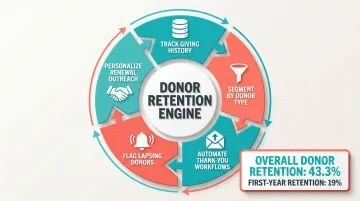
Donor retention is one of the highest-ROI activities in fundraising. Yet overall donor retention rates averaged just 43.3% in 2024, meaning more than half of donors who gave didn't give again the following year.
First-year donor retention is even steeper: approximately 19%. For every 100 new donors acquired, 81 won't give again.
How to improve retention through data:
- Track giving history to know who's lapsed, who's upgraded, and who gives annually
- Segment communications by donor type — monthly, major, and first-time givers need different messages
- Automate thank-you workflows so every donor receives timely, personalized acknowledgment
- Flag donors whose giving frequency has changed before they lapse entirely
- Reference past giving and specific impact when soliciting renewed support
A well-maintained CRM turns donor data into a retention engine. Clean records, consistent segmentation, and timely outreach compound over time—small improvements in retention rates translate directly into significant revenue gains without increasing acquisition costs.
Strategic Planning, Partnerships, and Impact Measurement Strategies
Strategies 16-17 — Create a living strategic plan and align all activities to mission
78% of nonprofit organizations have a formal strategic plan, but many file them away after board approval. A living strategic plan is regularly referenced, updated, and used as a filter for resource allocation decisions.
How to create a living strategic plan:
- Involve board, staff, clients, and community partners in the planning process
- Set measurable 3-year goals defined by specific outcomes, not just activities
- Review progress quarterly to assess what's on track and why things are off
- Update goals and strategies annually as conditions change
- Filter every major initiative through strategic priorities before committing resources
Boards that focus on strategic rather than operational issues receive significantly higher performance grades across governance dimensions. A clear strategic plan enables this focus by giving boards the framework to guide rather than micromanage.
Mission alignment matters just as much as the plan itself. Every program, partnership, and expense should advance strategic goals. When organizations lose sight of mission alignment, they drift toward opportunities that look attractive but don't serve their core purpose.
Strategies 18-19 — Forge community partnerships and collaborate strategically
Partnerships with peer organizations, government agencies, and community coalitions allow nonprofits to share resources, avoid program duplication, and extend reach. Strategic collaboration differs from informal networking—it involves structured agreements, shared goals, and mutual accountability.
Types of strategic partnerships:
- Coordinate complementary services with peer organizations to serve clients more comprehensively
- Pool resources with advocacy coalitions to influence policy changes affecting your shared mission
- Split costs for technology, facilities, or back-office functions through shared infrastructure agreements
- Exchange best practices and learning across organizations through knowledge networks
Effective partnerships require clear expectations, regular communication, and documented agreements about roles, resources, and decision-making authority. That same accountability mindset applies internally — particularly when measuring whether your programs are actually delivering change.
Strategy 20 — Measure, evaluate, and communicate program impact
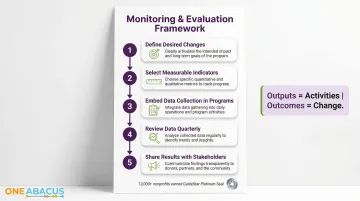
Funders and donors increasingly expect outcomes, not just outputs. Outputs measure activities (clients served, meals distributed). Outcomes measure change — skills gained, health improved, stability achieved.
Yet as many as 75% of foundation professionals surveyed did not believe evaluations provided meaningful insights. Most nonprofits are reporting activity — not the change funders are actually looking for.
Building a monitoring and evaluation framework:
- Define what specific changes your programs are designed to create
- Select measurable indicators that signal those outcomes are being achieved
- Build data collection into program operations from the start — not as an afterthought
- Review data quarterly to identify what's working and what needs adjustment
- Share both successes and challenges with funders, boards, and communities
More than 12,000 nonprofits have earned Candid's GuideStar Platinum Seal of Transparency by sharing results and impact data beyond basic financials. That level of openness builds funder confidence and long-term stakeholder trust — both essential to sustainability.
Conclusion
Nonprofit sustainability is built through consistent discipline — not a single strategic overhaul. Organizations that thrive long-term treat financial health, operational resilience, revenue diversification, and mission alignment as ongoing priorities, not one-time projects.
The 20 strategies in this guide form an interconnected system. Strong financials mean little without capable leadership. Diversified revenue doesn't help if programs drift from mission. A brilliant strategic plan fails without the operational capacity to execute it.
Start where your organization needs it most:
- If cash reserves sit below three months, that's your first priority
- If your executive director has no succession plan, address it now
- If 50% of revenue comes from one grant, diversification can't wait
Strengthening your financial foundation is often the fastest path to progress across all 20 strategies. One Abacus Advisory provides fractional CFO and COO services built specifically for nonprofits, giving boards and executive directors the financial leadership and clear reporting they need to make stronger decisions and build durable organizations.
Frequently Asked Questions
How can a nonprofit become sustainable?
Nonprofit sustainability requires building diverse revenue streams, maintaining financial reserves of three to six months of operating expenses, investing in leadership development and succession planning, and grounding all decisions in a clear strategic plan. These aren't one-time tasks — they require consistent organizational attention.
What are the 3 P's of sustainable improvement?
The 3 P's refer to People, Process, and Purpose. For nonprofits, this means investing in staff and leadership development (People), building efficient operational systems (Process), and staying mission-focused (Purpose). Organizations that develop all three build the resilience to adapt when conditions change.
What is a healthy operating reserve for a nonprofit?
Most nonprofit financial experts recommend maintaining between three and six months of operating expenses in reserve. The right target depends on revenue volatility, program obligations, and risk tolerance—organizations with unpredictable funding need larger reserves than those with stable, diversified revenue.
What are the most common reasons nonprofits fail?
The most frequently cited causes include over-reliance on a single funder, lack of financial controls and reserves, leadership turnover without succession planning, and mission drift. Each of these risks is addressable with proactive financial planning and distributed leadership.
How do you measure nonprofit financial sustainability?
Track these four indicators quarterly to catch risks early:
- Operating reserve ratio — months of expenses held in reserve
- Revenue concentration — no single source should exceed 25–30% of total revenue
- Program expense ratio — percentage of budget spent directly on programs
- Cash on hand — how many months of operations current liquidity covers
How often should a nonprofit update its strategic plan?
Most organizations benefit from a formal 3-year strategic plan reviewed annually, with quarterly check-ins against goals. Major environmental shifts—funding changes, leadership transitions, or significant changes in community needs—should trigger an accelerated review outside the normal cycle.