Introduction
For most nonprofit leaders, compliance isn't a single deadline — it's a constant stream of overlapping obligations. IRS Form 990 filings, grant reporting requirements, restricted fund tracking, state fundraising registrations, and board-level financial transparency each carry their own timelines and rules.
Most organizations manage this with fragmented spreadsheets and manual processes. The result: compliance becomes a reactive scramble instead of a predictable, systematic operation.
Modern financial technology changes that equation. By replacing manual, error-prone workflows with automated systems, nonprofits can meet regulatory obligations consistently — and free staff to focus on mission delivery instead.
This article covers the specific technology categories addressing nonprofit compliance challenges, where they create the biggest impact, and why even the best software requires experienced financial leadership to deliver its full value.
Key Takeaways
- Nonprofit compliance (IRS filings, grant reporting, audits, board transparency) breaks down fast when managed manually
- Accounting platforms, compliance tools, and document management systems each solve a distinct piece of the compliance puzzle
- Automation reduces missed deadlines, minimizes data entry errors, and creates audit trails that stand up to scrutiny
- AI-powered tools now offer real-time dashboards, predictive insights, and anomaly detection for nonprofit finance teams
- Technology works best alongside financial leadership that configures systems correctly and interprets what the data reveals
Why Nonprofit Compliance Is Uniquely Challenging
Nonprofits operate in a multi-layered regulatory environment that spans federal, state, and funder-specific requirements. At the federal level, organizations must maintain tax-exempt status and file IRS Form 990 annually. Approximately 40 states require charitable nonprofits to register before soliciting donations from residents, creating a patchwork of state-level fundraising regulations.
Add employment tax obligations and grant-specific reporting conditions with different deadlines and formats, and the compliance landscape becomes complex fast.
The structural challenges make manual compliance particularly fragile:
- Spreadsheet dependency: Many nonprofits still manage financial data in disconnected spreadsheets, making consistency and accuracy difficult to maintain
- Institutional knowledge risk: Critical compliance knowledge often resides with a single staff member or volunteer, creating vulnerability during transitions
- No centralized audit trail: Without systematic documentation, reconstructing who approved what—and when—becomes a scrambled email search
- Fund segregation difficulties: Separating restricted from unrestricted funds across multiple programs requires discipline that spreadsheets struggle to enforce
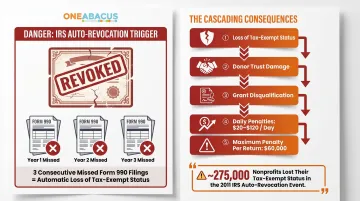
The stakes of non-compliance are high and tangible. The IRS automatically revokes tax-exempt status for any organization that fails to file Form 990 for three consecutive years—a rule that affected approximately 275,000 nonprofits in the initial 2011 auto-revocation list, with roughly 100,000 representing active organizations. Automatic revocation also triggers penalties, damages donor trust, and can disqualify an organization from future grants. For nonprofits operating on tight budgets, these aren't abstract risks—they directly threaten the programs and communities the organization exists to serve. That's precisely where the right technology infrastructure makes a measurable difference.
Key Technology Categories That Simplify Nonprofit Compliance
Accounting and ERP Software
Nonprofit-specific accounting software goes far beyond basic bookkeeping. Platforms like QuickBooks Nonprofit, Sage Intacct, and NetSuite support fund accounting, budget-versus-actual tracking, restricted fund segregation, and financial statement generation in formats boards and auditors expect.
These capabilities matter because nonprofits must track multiple funding sources with different restrictions and reporting requirements at the same time.
The right chart-of-accounts setup reduces compliance errors by ensuring program expenses are coded correctly from day one—not reclassified at year-end when patterns become clear. For growing nonprofits, working with a partner who can optimize these platforms improves how financial data maps to compliance requirements. One Abacus Advisory's NetSuite optimization work, for instance, helped the Philadelphia Zoo strengthen reporting capabilities and maintain operational continuity during a leadership transition.
Key platform considerations:
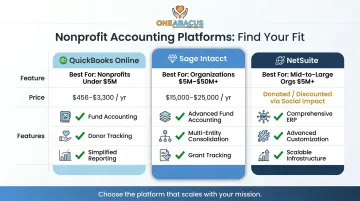
| Platform | Typical Target | Nonprofit Pricing | Key Features |
|---|---|---|---|
| QuickBooks Online | Organizations under $5M | $456-$3,300/year; 50% off first 3 months | Basic fund accounting, donor tracking, simplified reporting |
| Sage Intacct | Mid-size ($5M-$50M+) | $15,000-$25,000/year | Advanced fund accounting, multi-entity consolidation, grant tracking |
| NetSuite | Mid-to-large ($5M+) | Donated or discounted through Social Impact program | Comprehensive ERP, advanced customization, scalable infrastructure |
Proper system configuration from the start prevents the painful data cleanup projects that consume time and budget when compliance deadlines loom.
Compliance Tracking Software
Dedicated compliance tracking tools centralize all regulatory obligations in one system: deadlines for state charity registrations, grant reporting due dates, Form 990 filing windows, and board policy reviews. Automated reminders prevent missed deadlines before they become penalties—a critical safeguard when late filing penalties range from $20 per day for small organizations to $120 per day for those with gross receipts exceeding $1.2 million, with maximum penalties reaching $60,000 per return.
The value extends beyond reminders. Role-based access and audit trails within these systems mean that when a board member or auditor asks "who approved this expense?" the system produces a clear, timestamped record rather than requiring a manual search through email threads and file folders. During audits or leadership transitions, that audit trail can save days of manual reconstruction—and prevent serious gaps when institutional knowledge walks out the door.
Document Management Systems
Digital document management replaces physical filing cabinets with searchable, access-controlled storage for tax forms, board minutes, donor agreements, grant contracts, and IRS correspondence. When audit season arrives, document management systems transform audit prep from a week of scrambling to locate records into a straightforward retrieval exercise.
Benefits include:
- Find specific documents in seconds with full-text search
- Track changes to policies and agreements over time with version control
- Control who can view sensitive financial records with role-based permissions
- Protect critical files from physical damage or loss with automated backup
For organizations managing multiple grants with different documentation requirements, a centralized system means every contract, report, and correspondence is exactly where it should be when auditors ask for it.
Online Fundraising Platforms and Grant Management Tools
Online fundraising platforms built specifically for nonprofits help with state solicitation compliance by tracking donor data, generating required disclosures, and maintaining records of how funds were solicited. This documentation reduces liability for organizations operating in multiple states, where registration requirements vary and penalties for non-compliance can be significant.
Grant management tools similarly centralize proposal tracking, award documentation, budget monitoring, and reporting deadlines—ensuring compliance across the full grant lifecycle from application through closeout.
Where Technology Has the Biggest Compliance Impact
IRS Form 990 Preparation
Form 990 preparation represents one of the highest-risk compliance tasks for nonprofits. The form requires accurate financial data across all programs, correct classification of expenses into functional categories (program, management and general, fundraising), and consistency with prior-year filings. Research comparing 574 New York nonprofits' Form 990s with audited financial statements found significant discrepancies in activity statements and financial ratios, particularly when organizational structures created reporting complexity.
Accounting software that maintains clean, categorized records throughout the year significantly cuts the time and risk associated with 990 preparation. Instead of pulling numbers from disconnected spreadsheets at year-end, the data flows directly from properly configured accounts into the appropriate Form 990 schedules.
Common Form 990 errors that technology helps prevent:
- Missing or late filing (including paper filing when electronic is required)
- Outdated narratives copied from prior years without updates
- Incomplete board member information
- Incorrect reporting of unrelated business income
- Expense misclassification across functional categories
Organizations with well-structured accounting systems consistently report faster, more accurate 990 preparation and fewer questions from auditors reviewing the filing.
Grant Compliance and Restricted Fund Reporting
Organizations expending $1 million or more in federal awards must undergo a Single Audit under OMB Uniform Guidance (the threshold increased from $750,000 for fiscal years beginning October 1, 2024 or later). Single Audits examine whether organizations comply with federal regulations governing allowable costs, cash management, eligibility requirements, and procurement procedures.
Technology enables real-time tracking of restricted fund balances and spending against grant budgets, allowing finance staff to catch overspending or misallocations before they become audit findings. This visibility is especially critical when managing multiple grants with different allowable expense categories and reporting periods.
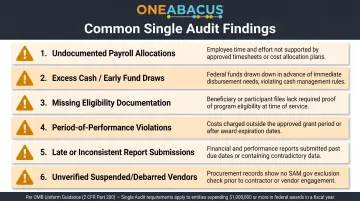
Common Single Audit findings that proper systems help prevent:
- Undocumented payroll allocations and inconsistent indirect cost application
- Drawing funds too far in advance or holding excess cash
- Missing eligibility documentation
- Period-of-performance violations
- Late submissions or inconsistencies between internal records and reports
- Failure to verify vendors are not suspended or debarred
Grant management technology creates systematic controls that enforce compliance requirements as part of normal operations, replacing manual checks that get missed when staff are stretched thin.
That operational discipline extends directly to the board level, where financial systems determine how well governance actually functions.
Board-Level Financial Reporting
Boards carry a fiduciary duty to oversee nonprofit finances, but most board members are not accountants. According to BoardSource's Leading with Intent 2023 study, 74% of nonprofit executives gave their boards an "A" or "B" grade for financial oversight—strong performance that depends on receiving clear, understandable financial information.
Reporting dashboards and automated financial reports translate complex financial data into clear visuals that enable better governance decisions. Budget-versus-actual comparisons, cash flow projections, and program spending summaries allow boards to quickly assess organizational health and ask informed questions about financial strategy.
Technology streamlines board reporting by:
- Generating consistent monthly financial packages automatically
- Creating visual dashboards that highlight trends and variances
- Providing drill-down capability for board members who want detail
- Maintaining historical data for year-over-year comparisons
Boards that receive financial information this way spend less meeting time decoding numbers and more time making strategic calls—which is exactly what funders and regulators expect of them.
Audit Readiness
Technology creates a continuous state of audit readiness rather than an annual scramble. Automated transaction logs, segregation of duties enforced by system controls, and centralized document storage mean that when auditors arrive, the evidence package is ready to go.
Instead of spending weeks reconstructing transactions and hunting down supporting documentation, organizations with strong financial systems can focus on substantive discussions with auditors about strategy and internal controls. The practical outcomes of that shift are consistent:
- Less staff time consumed by audit preparation
- Shorter audit timelines from start to opinion
- Fewer management letter comments and repeat findings
AI and Automation: Emerging Tools for Smarter Compliance
A recent survey of 346 nonprofits found that 92% currently use AI tools in some capacity, though only 7% report major improvements or strategic impact. The gap between adoption and results reflects the early stage of AI integration—most organizations (65%) use AI reactively for one-off tasks rather than embedding it into systematic workflows.
AI-powered features within modern compliance and accounting platforms are beginning to add capabilities beyond reminders and tracking:
- Anomaly detection: Flagging unusual transactions that may indicate errors or misuse before they become audit findings
- Predictive deadline management: Identifying upcoming compliance bottlenecks based on historical patterns
- Natural language querying: Allowing staff to ask financial questions without building manual reports
Automation delivers the most practical value for repetitive compliance tasks where human fatigue drives errors:
- 1099 vendor tracking and form generation
- Payroll tax reconciliation
- Grant drawdown calculations
- Recurring report production
One caution worth noting: AI tools are only as good as the data fed into them. Nonprofits must ensure their underlying financial systems are well-structured and consistently maintained for AI-generated insights to be reliable.
Foundational setup matters most here. A clean chart of accounts, consistent coding practices, and regular reconciliation create the data quality that makes AI outputs trustworthy.
Nonprofits considering AI investments should also plan for the adoption barriers organizations commonly report:
- Lack of training: Cited by 48% of non-users as the primary obstacle
- Privacy and security concerns: Raised by 32% of regular users
- Time constraints: Flagged by 31% as a limiting factor
Addressing these through governance policies, staff training, and phased implementation gives teams the confidence to use AI effectively rather than avoid it.
Technology Alone Isn't Enough: The Case for Expert Financial Leadership
Technology tools provide the infrastructure for compliance, but they require a knowledgeable financial leader to configure them correctly, establish the right account structures, and interpret what reports are actually indicating. Software cannot make judgment calls — a human still has to.
This matters most during organizational growth, leadership transitions, or audit responses. These are the moments when getting the financial details right directly impacts mission continuity.
Many nonprofits lack a full-time CFO but still need that level of financial oversight and strategic guidance. Most organizations don't need a full-time CFO until they reach approximately $25 million in annual revenue. For organizations below that threshold, fractional CFO services provide senior finance leadership on a flexible, right-sized basis.
One Abacus Advisory works this way — providing nonprofits executive-level financial leadership without the cost of a full-time hire. Services include audit preparation, internal controls, grant management, and strategic financial planning: the expertise needed to ensure technology investments serve compliance goals rather than just producing data no one fully understands.
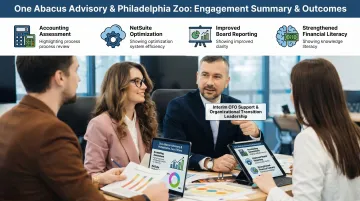
When the Philadelphia Zoo lost both their CFO and Controller simultaneously, One Abacus stepped in as interim financial leadership. The engagement delivered results that went well beyond system maintenance:
- Conducted a comprehensive accounting assessment to identify gaps
- Optimized the NetSuite environment for stronger reporting
- Improved month-end close processes and board reporting workflows
- Strengthened financial literacy across the executive team
Compliance stayed intact throughout the transition — something the technology platform alone couldn't have guaranteed.
The ideal model combines the right technology platform, configured by someone with deep nonprofit finance expertise, and monitored by leadership with the acumen to act on what it shows. That combination is what keeps compliance from becoming a distraction — and keeps your team focused on the mission.
Frequently Asked Questions
How can technology be used to improve compliance?
Technology improves compliance by automating deadline tracking, centralizing required documents, enforcing consistent financial controls, and generating the audit-ready records that regulators and funders expect—replacing error-prone manual processes with systematic workflows that reduce risk and save staff time.
What technology do nonprofits use for financial reporting?
Nonprofits typically use nonprofit accounting software (QuickBooks Nonprofit, Sage Intacct, NetSuite), reporting dashboards, and grant management tools. The right choice depends on organizational size, budget, and the complexity of fund structures and reporting requirements.
How does accounting software help with IRS Form 990 preparation?
Accounting software maintains categorized, year-round records that align with Form 990 schedules, reducing manual data compilation at year-end. It also improves accuracy in classifying expenses across program, management and general, and fundraising—the functional breakdown the form requires.
What is the difference between compliance software and accounting software for nonprofits?
Accounting software tracks financial transactions and produces financial statements, while compliance software manages regulatory deadlines, document storage, and governance workflows. Integrated platforms or a connected tech stack can handle both, eliminating the gaps that standalone tools leave behind.
Can small nonprofits afford compliance technology?
Many compliance and accounting tools offer nonprofit pricing tiers or discounts. The cost of software is typically far lower than the cost of missed deadlines, penalties, or reactive audit response—making it a sound investment even at modest budget levels. Late filing penalties alone can reach $12,000 to $60,000 per return.
When does a nonprofit need a fractional CFO instead of just software?
Software provides infrastructure but cannot replace strategic judgment. A fractional CFO becomes valuable when an organization is growing rapidly, managing complex grants, or navigating leadership transition—and when someone needs to configure systems correctly and translate financial data into clear, board-ready insights.