Introduction
The executive director sends an unexpected resignation email at 9:03 PM on a Thursday. By Friday morning, the board chair's phone is buzzing with anxious staff questions, a funder is asking who will sign the upcoming grant agreement, and the bank has already flagged a signature authorization issue. This scenario—chaotic, disorienting, and far more common than most boards anticipate—is precisely when governance structure matters most.
With approximately 19% annual voluntary turnover in the nonprofit workforce and only 34% of nonprofits maintaining written succession plans, most boards face executive transitions unprepared. The first formal governance action in this moment is passing a directors resolution to appoint an interim director — before posting a job description, before addressing staff concerns, before anything else.
This guide explains exactly what that resolution is, what it must contain, and how to pass it correctly — so the appointment holds up legally, keeps operations moving, and gives your board a credible foundation for the transition ahead.
Key Takeaways
- A directors resolution formally authorizes the board's appointment of an interim director and defines their authority
- Without one, the interim director has no authority to sign contracts, access bank accounts, or make staffing decisions
- The resolution must cover duration, scope of authority, financial signing limits, and reporting requirements
- Passage requires a formal board vote with proper notice, quorum, and documentation in board minutes
What Is a Directors Resolution for a Nonprofit Interim Director?
A directors resolution is the written record of a binding decision made by a nonprofit's board of directors. It is the legal mechanism through which a board officially grants authority to an individual to act on behalf of the organization — not a verbal assurance or informal agreement, but a documented, enforceable act.
In the nonprofit context, this resolution is specifically used to appoint an interim director when the permanent executive director position becomes vacant. It's narrower in scope and duration than a permanent employment contract, but carries more authority than simply reassigning duties to existing staff.
That authority has real operational weight. Without a properly executed resolution, even a highly qualified interim director cannot effectively operate:
- Banks require a board resolution before recognizing any individual as an authorized signatory
- Government agencies won't process filings without documented proof of authority
- Grant funders and major vendors typically require a resolution on file before allowing contract execution
State nonprofit laws vary on formal requirements. The Model Nonprofit Corporation Act (MNCA) guides many states, specifying that "all corporate powers shall be exercised by or under the authority of the board of directors."
Before passing a resolution, boards should review their state's nonprofit corporation act and their own bylaws to confirm procedural requirements, quorum thresholds, and voting rules.
When Does a Nonprofit Board Need This Resolution?
A directors resolution becomes necessary in both planned and emergency scenarios:
Common triggering events:
- Planned retirement or scheduled departure
- Sudden or forced resignation
- Medical leave or extended absence
- Termination for cause
- Death of the executive director
The risk of handling transitions informally:
Many boards ask a senior staff member to "step up temporarily" or have a board member take over day-to-day management. Both approaches create immediate legal and operational exposure. The interim director must have documented authority from day one to:
- Sign contracts and execute agreements
- Access organizational bank accounts
- Make personnel decisions
- Represent the organization to funders and regulators
- Manage vendor relationships
Critical timing:
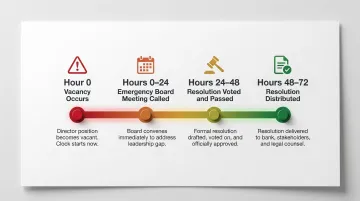
Without that documented authority, even routine decisions can stall—or expose the organization to liability. The resolution should be passed at an emergency or special board meeting before the interim director begins their duties. For unplanned vacancies, ratify it within 48-72 hours. Most states require only two days' notice for special board meetings, so acting fast and governing properly aren't mutually exclusive.
What Must a Directors Resolution for an Interim Director Include?
Name and Title
State the individual's full legal name and exact title they will hold, such as "Interim Executive Director." Avoid vague language like "acting director" or "temporary manager," which creates confusion with funders, banks, and government agencies.
Effective Date and Duration
Specify:
- The start date (exact date the interim begins their role)
- The anticipated end date or triggering condition (e.g., "until a permanent Executive Director is appointed and begins employment")
- Any bylaw-imposed caps on interim appointment periods (most governance advisors recommend capping these at 9–12 months)
Including a sunset clause prevents the interim arrangement from drifting indefinitely, which can undermine donor confidence and staff stability.
Scope of Authority
Clearly enumerate the powers being granted:
- Authority to manage staff and day-to-day operations
- Power to execute contracts below a specified dollar threshold
- Authority to represent the organization publicly
- Ability to manage vendor relationships
- Permission to communicate with funders and government agencies
Financial Authority and Limits
This is where most boards create risk by being too vague. The resolution must specify:
- Signing authority for bank accounts
- Check-signing thresholds (e.g., checks under $5,000 may be signed individually; checks over $5,000 require dual signatures)
- Grant disbursement authority
- Credit card and wire transfer limits
- Dollar threshold above which board approval is required for contracts or expenditures
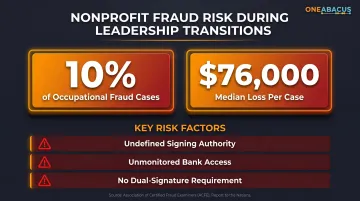
The Association of Certified Fraud Examiners found that nonprofits account for 10% of occupational fraud cases, with a median loss of $76,000 per case. Leaving financial authority undefined in a transitional role is one of the most common — and costly — governance gaps boards create.
Reporting and Oversight Requirements
Once financial boundaries are set, the resolution should define accountability measures to match:
- Frequency of reports to the board (e.g., bi-weekly written updates, monthly board meetings)
- Designation of a board liaison or oversight committee
- Required approvals for major decisions
- Financial review protocols (e.g., board treasurer reviews monthly financials)
A designated board liaison — rather than the full board — typically works best here, creating a single point of contact that keeps oversight consistent without slowing the interim's day-to-day work.
How to Draft and Pass the Resolution: A Step-by-Step Approach
Each step below builds on the last — skipping any one can expose the organization to legal or operational risk. Work through them in order.
Step 1 — Review Bylaws and Prior Resolutions
Before drafting, the board chair or legal counsel should review:
- The organization's bylaws for specific language requirements for interim appointments
- Quorum thresholds for calling a special meeting (MNCA default is a majority of directors, with a minimum floor of one-third)
- Voting requirements (simple majority vs. supermajority)
- Notice requirements for special meetings (varies by state; Colorado requires two days' notice)
- Any prior resolutions that set precedent or delegate authority
Step 2 — Draft the Resolution Language
Standard resolution structure:
- Opening recitals ("Whereas" clauses) — State the reason for the appointment and factual background
- Resolved clauses — Each specific grant of authority, numbered sequentially
- Signature block — Board chair and secretary signatures
- Date — Date of board action
First-time boards should use a template from a nonprofit attorney or state nonprofit association. The resolution must be clear, specific, and aligned with the organization's bylaws.
Step 3 — Hold a Properly Noticed Board Meeting
Meeting requirements:
- Adequate notice must be given to all board members (minimum two days in many states; check your bylaws)
- A quorum of directors must be present (in-person or virtually, per bylaws)
- The board must present, discuss, and vote on the resolution
- The vote count must be recorded (majority of directors present is required under MNCA Section 8.24 unless bylaws specify otherwise)
Alternative: Action without a meeting requires unanimous written consent under default MNCA rules, though some bylaws allow a lower threshold. For most interim appointments, an emergency meeting is the faster path.
Step 4 — Record and Distribute
The resolution must be:
- Entered into official board minutes, signed by the board chair and secretary
- Distributed to the interim director
- Provided to the organization's bank (to update authorized signatories)
- Filed with legal counsel
- Shared with major funders, if required by grant agreements
- Provided to any other entities requiring it (insurance companies, government agencies)
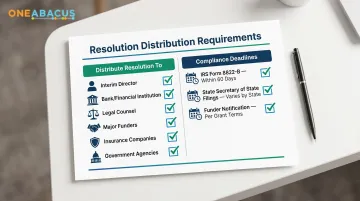
Compliance deadlines:
- IRS Form 8822-B must be filed within 60 days if the "responsible party" changes
- State Secretary of State filings may be required to update registered agents or officers (varies by state)
- Grant funders may require written notification within specific timeframes
Financial Authority and Oversight During the Interim Period
Leadership transitions are periods of heightened financial vulnerability. Staff may test boundaries, internal controls can slip, and deferred financial issues often surface once a new leader begins reviewing the books. Tight financial oversight during this period is non-negotiable.
Key financial safeguards to implement alongside the resolution:
- Require dual signatures for checks or wire transfers above a set threshold (such as $5,000)
- Have the board treasurer review monthly financials with written sign-off
- Restrict access to credit accounts until the board reviews and reauthorizes them
- Route monthly bank reconciliations to someone other than the preparer for review
- Schedule surprise audits or periodic vendor list reviews to catch irregularities early
Fractional Financial Leadership During Transitions
These safeguards are easier to sustain when someone with financial expertise owns the process. Some nonprofits use the transition period to bring in fractional financial leadership—such as a fractional CFO or COO through a firm like One Abacus Advisory. This approach maintains financial controls, produces clear financial reporting for the board, and ensures the organization is financially prepared when permanent leadership steps in.
When the Philadelphia Zoo experienced a leadership transition following the departure of both their CFO and Controller, One Abacus Advisory stepped in with fractional CFO and Controller support. Their work included optimizing the NetSuite environment for enhanced reporting and improving month-end close processes.
The engagement also supported the recruitment and onboarding of new financial leadership—ensuring continuity, strengthening financial literacy across the executive team, and maintaining board confidence throughout.
Common Mistakes Nonprofit Boards Make With Interim Director Resolutions
Mistake 1: Granting Unlimited or Undefined Authority
Vague resolutions like "the interim director shall have full authority to manage the organization" create risk. Without clear limits, the board cannot hold the interim accountable or easily contain decisions that exceed the board's intentions. Every resolution should specify dollar thresholds, approval requirements, and restricted actions.
Mistake 2: Failing to Notify External Stakeholders
After passing the resolution, the board must proactively notify:
- The bank to update authorized signatories (provide a certified copy of the resolution)
- Major funders whose grant agreements require notification of leadership changes
- Government agencies for registered agent or signatory updates
- Key vendors who need updated contact and authorization information
Failing to complete these notifications can freeze operations, delay payments, and undermine funder confidence.
Mistake 3: Delaying the Permanent Search or Extending Interim Tenure Indefinitely
An interim appointment is designed to be time-limited. Most nonprofit governance advisors recommend keeping interim appointments to 9–12 months — enough time for a thorough permanent search without stalling the organization. Boards that allow the interim period to extend beyond this timeframe risk:
- Donor uncertainty about organizational stability
- Staff instability and turnover
- Dependency on a temporary leader who lacks long-term incentive alignment
- Loss of strategic momentum
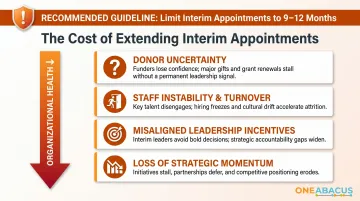
The resolution should include a defined term or clear end condition, not an open-ended appointment.
Frequently Asked Questions
What is the role of an interim director?
An interim director is a temporary, experienced leader appointed by the board to maintain organizational stability, manage day-to-day operations, and prepare the organization for its next permanent executive. This is a strategic appointment, not a placeholder role—the interim is accountable for keeping the organization on course during the transition.
How much does an interim director make?
Compensation varies widely based on organization size, geography, and the interim's experience. According to Candid's 2025 Nonprofit Compensation Report, the median CEO/Executive Director salary is $110,000, though interim roles may be structured differently. Boards should benchmark current nonprofit sector salaries and set compensation in the resolution or an accompanying offer letter.
Can a board member serve as the interim director?
Most governance experts advise against it. Serving in both roles simultaneously blurs the line between governance and management, creates conflicts of interest around salary approval and budget oversight, and undermines the objectivity the interim role requires. If a board member must serve, full disclosure, formal documentation, and recusal from all compensation votes are non-negotiable.
Does a directors resolution for an interim director need to be filed with the state?
The resolution itself is generally an internal governance document and does not require state filing. However, any resulting changes to registered agents or authorized officers must be updated through the appropriate state nonprofit filings. Additionally, IRS Form 8822-B must be filed within 60 days if the organization's "responsible party" changes.
How long should an interim director serve?
Most sector guidance recommends a term of 9-12 months, sufficient for the board to conduct a thoughtful permanent search without rushing. The resolution should specify the duration or a clear end condition (such as "until a permanent Executive Director is hired and begins employment") rather than leaving it open-ended.
Can the interim director be considered for the permanent role?
Most governance advisors caution against it. An interim angling for the permanent role may make decisions designed to impress the board rather than serve the organization's best interests. If the board wants to consider the interim as a candidate, end the interim contract first and run a transparent, competitive search.