AI isn't a futuristic concept for nonprofit finance teams — it's an operational tool already reshaping how high-performing organizations work today. From automating invoice processing to flagging compliance risks before they reach auditors, AI enables nonprofits to redirect scarce time from transaction processing toward strategic decision-making and mission delivery.
This article covers specific AI use cases already delivering measurable results in nonprofit finance, how AI enables more strategic decision-making, what organizations need before implementation, and practical first steps that don't require large budgets or technical expertise.
TLDR:
- AI automates high-volume finance tasks like AP processing, expense management, and compliance monitoring
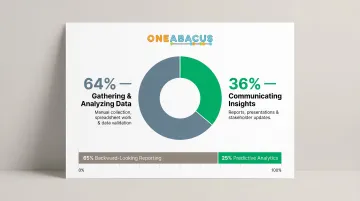
- Finance professionals currently spend 64% of time gathering data versus communicating insights — AI shifts this ratio
- Organizations need clean data infrastructure and human oversight frameworks before adopting AI tools
- Starting with one workflow (such as AP automation) delivers fastest ROI and builds momentum for broader adoption
- Fractional CFO support helps nonprofits assess readiness and implement AI responsibly without full-time hires
Why Nonprofit Finance Teams Are Under Pressure
The resource asymmetry facing nonprofit finance teams is structural, not temporary. While for-profit companies typically staff finance functions based on transaction volume and complexity, nonprofits operate under a different constraint: maximizing the percentage of every dollar that reaches program delivery. This creates finance teams expected to manage grant tracking, restricted versus unrestricted fund accounting, donor reporting, and audit preparation — often with fewer people than similarly-sized for-profit organizations.
Research from the National Council of Nonprofits confirms the scale: 59% of US nonprofits operate with annual budgets under $50,000, and 97% have budgets below $5 million. These organizations collectively employ 12.8 million workers — nearly 10% of the US private workforce — yet maintain extremely lean administrative functions by design.
Staffing makes the problem harder to solve over time. According to the NCN Workforce Survey, 72% of nonprofits struggle with finance and accounting turnover, with 38% reporting frequent or very frequent turnover. The top barriers:
- Salary competition (72.2%)
- Budget constraints (66.3%)
- Nearly one in three nonprofits cite timely and accurate financial reporting as their top financial challenge
Compliance requirements are expanding on the same lean teams. The Single Audit threshold increased to $1 million starting with fiscal years ending September 30, 2025, pushing organizations managing federal grants onto dual compliance paths depending on award dates. New standards such as ASC 842 lease accounting add present-value calculations, expanded disclosures, and new internal control requirements.
The net result: finance leaders spend more time on transactions and controls, less on strategy.
AICPA & CIMA research covering over 5,500 finance professionals found that finance teams spend 64% of their time gathering and analyzing information versus only 36% communicating insights. 65% of reporting remains backward-looking (descriptive or diagnostic), with only 25% of teams using predictive or prescriptive analytics.
Automating high-volume, repeatable financial tasks — not overhauling everything at once — is where AI gives nonprofit finance teams real room to breathe.
High-Impact AI Use Cases in Nonprofit Financial Management
Accounts Payable Automation
AI-powered AP automation works by scanning invoices, extracting data through optical character recognition, coding transactions to the correct fund or program, and routing approvals through rule-based workflows. Finance staff receive exception summaries rather than reviewing every transaction manually.
This matters especially for nonprofits managing multiple restricted grants. Each invoice must be coded not just to an expense category but to a specific funding source with its own compliance requirements. Manual processes create bottlenecks and audit risk.
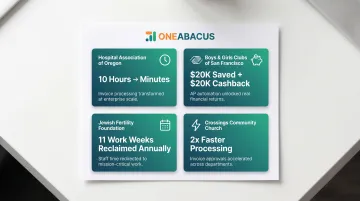
Named case studies from Ramp demonstrate measurable outcomes:
- Hospital Association of Oregon: Reduced batch processing from 10 hours to minutes; eliminated 10+ hours per week of manual check printing
- Boys & Girls Clubs of San Francisco: Saved $20,000 annually by eliminating prior AP platform fees; earning over $20,000 per year in cashback rewards
- Jewish Fertility Foundation: Reclaimed 11 work weeks of staff time annually
- Crossings Community Church: Accelerated bill processing by 2x, reducing invoice review from weeks to hours
AI-Enabled Expense Management
Virtual card platforms now integrate AI to restrict spending to approved categories, auto-code expenses at the point of transaction, and map costs directly to grants or program funds. Employees receive mobile alerts prompting receipt submission, eliminating month-end scrambles.
For organizations managing multiple funding sources with different allowable costs, this capability accelerates close timelines and reduces manual reconciliation. Expense policy violations are flagged in real time rather than discovered weeks later during reconciliation.
Payroll and Labor Compliance
For nonprofits with hourly or grant-funded staff, AI integrated into payroll processing flags unexpected overtime, identifies rate discrepancies, and highlights missing personnel documentation during payroll runs rather than at audit time.
For organizations billing labor to federal grants, this is particularly high-stakes — payroll errors can trigger questioned costs and put funder relationships at risk. Catching discrepancies at the time of payroll, rather than months later during an audit, is a meaningful operational shift.
Budgeting and Forecasting
AI consolidates historical financials and program funding data faster than manual processes, enabling finance teams to model scenarios, run rolling forecasts, and shift time from data assembly to analysis.
Traditional budgeting involves weeks of spreadsheet wrangling across departments. AI-enabled platforms change that dynamic:
- Pull actuals automatically from connected systems
- Apply budget assumptions consistently across all programs
- Refresh forecasts on demand without manual rebuilding
- Free finance leaders to validate assumptions rather than hunt for numbers
Fraud Detection and Financial Anomaly Monitoring
ACFE research analyzing 1,921 fraud cases found that organizations using proactive data analytics experience fraud losses 50% lower than those that do not. AI systems monitor 100% of transaction data continuously, flagging unusual patterns or outlier transactions for human review.
Manual spot-checking simply cannot match this coverage. AI detects:
- Duplicate vendor payments
- Unusual transaction timing or amounts
- Vendors with employee address matches
- Expense patterns inconsistent with historical norms
AI-Assisted Audit Preparation
Depreciation schedules, present-value calculations for pledges receivable, and grant amortization schedules can now be generated directly from system data. Staff time shifts from manual schedule preparation to validation and documentation.
For organizations preparing for Single Audits or financial statement audits, this reduces the weeks-long scramble to assemble workpapers and allows finance teams to focus on substantive audit questions.
How AI Elevates Strategic Financial Decision-Making
The Strategic Time Shift
When routine transaction processing and reconciliations are automated, finance leaders redirect time toward analysis, forecasting, and advising leadership. McKinsey research surveying 102 CFOs found that a global consumer goods company achieved an estimated 30% savings in finance professionals' time by using AI to replace manual number crunching for budget variance insights.
The AICPA study notes that more than half of finance respondents expect over 20% of finance tasks to be automated within three years — yet only 10% of teams currently have the skills to support this transition.
Real-Time Financial Dashboards and Board Reporting
Instead of producing backward-looking reports, finance leaders can give boards direct access to current financial health metrics, variance analysis, and program-level spending data — in formats built for decision-making, not just recordkeeping.
Organizational accountability and donor transparency both depend on it. Board members need to understand not just what happened last quarter, but whether the current trajectory puts the organization on track to end the year on budget — and where course corrections may be needed.
Grant Fund Tracking and Compliance
AI-enabled ERP systems handle grant oversight tasks that previously required manual monitoring:
- Track spending against grant budgets by fund and program
- Flag budget-to-actual variances in near real time
- Generate compliance reports tied to funder requirements
This reduces audit findings risk and protects funder relationships.
For organizations managing multiple restricted grants simultaneously, manual tracking creates lag time between spending and awareness of budget overruns. Automated variance monitoring enables course correction before overruns become audit findings.
Revenue Forecasting and Funding Trend Analysis
AI tools analyze historical donor giving patterns, grant renewal cycles, and program revenue trends — helping finance leaders anticipate cash flow gaps months in advance and model funding scenarios before decisions become urgent.
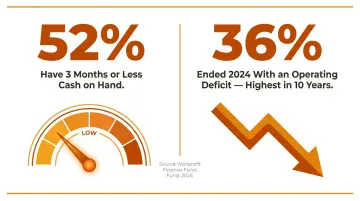
The Nonprofit Finance Fund's 2025 survey found that 52% of nonprofits have three months or less of cash on hand, and 36% ended 2024 with an operating deficit — the highest in 10 years. For organizations already operating on thin margins, having that early warning window is what separates a managed response from a financial emergency.
What Nonprofits Need Before Implementing AI
Data Infrastructure: The Primary Failure Point
Gartner research cited by RSM Technology predicts that 60% of AI projects will fail due to weak data foundations — incomplete, outdated, or incorrect data. AI tools require clean, consistent, and connected financial data to function reliably. Organizations without a modern ERP or cloud accounting system as a single source of truth will find AI tools underperform or produce unreliable outputs.
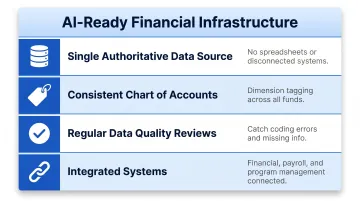
"AI-ready" financial infrastructure means:
- One authoritative data source for financial transactions (not multiple spreadsheets or disconnected systems)
- Consistent chart of accounts and dimension tagging across all funds and programs
- Regular data quality reviews to catch coding errors or missing information
- Integration between financial, payroll, and program management systems
Research from NonProfit PRO found that 61% of nonprofits still rely on generic spreadsheets for financial management, and only 21% are taking steps to modernize their financial systems.
Governance and Human Oversight
AI cannot sign off on financial statements, defend a judgment call to auditors, or take responsibility for a control failure. Human-in-the-loop controls are essential, especially in nonprofit environments where board accountability and funder scrutiny are high.
TechSoup's AI Usage Policy Resource Guide recommends that nonprofits establish governance frameworks covering:
- Which AI tools are approved for use with sensitive data
- Who reviews AI-generated outputs before they inform decisions
- How AI recommendations are documented for audit trails
- Data protection responsibilities for donor information, employee records, and financial data
Research from Nonprofit Tech for Good found that 40% of nonprofit staff say no one at their organization is educated in AI, and only 4% of nonprofits have specific budgets allocated for AI training.
Cybersecurity and Data Protection
The CyberPeace Institute reports that 68% of nonprofits experienced a data breach in the prior three years, and 56% have no cybersecurity budget. Nonprofits are the second most targeted sector by cybercriminals according to Microsoft's Digital Defence Report.
Adopting AI without security safeguards creates real exposure. Key steps include:
- Verify vendor data protection agreements are in place
- Ensure AI tools operate within approved enterprise environments (not public platforms)
- Establish policies prohibiting confidential data input into unapproved AI tools
- Conduct security reviews of any third-party AI vendor
The Role of Strategic Financial Leadership
Assessing AI readiness, evaluating tools against existing workflows, and building governance frameworks requires financial leadership most nonprofits don't have in-house. A fractional CFO fills that gap — bringing the strategic oversight needed to implement AI responsibly, at a fraction of the cost of a full-time hire.
One Abacus Advisory has partnered with organizations including the San Diego Food Bank and Philadelphia Zoo on exactly this kind of work. At the Philadelphia Zoo, the team stepped in during a period when both the CFO and Controller roles were vacant — optimizing the NetSuite environment and strengthening reporting capabilities while leadership transitioned.
A Practical Starting Roadmap for Nonprofits
Start with One High-Volume Pain Point
Attempting broad transformation creates overwhelm and delays results. Most organizations find the fastest, most measurable early wins in accounts payable processing and expense management.
These workflows are:
- High-volume and repeatable (perfect for automation)
- Time-consuming when done manually
- Subject to compliance and audit requirements (automation improves control documentation)
- Directly measurable (hours saved, processing time reduced, errors eliminated)
The Ramp case studies demonstrate that AP automation consistently delivers ROI across nonprofit budget sizes.
Build Sustainably: Understand, Train, Measure
Once AP automation is running, resist the urge to scale immediately. Understand the tools, train staff, and measure results before expanding to other workflows. A simple internal governance structure might include:
- Designating a single point person to coordinate AI evaluation
- Establishing a quarterly review to assess results and share learnings
- Documenting what works (and what doesn't) for future reference
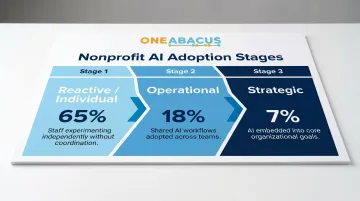
Research from Virtuous and NonProfit PRO found that 65% of nonprofits are at the reactive/individual stage (staff experimenting independently), 18% are operational (shared workflows across teams), and only 7% are strategic (AI embedded in organizational goals). Moving from reactive to operational requires deliberate coordination — not just individual experimentation.
The Lead-or-Follow Question
The timing question is real. Peer organizations that adopt AI tools early will gain efficiency advantages that compound over time. But adoption without data infrastructure or governance frameworks creates compliance and reputational risk.
Strategic experimentation — starting small, measuring results, documenting learnings, and expanding methodically — threads that needle.
The Essential Role of Strategic Financial Leadership
Strategic financial leadership is essential throughout this process — from initial readiness assessment to tool selection to ongoing oversight. For nonprofits without a dedicated CFO, engaging a fractional CFO partner with nonprofit-specific expertise provides the right level of guidance without over-committing internal resources.
For example, when the San Diego Food Bank faced a critical leadership transition, One Abacus Advisory stepped in as interim Finance Director — keeping month-end close processes on track while the organization recruited a permanent replacement. Expertise in nonprofit accounting and NetSuite meant operations stabilized quickly, freeing the internal team to stay focused on mission delivery.
Frequently Asked Questions
What are the biggest barriers nonprofits face when adopting AI in finance?
The most common obstacles are limited clean data infrastructure, tight budgets, and uncertainty about where to start. Beginning with one high-volume workflow — such as AP automation — lowers the barrier and builds organizational confidence from a practical, measurable win.
How does AI help with grant compliance and restricted fund accounting?
AI-enabled systems track spending by fund and grant in real time, flag budget variances automatically, and generate compliance documentation. This reduces manual effort and audit risk for organizations managing multiple restricted grants at once.
Is AI secure enough for sensitive nonprofit financial and donor data?
Security depends on implementation. Use AI tools only within approved enterprise environments, never input confidential data into public AI platforms, and ensure vendor data protection agreements are in place before adoption. Given that 68% of nonprofits experienced breaches in the past three years, vendor security evaluation is non-negotiable.
Does a nonprofit need a large budget to start using AI in financial management?
Not necessarily. Many modern ERP and accounting platforms — including Sage Intacct — include embedded AI features within core subscriptions, and starting with one workflow like AP automation can deliver ROI that funds broader adoption.
How is AI different from the accounting software nonprofits already use?
Traditional accounting software records and reports transactions. AI tools go further — analyzing patterns across large data volumes, flagging anomalies, automating routing decisions, and generating predictive insights layered on top of existing systems.
Should nonprofits hire a dedicated AI specialist to implement these tools?
Most nonprofits don't need a dedicated hire for early-stage implementation. Designating an internal point person and engaging external financial or technology advisors for governance and tool selection is a more practical and cost-effective approach. Fractional CFO partners with nonprofit expertise can provide strategic oversight without the commitment of a full-time role.