Introduction
Most nonprofits today face a challenging operational reality: administrative budgets are shrinking while compliance demands multiply. Organizations juggle multiple funding streams—each with distinct tracking requirements—while lean finance teams struggle to manage month-end close, grant reporting, and audit preparation. 36% of nonprofits ended 2024 with an operating deficit, the highest level in a decade, and 52% have three months or less of cash reserves.
That financial pressure is exactly where automation earns its place. Financial automation is often framed as a technology discussion: dashboards, APIs, cloud platforms. For nonprofits, its real value shows up elsewhere—in mission outcomes.
This article breaks down the specific, measurable advantages financial automation delivers to nonprofit organizations. Not in theory, but in daily operations where more staff hours reach programs, compliance surprises shrink, and funders gain confidence from transparent, accurate reporting.
Key Takeaways
- Financial automation replaces error-prone manual tasks like reconciliation, grant tracking, and reporting with systems that run without intervention
- Top benefits: automated fund restrictions strengthen grant compliance, staff time shifts to mission work, and real-time data enables proactive decisions
- Without it, nonprofits risk audit surprises, burned-out finance staff, and leadership acting on stale financial data
- Automation's value compounds over time—especially as organizations scale, add grants, or navigate leadership transitions
What Is Financial Automation for Nonprofits?
Financial automation uses software and systems to handle routine financial tasks without manual intervention at each step. This includes:
- Accounts payable and payroll processing
- Bank reconciliation
- Fund accounting and grant expense tracking
- Monthly financial statement generation
- Automated compliance reporting
Financial automation isn't a single tool—it's a process layer applied across accounting, budgeting, grant management, and compliance workflows. Organizations implement automation through platforms like NetSuite, Sage Intacct, QuickBooks, or specialized nonprofit ERP systems.
When implemented well, these platforms give finance teams more control, reduce human error by design, and free leadership to focus on strategy rather than chasing down data issues. For the over 2 million nonprofit organizations registered in the US, that shift means more time and resources directed toward programs—not paperwork.
Key Advantages of Financial Automation for Nonprofits
The three advantages below address challenges that directly affect a nonprofit's ability to function, grow, and maintain stakeholder trust. Each advantage is grounded in operational impact, not theory.
Advantage 1: Stronger Grant Compliance and Fund Accountability
Nonprofits operate under strict requirements from grantors, the IRS, and regulators. They must track restricted versus unrestricted funds, document allowable expenses, and maintain audit-ready records. Manual processes create significant compliance exposure.
How automation addresses this:
Automated fund accounting systems apply restrictions at the transaction level. When a staff member codes an expense, the system enforces fund rules immediately: flagging misallocated charges, maintaining continuous audit trails, and blocking restricted grant funds from being used inappropriately.
This enforcement happens across multiple grants simultaneously, without requiring staff to memorize each grant's unique rules.
Why this matters:
A single compliance error—charging a restricted grant for unallowable expenses, for instance—can trigger grant termination, tax-exempt status review, or reputational damage that affects future fundraising. Research shows that 83-94% of spreadsheets contain at least one error, with cell error rates ranging from 1.1% to 5.6% in controlled experiments. Among 25 operational spreadsheets audited in one study, 11 contained errors exceeding $100,000.
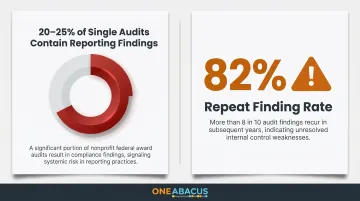
For nonprofits managing federal awards, the stakes are higher. Among Single Audit submissions (required when federal funding exceeds $1,000,000), reporting findings appeared in 20-25% of audits, and nonprofits carry an 82% repeat finding rate—meaning organizations that receive a compliance finding are highly likely to receive the same finding again without systemic process changes.
Beyond penalty avoidance, audit-clean financials position organizations to compete for larger, more complex grants.
KPIs impacted:
- Grant reporting accuracy rate
- Compliance incident frequency
- Audit preparation time
- Number of restricted funds managed concurrently without error
When this matters most:
This advantage delivers highest impact when nonprofits are managing five or more active grants, have recently received federal or multi-year awards, or are scaling into new program areas with distinct funding requirements.
Advantage 2: Freed Staff Capacity for Mission-Driven Work
Most nonprofits with budgets under $5M rely on one or two finance staff members who often handle non-finance duties as well. Manual processes like monthly reconciliation, payroll, invoicing, and report generation consume hours that could otherwise support program delivery.
How automation addresses this:
Recurring tasks run on schedule without manual input. Bank reconciliation happens automatically overnight. Bill payments process according to approval workflows. Payroll runs without data re-entry. Monthly close procedures follow templated steps, reducing the finance team's administrative burden while maintaining accuracy and oversight.
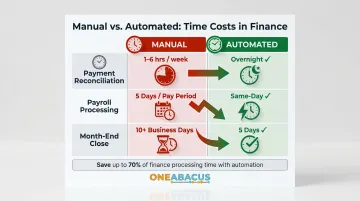
The time savings are measurable:
- Finance professionals spend 1–6 hours weekly on payment reconciliation alone, depending on transaction volume
- Manual payroll takes approximately 5 days per pay period—roughly 21 days annually
- A healthy month-end close runs 5–10 business days; manual processes often stretch to two weeks or more
Why this matters:
The overhead ratio—administrative costs as a percentage of total expenses—is a metric donors and rating organizations use to evaluate nonprofits. Charity Navigator emphasizes that 70% or more of expenses should support programs, while BBB Wise Giving Alliance requires at least 65% program spending. Reducing manual finance tasks directly improves this ratio and signals operational efficiency.
Staff time recovered from routine processing shifts directly to program coordination, donor stewardship, or grant writing. That reallocation matters even more given that nonprofit sector turnover runs at 19% compared to 12% in other sectors, with replacement costs estimated at 33–200% of annual salary. Reducing administrative burden is one of the more direct levers for retaining finance staff.
KPIs impacted:
- Administrative overhead percentage
- Monthly close cycle time
- Staff hours spent on routine finance tasks
- Program expense ratio
When this matters most:
This advantage is most critical during organizational growth, leadership transitions, or when operating without a full-time CFO—situations where a lean finance function is stretched beyond capacity.
Advantage 3: Real-Time Financial Visibility for Boards and Leadership
Nonprofit boards carry fiduciary responsibility but often receive financial information that is weeks old, inconsistently formatted, or difficult to interpret. Executive directors face the same problem when navigating cash flow, budget variances, or program-level spending.
How automation addresses this:
Integrated financial systems generate live dashboards, automated variance reports, and on-demand statements. Board members and leadership access an accurate, current picture of organizational finances without requiring the finance team to manually compile data before each meeting. Reports automatically include budget-to-actual comparisons, restricted versus unrestricted cash breakdowns, and trend analyses.

Why this matters:
When financial data is current, leaders can identify budget shortfalls, cash flow gaps, or overspent programs weeks earlier—and adjust before small variances become serious problems.
Despite 85% of nonprofit CEOs rating their boards A or B for financial oversight, overall board performance remains a B-, and only 58% of CEOs feel boards are highly effective at monitoring strategic progress. The gap suggests boards receive financial data but lack the context needed for strategic decision-making. Best practice recommends boards receive financial reports within 10-15 days of month-end, but many organizations miss this window with manual processes.
When leadership can produce accurate, detailed financial reports quickly—whether for a major donor, grant application, or audit—it strengthens organizational credibility and increases competitiveness for funding.
KPIs impacted:
- Board reporting turnaround time
- Budget-to-actual variance accuracy
- Time to produce monthly financial statements
- Donor report completion rate
When this matters most:
Real-time visibility is most valuable during rapid growth phases, periods of cash flow uncertainty (such as seasonal program cycles or delayed grant disbursements), and when preparing for audits, leadership transitions, or major funding renewals.
What Happens When Financial Automation Is Missing or Ignored
Manual financial processes create compounding consequences in nonprofit settings:
Restricted fund errors — Spreadsheet-based tracking relies on staff remembering each grant's unique rules. With error rates of 1-5% per cell and human inspectors catching only 34-69% of present errors, misallocations slip through. During annual audits, these surface as compliance crises: significant staff time lost, potential legal exposure, and strained funding relationships.
Data entry crowding out analysis — Manual reconciliation, invoice processing, and report compilation consume hours every week. In a sector already facing 19% staff turnover, finance roles are hard to fill — and when institutional knowledge walks out the door, the operational damage compounds quickly.
Decisions made on stale data When month-end close takes two weeks and board packets require additional days to compile, decisions lag reality by three or more weeks. Budget overruns, program underfunding, or missed grant opportunities result from this delayed visibility.
Complexity outpaces capacity What works at $500K revenue becomes unmanageable at $3M. Organizations experience a reactive scramble to upgrade systems under pressure — during a funding surge, right before an audit, or after a compliance finding. Rushed implementation under duress tends to introduce new errors rather than resolve old ones.
Most nonprofits hit these walls not because of poor management, but because manual systems simply weren't built for today's grant compliance and reporting demands. That's exactly the gap financial automation addresses.
How to Get the Most Value from Financial Automation
Financial automation delivers its greatest return when implemented with clear understanding of the organization's funding structure, compliance requirements, and reporting needs. Configuration matters as much as the system itself.
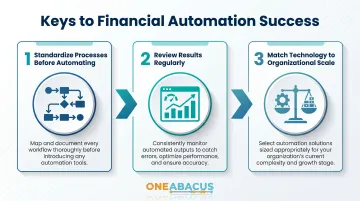
Three conditions consistently deliver best outcomes:
Standardize processes before automating. Automating a broken process just makes errors faster. Map current workflows, identify inefficiencies, and redesign before implementation.
Review results regularly. Leadership must actually use the visibility the system creates — through dashboards or monthly financial reviews. Automated reports sitting unread provide zero value.
Match technology to organizational scale and complexity. Entry-level platforms like QuickBooks work well for smaller budgets; complex grant portfolios require more sophisticated fund accounting. Selection based on price alone often creates future problems.
Getting these three conditions right is easier said than done — especially without dedicated financial leadership. Nonprofits without a CFO, which includes most organizations with annual revenue under $10M, gain measurable advantages from pairing financial automation with fractional financial leadership. A fractional CFO can oversee system selection, configuration, and ongoing interpretation of the data automation surfaces. That's the difference between technology that drives strategy and technology that just produces cleaner spreadsheets.
For example, when One Abacus Advisory supported the Philadelphia Zoo during a leadership transition, they optimized the organization's NetSuite environment, enhanced reporting capabilities, and improved month-end close processes. The result: stronger confidence in financial reporting and uninterrupted continuity while new leadership got up to speed. One Abacus has guided similar implementations at the San Diego Food Bank and Laguna Playhouse, where expert oversight turned automation into lasting operational improvement — not just a one-time upgrade.
Conclusion
Financial automation earns its place in nonprofit operations through what it produces: control over compliance, clarity in reporting, and consistency in processes that donors and auditors depend on. For organizations already stretched thin, these aren't abstract benefits — they're operational necessities.
The advantages of automation compound over time. Organizations that invest early build financial infrastructure that scales with mission growth rather than becoming a bottleneck. Over time, the compounding effects become tangible:
- Fewer audit surprises as error risk decreases
- Staff capacity shifts toward programs instead of manual reconciliation
- Leadership gains real-time visibility to act on emerging financial signals
Automation requires ongoing practice: the right systems, the right oversight, and periodic review to ensure it continues serving evolving needs. For nonprofits navigating this without full-time finance leadership, expert guidance makes the difference between implementation and lasting impact.
Frequently Asked Questions
What are the main advantages of financial automation for nonprofits?
The three core benefits are: strengthened grant compliance through automated fund restrictions that prevent misallocation errors, freed staff capacity by eliminating manual data entry and reconciliation tasks, and real-time financial visibility that enables boards and leadership to make proactive decisions. Each benefit becomes more pronounced as organizations grow and manage greater financial complexity.
What financial processes should a nonprofit automate first?
Start with bank reconciliation, accounts payable, payroll, and grant expense tracking. These are the most time-consuming and error-prone manual tasks for lean finance teams, often consuming 5-10 hours weekly. Automating them delivers immediate capacity gains and compliance improvements—and sets a solid foundation for broader automation over time.
How does financial automation help nonprofits stay grant-compliant?
Automation applies fund restrictions at the transaction level, maintaining audit trails automatically and flagging misallocations in real time. This reduces the risk of restricted fund misuse that can trigger clawbacks, grant terminations, or funder sanctions—particularly significant given that nonprofits carry an 82% repeat finding rate in Single Audits.
Can small or mid-sized nonprofits afford financial automation?
Yes. Cloud-based platforms have made automation accessible at lower price points, with entry-level solutions starting around $60-$120 monthly. The cost is typically offset quickly by time savings, reduced compliance risk, and improved overhead ratios—especially for organizations currently relying on manual spreadsheets with high error rates.
What is the difference between accounting software and financial automation?
Accounting software records transactions and produces reports. Financial automation goes further: it automatically executes recurring tasks, enforces fund restrictions, generates reports on schedule, and flags exceptions—without manual input at each step. The result is a system that actively controls operations, not just documents them.
How do I know if my nonprofit is ready for financial automation?
Key readiness signals include: your team spends more time compiling data than analyzing it, monthly close takes longer than five business days, you're managing three or more restricted grants manually, or you've received audit findings related to fund tracking or reporting timeliness. If two or more of these apply, automation is likely overdue.