This scenario plays out in nonprofit offices every day. In today's competitive funding environment, where proposal success rates hover between 10-30% according to the Grant Professionals Association, simply submitting a compelling narrative isn't enough. Funders are vetting the whole organization—your financial systems, governance structure, track record, and capacity to deliver results. They're not just investing in your program; they're investing in your organization's ability to manage their funds responsibly.
This guide covers two critical dimensions of grant readiness: your ability to submit a competitive application AND your capacity to manage funding once awarded. We'll walk through both with a practical self-assessment checklist you can use today.
Key Takeaways
- Grant-ready means having documented systems and organizational clarity that funders evaluate—not just passionate storytelling
- Readiness includes both application competitiveness and post-award management capacity
- Core pillars: legal status, financial health, governance, program clarity, and data systems
- Scoring "not yet ready" shows exactly which systems to fix before your next application
- Fractional financial leadership accelerates readiness by building grant-compliant systems without full-time costs
What Does "Grant-Ready" Really Mean?
Grant readiness is the state where your organization has the foundational infrastructure, documentation, and demonstrated capacity to both compete for and responsibly manage grant funding. It's not about the eloquence of your writing or the passion behind your mission. It's about whether funders can trust that their investment will be well-managed, impactful, and aligned with their priorities.
A common misconception is that grant-ready equals "great writer on staff." In reality, Candid's survey of funders identified seven red flags that lead to proposal rejection, and the #1 most cited disqualifying factor was failure to follow funder instructions. Five of the seven red flags traced back to systems and infrastructure, not storytelling ability.
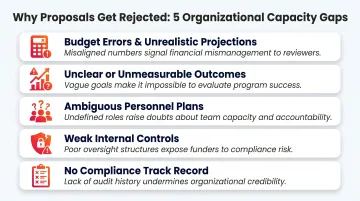
The issues that sink proposals most often are organizational capacity problems:
- Budget errors and unrealistic cost projections
- Unclear or unmeasurable program outcomes
- Ambiguous personnel plans and staffing structures
- Weak internal controls or missing financial documentation
- Failure to demonstrate compliance track record
Grant readiness sits on a spectrum. Your organization might be ready for a $25,000 foundation grant but not a $500,000 federal award. You might be ready to apply but not to manage. Understanding where you fall on this spectrum helps you target the right opportunities and close the right gaps before you invest time in applications that aren't likely to succeed.
Part 1: Are You Ready to Apply?
This section covers the foundational elements funders check before they even read your proposal narrative. Think of these as the organizational prerequisites that determine whether your application will be seriously considered.
Legal and Governance Foundation
Most grant opportunities require active 501(c)(3) IRS status, and federal grant programs require additional registrations. Here's what you need:
IRS Determination Letter and Entity Registrations:
- Active 501(c)(3) status with current IRS determination letter
- For federal grants: registration with SAM.gov and Grants.gov, which can take 4-6 weeks or longer if information isn't readily available
- A Unique Entity ID (UEI), which is automatically assigned through SAM.gov
- Designated Authorized Organization Representatives (AORs) who can submit applications
Processing times matter. The IRS receives over 115,000 tax-exempt applications annually, with Form 1023 determinations issued within 191 days at the 80th percentile. If you're a new nonprofit, plan 6+ months of lead time before you're grant-eligible.
Active Governance Structure:
Funders want to see an engaged board of directors with documented oversight practices:
- Current bylaws and conflict-of-interest policies
- Regular board meetings with documented minutes
- Financial oversight and approval processes
- Clear organizational charts showing accountability
Stability and accountability are what funders are actually assessing here. A well-documented governance structure tells them your organization will handle their investment responsibly.
Financial Health and Documentation
Solid governance opens the door; your financial documentation is what funders walk through. Funders assess fiscal responsibility through specific documents, not just your bank balance. Candid's grant-readiness framework identifies the standard package:
Required Financial Documents:
- Current-year and prior-year operating budgets
- Recent financial statements (balance sheet, income statement, cash flow)
- Annual Form 990 filings (no gaps or late filings)
- Written accounting policies and procedures
- Audited financial statements (for larger grants)
Financial stability doesn't mean you need massive reserves. Funders need confidence that you can track restricted funds separately from general operating dollars and that you have systems to manage their investment properly.
Sector guidance recommends maintaining operating reserves equivalent to 3-6 months of expenses, a ratio of roughly 0.25 to 1.0 between reserves and annual expenses.
Critical compliance note: The IRS automatically revokes tax-exempt status for organizations that fail to file Form 990-series returns for three consecutive years. Between 2011 and 2017, approximately 28,000 501(c)(3) organizations lost status annually, with only about 20% reinstated. Let your 990 lapse, and you lose grant eligibility entirely.
Mission Alignment, Program Clarity, and Track Record
Grant-ready organizations can clearly articulate who they serve, what specific programs address that need, and why those programs work. Vague or scattered programming sends red flags to reviewers.
What Funders Look For:
- Clear definition of target population and community need
- Specific program models with documented methodologies
- Evidence of past performance: client data, partnerships, testimonials
- Understanding of the difference between outputs and outcomes
This last point is crucial. Candid's funder survey specifically identifies confusing activities (outputs) with outcomes as the #3 most cited red flag. Outputs are what you did: "served 500 clients." Outcomes are what changed: "85% of clients gained stable housing within six months." Funders want to see the latter.
The Evaluation Gap:
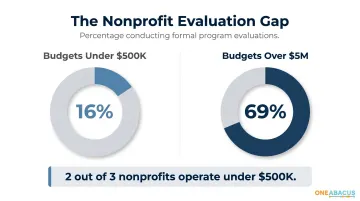
According to Stanford Social Innovation Review, only 16% of nonprofits with budgets under $500,000 conduct formal evaluations, compared to 69% of those with budgets over $5 million. Since more than two-thirds of all 501(c)(3)s have budgets under $500,000, this gap affects the vast majority of the sector.
The good news? Evaluation doesn't require sophisticated software. Structured spreadsheets, simple survey tools, and shared measurement platforms can reduce costs to under 0.05% of program budget while still demonstrating results.
Strategic Plan and Community Reputation
A current strategic plan demonstrates that your organization is working toward defined goals and can show how a grant fits into your larger vision, not just a one-off opportunity. The National Council of Nonprofits recommends using SWOT analysis and ongoing plan revision rather than a static document.
Why does this matter to funders? A strategic plan signals:
- Intentionality and organizational direction
- A clear connection between grant funding and long-term goals
- Measurable objectives funders can track over time
- Organizational maturity and planning discipline
Community Connection:
Reputation matters as much as documentation. Partnerships, collaborations, volunteer engagement, and community presence all signal that your organization is trusted and that others validate your approach.
Funders want to know you're not working in isolation. Organizations with strong community ties are seen as lower-risk investments with greater potential for sustainable impact.
Part 2: Are You Ready to Manage a Grant?
Many organizations can submit a solid application but are unprepared for the operational reality of managing a grant post-award. This dimension is often overlooked and is where nonprofits most commonly stumble.
Operational and Staffing Capacity
Funders expect you to have enough personnel to actually implement the grant-funded work. This includes:
- A designated project lead responsible for program implementation
- Program staff to deliver services directly
- Someone accountable for financial compliance and reporting
- Administrative support for data tracking and documentation
Some staffing costs can be built into the grant budget, but you need to demonstrate that existing capacity can absorb additional grant-related responsibilities without compromising day-to-day operations.
That's a real constraint for most organizations: 53% of nonprofits reported struggling with adequate staffing in the past year, and two-thirds operate with fewer than 5 employees.
For under-resourced organizations, fractional financial leadership — like the kind One Abacus Advisory provides — is a practical alternative to a full-time CFO hire. Nonprofits get executive-level financial oversight on a flexible basis, keeping grant compliance and reporting on track without the overhead of a permanent hire.
Financial Systems and Fund Tracking
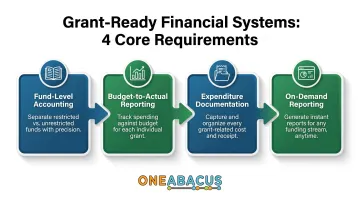
Grant-ready financial systems can track grant funds separately from other organizational funds—a requirement for many funders, especially government grantors.
What This Means in Practice:
- Fund-level accounting that separates restricted from unrestricted funds
- Budget-to-actual reporting by individual grant
- Clear documentation for every grant-related expenditure
- Ability to generate financial reports on demand for any funding stream
Federal Grant Compliance
Nonprofits applying for federal grants must comply with Uniform Guidance (2 CFR Part 200), which covers audit requirements, internal controls, procurement standards, and record retention policies. The Single Audit threshold was raised from $750,000 to $1 million in April 2024, providing some relief for smaller federal grantees — but all federal recipients must maintain audit-ready practices regardless of size.
The practical takeaway: build compliant financial systems before you apply. Organizations that wait until after an award to set up fund accounting or internal controls spend the first months of a grant fixing infrastructure instead of delivering programs.
Data Tracking and Evaluation Capacity
Funders expect the ability to track participant data, measure progress toward grant objectives, and report results on a defined schedule.
Minimum Data Requirements:
- Systems to track clients or participants served
- Baseline and follow-up data collection
- Progress measurements aligned with grant objectives
- Consistent use of data collection tools (even simple spreadsheets work)
- Scheduled reporting that meets funder timelines
Evaluation capacity should be built into the program design from the start, not added as an afterthought. Nonprofits can implement basic evaluation frameworks without large budgets. The key is consistency and clarity about what you're measuring and why.
Your Grant Readiness Self-Assessment Checklist
Use this practical tool to score your readiness across both dimensions right now.
Readiness to Apply: Key Questions
Legal and Governance:
- ☐ Active 501(c)(3) status with current IRS determination letter
- ☐ Required registrations (SAM.gov UEI, Grants.gov) if pursuing federal funds
- ☐ Active, engaged board with documented meetings and oversight policies
- ☐ Current bylaws and conflict-of-interest policies
Financial Documentation:
- ☐ Current-year and prior-year operating budgets
- ☐ Recent financial statements (balance sheet, income statement, cash flow)
- ☐ Clean Form 990 filings with no gaps
- ☐ Written accounting policies and procedures
- ☐ Operating reserves of at least 3 months of expenses
Program and Strategy:
- ☐ Current strategic plan with measurable objectives
- ☐ Clearly defined target population and community need
- ☐ Documented program outcomes (not just outputs)
- ☐ Evidence of community partnerships or collaborations
- ☐ Track record with testimonials or performance data
Readiness to Manage: Key Questions
Staffing and Capacity:
- ☐ Designated staff for grant implementation and program delivery
- ☐ Personnel responsible for financial compliance and reporting
- ☐ Capacity to absorb additional grant-related workload
- ☐ Clear roles and accountability for grant management
Financial Systems:
- ☐ Accounting system capable of fund-level tracking
- ☐ Ability to produce budget-to-actual reports by grant
- ☐ Documented policies for procurement, timekeeping, and record retention
- ☐ Internal controls for restricted fund management
Data and Evaluation:
- ☐ Data tracking systems for participant or client outcomes
- ☐ Evaluation plan built into program design
- ☐ Consistent data collection tools and processes
- ☐ Capacity to report results on funder timelines
How to Use Your Results
Gaps on this list point directly to where your organization needs to focus before applying. If your application readiness is solid but management readiness is thin, start with smaller foundation grants rather than federal or government funding—these carry lighter compliance requirements and give you room to build internal systems while generating real outcomes to show future funders.
What to Do If You're Not Grant-Ready Yet
Being "not ready" isn't a dead end—it's a strategic advantage. Knowing your gaps before submitting an application saves time, protects your reputation with funders, and gives you a clear organizational development roadmap.
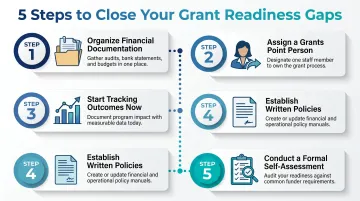
Concrete Next Steps for Closing Common Gaps:
- Organize financial documentation – Gather 990s, budgets, and financial statements; ensure Form 990 filing is current
- Assign a grants point person – Designate one staff member or volunteer to coordinate all grant activities
- Start tracking outcomes now – Implement simple data collection tools even before applying
- Establish written policies – Create basic financial management and internal control policies if none exist
- Conduct a self-assessment – Use tools from the National Council of Nonprofits or the Ford Foundation's Organizational Mapping Tool
Timeline Expectations:
Candid advises nonprofits to anticipate a 6-9 month timeline from initial proposal to receiving funds. This means your infrastructure must be in place well before you apply. Some organizations can become grant-ready in 60-90 days by organizing existing documentation, while others may need 6-12 months to build financial systems, governance policies, and outcome tracking infrastructure.
When to Consider Fractional Financial Leadership:
That timeline pressure is where staffing gaps hurt most. For nonprofits without a dedicated finance team, working with a fractional CFO or COO can accelerate grant readiness without the cost of a full-time hire. One Abacus Advisory, for example, offers fractional CFO services specifically built for nonprofits navigating this stage.
A fractional CFO can help build grant-compliant financial systems, prepare audit-ready records, create fund-level accounting infrastructure, and establish the financial reporting processes funders expect. It's a practical fit for smaller nonprofits that need executive-level expertise but operate on limited budgets.
Frequently Asked Questions
What are the 5 R's of grant writing?
The 5 R's framework includes Readiness, Research, Relationship, wRiting, and Reporting. Readiness comes first—solidifying internal infrastructure and systems before you begin researching funders or drafting proposals. In other words, your organization must be operationally sound before the writing begins.
How can a nonprofit assess its grant funding readiness?
Use the two-part framework covered in this guide: readiness to apply (legal status, financial documentation, program clarity) and readiness to manage (staffing capacity, financial systems, data tracking). Run through the checklist in this guide before approaching any funder—it will show you exactly where to focus first.
What documents do nonprofits need to be grant-ready?
Core documents include: active IRS determination letter, current financial statements and budgets, recent Form 990, organizational bylaws and governance policies, strategic plan, and program outcome data. Federal grant applicants also need SAM.gov registration and a Unique Entity ID.
What is the difference between grant readiness and grant writing?
Grant writing is the skill of crafting a compelling proposal narrative. Grant readiness is the organizational infrastructure—financial systems, governance, compliance capacity—that makes the proposal credible. You need both to be competitive, but readiness must come first.
Can small nonprofits with limited staff become grant-ready?
Yes. Size doesn't disqualify an organization, but small nonprofits should prioritize essentials: legal status, clean finances, and clear outcomes. Consider phased readiness—starting with smaller foundation grants before pursuing larger federal funding. Fractional leadership services can provide expertise without full-time costs.
How long does it take for a nonprofit to become grant-ready?
Organizations with existing documentation may reach readiness in 60-90 days by organizing what they already have. Those starting from scratch typically need 6-12 months to build financial systems, governance policies, outcome tracking, and a strategic plan.