Introduction
Your program staff report to a community center at 8 a.m. Your finance team logs in from home. And your HR policy treats them the same way. That gap—common in nonprofits navigating hybrid work—creates real friction that corporate HR playbooks weren't built to solve.
When remote-eligible and on-site staff operate under the same policies, visible equity gaps emerge—in schedule flexibility, access to leadership, and perceived fairness. These gaps erode morale faster in mission-driven organizations, where staff are already underpaid relative to the private sector.
Compounding this: most nonprofits don't have a dedicated HR professional. As Nonprofit HR has documented, the HR function often falls to an Executive Director or COO juggling a dozen other priorities.
This article covers 6 concrete strategies to manage hybrid nonprofit teams effectively—from setting equitable policies to staying compliant—without losing the culture that drives your mission.
Key Takeaways
- A clear written hybrid work policy should define eligibility, expectations, and equity measures for every staff member
- Build communication norms and inclusive meeting practices to keep remote employees connected to the mission
- Move performance management from presence-based to outcomes-based metrics for fairness across locations
- Prioritize well-being support and burnout prevention — nonprofit staff carry higher emotional load than most sectors
- Update onboarding and compliance practices to ensure hybrid work is legally sound and culturally effective
- Use the right tools and infrastructure to support collaboration, equity, and accountability in a distributed team
Why Hybrid Work Creates Unique HR Challenges for Nonprofits
The Equity Gap Between Remote and On-Site Roles
Nonprofits face a distinct tension: program staff—food bank workers, educators, social workers—cannot work remotely, while administrative or development staff can. This creates a two-tier workforce where flexibility becomes a visible privilege.
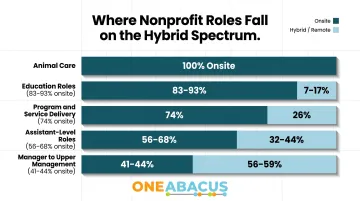
Data from Idealist and the National Council of Nonprofits shows that approximately 43% of nonprofit job postings are onsite, 38% are hybrid, and 19% are fully remote. But role-level disparities are stark:
- 100% of animal care roles are onsite
- 83-93% of education roles are onsite
- 56-68% of assistant-level roles are onsite
- 41-44% of manager to upper-management roles are onsite
74% of nonprofit vacancies are in program and service delivery positions requiring in-person responsibilities. Left unaddressed, this disparity creates cultural friction — resentment builds when flexibility feels like a reward distributed by job title rather than policy.
The Resource Gap: HR Without HR
Most nonprofits manage HR informally. BoardSource and Nonprofit HR data confirm that small organizations with operating budgets under $500,000 almost universally lack a second executive position, concentrating HR duties on the Executive Director. The consequences show up quickly:
- Compliance gaps as policies go undocumented or unreviewed
- Payroll errors from stretched, generalist oversight
- Talent loss when staff feel unsupported or undervalued
Hybrid Work as a Retention Tool
For most nonprofits, hybrid work has shifted from a nice-to-have to a direct retention lever. The National Council of Nonprofits 2023 Workforce Survey found that 57.7% of nonprofits adopted a remote work policy to retain employees. Remote nonprofit job postings receive 9 times as many applications as onsite postings, and 88% of job seekers using location filters seek remote roles.
Nonprofit HR's 2023 Talent Retention Survey reported a 25% improvement in retention among the 31-49 age group, attributed directly to embracing hybrid work. With nonprofit turnover at approximately 19% compared to 12% in other sectors, how nonprofits structure and communicate hybrid policies has a direct impact on whether staff stay or leave.
Building Culture, Communication, and Inclusion Across a Hybrid Nonprofit Team
Strategy 1: Establish a Written Hybrid Work Policy
Many nonprofits operate without a formal hybrid work policy, relying instead on informal agreements. This creates inconsistency, perceptions of favoritism, and legal risk. As of 2023, approximately 42% of nonprofits had not adopted a remote work policy.
What a Written Policy Must Include:
- Defines which roles qualify for remote work and the reasoning behind each decision
- Specifies core hours when all staff must be reachable
- Clarifies who supplies technology, internet stipends, and home office equipment
- Establishes clear, consistent consequences for non-compliance
The Equity Imperative:
Your policy must explicitly address staff in roles that cannot go remote. This prevents resentment and perceptions of a two-tier workforce. Consider:
- Compensating benefits such as flexible scheduling, compressed workweeks, or additional PTO for on-site-only staff
- Transparent communication about why certain roles require physical presence
- Regular surveys to gauge perceived fairness across all staff
Strategy 2: Create Communication Norms That Bridge Locations
A written policy sets the foundation — but it only works if people know how to communicate across it. Adopting Slack or Teams isn't enough. Staff need to know when to use which channel, how quickly to respond, and how to signal availability.
Create a Communication Charter:
- Sets response time expectations by channel — Slack within 2 hours during core hours, email within 24 hours
- Defines meeting cadences — weekly team standups, monthly all-hands, quarterly 1:1s
- Establishes escalation protocols for urgent issues (phone call, urgent Slack tag)
Deliberate Inclusion in Hybrid Meetings:
- Keep a visible list of remote attendees to avoid forgetting who's on the call
- Solicit virtual input before in-room discussion wraps
- Use shared digital materials rather than only physical handouts
- Rotate meeting facilitation between remote and on-site staff
- Start meetings with a "virtual roll call" to ensure everyone can hear and be heard
Strategy 3: Foster a Sense of Belonging for All Staff
Clear communication norms keep teams connected day-to-day, but belonging runs deeper. Nonprofits have a genuine edge here: mission alignment. Use it as an active tool for building culture across locations, not just a tagline on your website.
Practical Tactics:
- Open team meetings with a short beneficiary impact story — rotate who shares across remote and on-site staff
- Celebrate wins in channels visible to all locations, not just in the office
- Pair remote and on-site staff for informal virtual coffee chats to build cross-location relationships
Address Inclusion Through a DEI Lens:
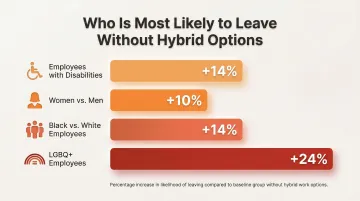
Research from McKinsey shows that hybrid work affects employees differently:
- Employees with disabilities are 14% more likely to leave if hybrid work is unavailable
- Women are 10% more likely to leave than men without hybrid options
- Black employees are 14% more likely to leave than White peers
- LGBQ+ employees are 24% more likely to leave without hybrid availability
Survey staff regularly on their hybrid experience to surface inequities before they become grievances.
Operational and Performance Management for Hybrid Nonprofit Teams
Strategy 4: Shift to Outcomes-Based Performance Management
Presence-based management doesn't translate to hybrid. Managers can't monitor activity, so the proxy often becomes responsiveness—reply speed, camera use—which measures availability, not results.
Set Clear, Measurable Outcomes:
Use a simple framework: Goal + Quality Standard + Timeline
Example:
- Goal: Increase donor retention rate
- Quality Standard: Achieve 75% retention among donors giving $500+
- Timeline: By end of fiscal year
Why This Matters:
Outcomes-based goals create a level playing field between remote and on-site staff, reducing bias in performance reviews. Gallup's 2025 State of the Global Workplace report found that fully remote workers are the most engaged at 31%, compared with 23% for hybrid and 19% for on-site non-remote-capable employees. The data points to a clear conclusion: autonomy helps people work more effectively.
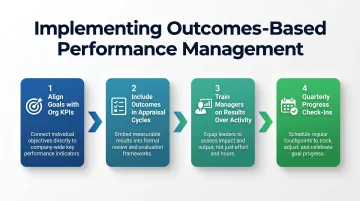
Implementation Steps:
- Align individual performance goals with organizational KPIs
- Include outcomes in formal performance appraisal cycles
- Train managers to evaluate results, not activity
- Conduct quarterly check-ins focused on progress toward outcomes, not daily tasks
Strategy 5: Prioritize Employee Well-Being and Burnout Prevention
Nonprofit employees already face elevated burnout and compassion fatigue. CEP's 2024 State of Nonprofits report found that 95% of nonprofit leaders cited burnout as a top concern, and the National Council of Nonprofits 2023 Survey reported that 50.2% of nonprofits cited stress and burnout as a major cause of workforce shortages.
Hybrid and remote work can compound that pressure. Gallup research shows that 45% of fully remote workers experienced significant stress, versus 39% for on-site workers. Remote employees are also more likely to report anger, sadness, and loneliness — isolation risks that don't disappear just because the schedule is flexible.
Structured Well-Being Check-Ins:
Go beyond project updates. Ask:
- "Are you feeling connected to the team and the mission?"
- "What support do you need right now?"
- "What's one thing we could change to improve your work experience?"
Promote Employee Assistance Programs (EAPs):
Average EAP utilization rates are only 5-7%, and 26% of employees don't know whether their employer offers an EAP. Actively promote these programs through:
- Regular reminders in team meetings and newsletters
- Testimonials from staff who've used EAP services (anonymized)
- Manager training on how to refer employees to EAP resources
Strategy 6: Update Onboarding and HR Compliance Practices for Hybrid Work
Hybrid onboarding is a critical, often-overlooked gap. New hires who start remotely may never fully absorb organizational culture, workflow norms, or mission identity if onboarding isn't redesigned.
Structured Hybrid Onboarding Checklist:
- Schedule video calls with key team members across departments in the first week
- Run a mission immersion session covering organizational history, impact stories, and values
- Build a 30-60-90 day outcomes roadmap with clear milestones from day one
- Assign a culture buddy who checks in weekly for the first month
TalentLMS and BambooHR research found that 73% of hybridly onboarded employees felt onboarding accelerated their ability to perform, compared to 61% for remote onboarding. Yet 31% of new hires said their onboarding lacked human interaction — a gap nonprofits must close deliberately.
Address Compliance Risks:
Multi-state remote employees create a patchwork of wage laws, payroll tax obligations, and benefits requirements. According to the American Bar Association, the state-level differences are significant:
- Vermont's minimum wage is $14.42/hour, nearly double the federal $7.25/hour
- California requires overtime after 8 hours/day, not just 40 hours/week
- Maine levies a payroll tax on both employers and employees for paid family leave
- Colorado prohibits "use-it-or-lose-it" PTO policies
- California requires employers to reimburse remote employees for cell phone and internet expenses
Action Steps:
- Audit remote employee locations
- Consult with legal or HR compliance resources to close gaps
- Update employee handbooks to reflect multi-state obligations
- Train managers on state-specific requirements
The Financial Side of Hybrid HR: Planning for the Long Term
Hybrid work has real cost implications nonprofits often don't budget for: technology stipends, collaboration software subscriptions, updated HR policies requiring legal review, and compliance costs from multi-state employees. Leaders need to proactively build these into operational budgets rather than treating them as one-time expenses.
That complexity is compounded for smaller nonprofits that don't have dedicated staff to manage both financial planning and HR strategy at once. Fractional CFO or COO support fills that gap. One Abacus Advisory's fractional leadership model helps nonprofits build the financial and operational infrastructure to manage hybrid work without the overhead of a full-time hire.
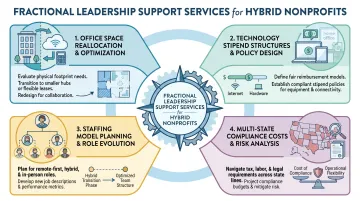
Services cover the decisions that matter most during this transition:
- Office space reductions and reallocation
- Technology upgrades and stipend structures
- Staffing models that balance remote and on-site needs
- Compliance costs for multi-state employees
Hybrid work also creates a practical window to revisit overhead allocations. Nonprofits that approach this proactively — rather than reactively — tend to find cost savings that can be redirected toward mission-critical programs.
Frequently Asked Questions
What is the role of HR in the hybrid work model?
HR's role in hybrid work expands beyond compliance and payroll to include designing policies, communication norms, equity frameworks, and well-being programs. In nonprofits, HR ensures that distributed teams stay aligned and mission-focused while addressing the unique needs of remote and on-site staff.
How can HR ensure productivity and engagement in a hybrid workforce?
HR ensures productivity and engagement through outcomes-based goal setting, regular structured check-ins, and inclusive communication practices. Measuring results rather than activity — and fostering connection across locations — keeps both remote and on-site staff engaged and performing.
What are the 5 C's of hybrid work?
The 5 C's are Communication, Connection, Culture, Coordination, and Consistency. For nonprofits, this translates to clear communication norms, mission-driven connection, intentional culture-building, cross-location coordination, and consistent policy application for all staff.
How do you maintain nonprofit culture with a hybrid team?
Embed mission moments into virtual meetings and create rituals that include remote and on-site staff equally. Visible recognition practices and regular storytelling about beneficiary impact keep culture grounded across locations.
What HR policies should nonprofits update for hybrid work?
Key policies to update include:
- Hybrid/remote eligibility policy — defines which roles qualify
- Communication norms guide — specifies channels and response times
- Technology and equipment policy — covers stipends and reimbursements
- Performance management framework — shifts evaluation to outcomes, not presence
How can nonprofits address equity between remote and on-site employees?
Equity starts with the written hybrid policy. Acknowledge which roles can't go remote, offer compensating benefits or flexibility where possible, and survey all staff regularly. Transparent communication about role requirements prevents resentment and builds trust.